You head downstairs to grab something from storage and your sock hits cold water on the third step. The bottom half of the staircase is submerged. Your furnace is sitting in six inches of standing water. Boxes of family photos are soaking on the floor.
Basement flooding is one of the most common and most frustrating water damage scenarios we handle, and after 15 years of restoration work, we'll tell you this: most basement flooding isn't random. There's almost always a root cause, whether that's foundation cracks allowing groundwater in, a sump pump that quit during a heavy rain, hydrostatic pressure forcing water through the slab, or an aging French drain system that has clogged with sediment over the years. Understanding the cause matters -- if you're ignoring the root cause, you'll be cleaning up again next season.
This guide covers the full process of basement flooding cleanup, from the moment you discover standing water through extraction, structural drying, and the waterproofing strategies that prevent it from happening again. If your basement is flooded right now, call (844) 426-5801. Our emergency crew arrives within 60 minutes with truck-mounted extraction equipment that handles hundreds of gallons per hour.
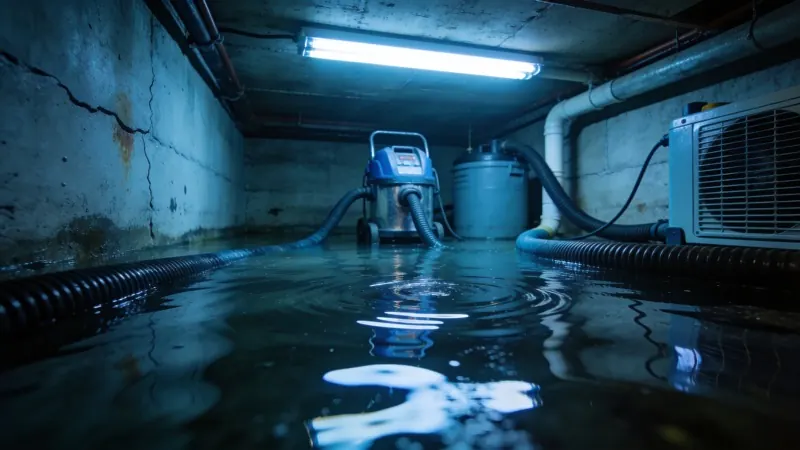
Why Basements Flood: The Root Causes Most Homeowners Miss
A flooded basement is a symptom. The real problem is almost always underneath the surface, and it's typically one of these five issues working alone or in combination.
Foundation Cracks and Wall Seepage
Poured concrete foundations develop cracks as they cure and settle. Some are hairline and cosmetic. Others aren't -- they're water highways. The main entry points include:
- Vertical cracks in poured walls -- the most common type, formed as concrete shrinks during curing. In a dry year, you might not even know they exist. But when saturated soil builds hydrostatic pressure, those hairline cracks become water entry points.
- Block wall mortar joints -- water travels through the hollow cores of concrete blocks and along mortar joints. You'll often see stair-step cracking patterns following the mortar lines where the bond is weakest.
- The cove joint -- where the basement floor meets the wall. In most residential construction, the slab is poured separately from the walls. That joint isn't watertight, and hydrostatic pressure pushes water right through it.
Hydrostatic Pressure: The Invisible Force Behind Basement Flooding
This is the concept most homeowners have never heard of, but it explains the majority of basement water intrusion we see.
Hydrostatic pressure is the force of standing water in the soil around your foundation. When it rains, that soil fills with water. Water is heavy -- about 62 pounds per cubic foot. When it fills the soil around your basement walls and under the floor slab, it pushes hard against those surfaces.
Your basement walls and floor slab are strong, but they aren't waterproof in most residential construction. They were designed to hold back soil, not sustained water pressure. When hydrostatic pressure builds, water exploits every weakness:
- Cracks in the walls
- The cove joint
- Pipe penetrations
- Window wells
- The pores in the concrete itself
Homes built on clay-heavy soil are more susceptible. Clay doesn't drain well, holds water, and expands when wet, adding both hydrostatic pressure and lateral soil pressure against foundation walls. Sandy or loamy soils drain more quickly.
Hydrostatic pressure also explains why basements flood from below. If the water table rises above the bottom of your slab, water pressure pushes upward through cracks, control joints, and sometimes directly through the concrete. You'll see damp spots or puddles appearing on the basement floor with no visible source on the walls.
Sump Pump Failure
A functioning sump pump is the last line of defense against basement flooding in homes that have one. When it fails, flooding can happen fast.
Sump pumps fail for several reasons we see regularly:
- Power outage. This is the number one cause. A storm heavy enough to saturate the soil and raise the water table is the same storm that knocks out power. The pump needs electricity. No power, no pumping. Battery backup systems exist for exactly this reason, and if your home relies on a sump pump, we strongly recommend one.
- Switch malfunction. The float switch that activates the pump can get stuck, tangle against the pit wall, or fail mechanically. The pump motor is fine, but it never gets the signal to turn on.
- Overwhelmed capacity. Sump pumps are rated in gallons per minute (GPM) and gallons per hour (GPH). A typical residential pump moves 2,000 to 3,000 GPH. During extreme rain events, the water inflow can exceed the pump's capacity.
- Check valve failure. The check valve prevents water from flowing back down the discharge pipe into the pit after the pump shuts off. If it fails or is missing, the pump cycles continuously as the same water flows back into the pit.
- Clogged intake or impeller. Sediment, gravel from the sump pit, or debris can clog the pump's intake screen or jam the impeller. The motor runs but water isn't moving.
- Age. Sump pumps have a lifespan of roughly 7 to 10 years. After that, mechanical wear reduces reliability.
French Drain Failure and Drainage System Problems
An interior French drain system (also called interior drain tile or a perimeter drain) is designed to intercept water at the base of the wall and direct it to the sump pit. When these systems fail, water backs up and floods the basement floor.
Drain tile systems fail because they clog. Over 10 to 20 years, silt and mineral deposits build up inside the pipe. Flow drops slowly until it's blocked. You won't notice until a heavy rain overwhelms the system.
Older homes may have exterior clay tile drains from the original build. These tiles crack and collapse over time, losing their ability to move water.
Poor Exterior Drainage and Grading
Sometimes the problem starts at the surface, well before water reaches the foundation. Common exterior drainage failures include:
- Improper grading -- the ground should slope at least six inches over the first 10 feet away from the foundation. Over time, settling and landscaping changes can reverse that slope, directing water toward the foundation.
- Clogged or short downspouts -- a single downspout moves over 1,000 gallons during a moderate rainstorm. If it dumps water right at the foundation, all that volume saturates the soil next to your basement walls.
- Window wells without drainage -- wells without proper drains or covers fill with rainwater and feed it directly through basement window seals.
Basement Flooding Cleanup: The Professional Restoration Process
When we arrive for a basement flooding cleanup, the job follows a specific sequence. Skipping steps or doing them out of order leads to problems down the road.
Step 1: Safety Assessment First
Before anyone enters a flooded basement, we verify that power to that level is off. Standing water and live circuits are a deadly mix. If the panel is upstairs, we shut it off. If it's in the flooded basement, we call the utility company for a disconnect.
We also assess the air quality. If sewage backup is involved, or if there's a natural gas smell, we address those hazards before starting water work. Sewer backup flooding requires full PPE (Tyvek suits, respirators, rubber boots) and changes the entire cleanup protocol.
Step 2: Water Extraction
This is where professional equipment makes the biggest difference.
For significant basement flooding, six inches or more, we deploy submersible pumps that can move 3,000 to 5,000 gallons per hour. These sit directly in the standing water and discharge through hoses to the exterior. For lower water levels, truck-mounted extraction units and portable wand extractors pull water from carpet, concrete surfaces, and hard-to-reach areas along walls.
A real example of what this looks like in practice: We responded to a home in suburban Chicago where the sump pump burned out during a spring thaw. By the time the homeowner discovered it the next morning, the finished basement had 10 inches of standing water. The furnace, water heater, and all the electrical outlets along the baseboards were submerged.
We deployed two submersible pumps running simultaneously and extracted the standing water in about three hours. Then we used portable extractors on the carpet and spent another two hours pulling saturated water from the pad and carpet fibers. Total extraction time: roughly five hours for a 1,200-square-foot finished basement.
Consumer wet/dry vacuums and rental pumps can technically move water, but the volume difference is massive. A shop vac holds 10 to 16 gallons and must be emptied constantly. Our submersible pumps run continuously.
Step 3: Contamination Assessment
Not all basement flooding is the same, and the cleanup protocol depends entirely on where the water came from:
- Category 1 (clean water): Broken supply line, water heater failure, or rainwater through a foundation crack. Porous materials can often be dried in place.
- Category 2 (gray water): Sump pump discharge, washing machine overflow, or groundwater sitting long enough to develop bacterial contamination. Some porous materials may need removal.
- Category 3 (black water): Sewage backup, river flooding, or soil-contaminated water. All porous materials must be removed -- carpet, pad, drywall to 24 inches above the water line, insulation, and stored contents. Antimicrobial treatment of all remaining surfaces is required.
Groundwater intrusion through foundation cracks is typically Category 1 initially, but if it sits for more than 72 hours, bacterial growth reclassifies it to Category 2. This is another reason speed matters.
For a full breakdown of contamination categories, see our water damage categories guide.
Step 4: Demolition of Damaged Materials
In a finished basement, this step determines the scope of the project. If the water was Category 1 and caught within 24 hours, we can often save the drywall through a flood cut approach. Here's what typically gets removed:
- Drywall below the flood cut line -- removed to 24 inches above the water line, exposing wall cavities for drying while preserving the upper wall
- Carpet pad -- almost always removed. It's a thick, porous sponge that holds contaminated moisture and is nearly impossible to dry
- Carpet -- can sometimes be saved with professional cleaning if the water was Category 1, though many homeowners choose replacement
- Baseboard trim -- comes off to allow air circulation behind walls
- Vinyl flooring -- removed if water reached the subfloor, because vinyl traps moisture against the slab and creates ideal mold conditions
Step 5: Structural Drying
Basement drying is different from drying the upper floors of a home, and it takes longer. The reason is concrete.
Concrete is porous. A basement slab and foundation walls absorb water during flooding and release it slowly. Very slowly.
An LGR (Low Grain Refrigerant) dehumidifier running full capacity in a 1,000-square-foot basement typically removes 15 to 20 gallons of moisture from the air per day. We position these units centrally and supplement with high-velocity air movers directing airflow across the slab and along the exposed wall cavities.
We take moisture readings daily with pin-type and pinless moisture meters. Concrete should read below 4% on a calcium chloride moisture test or below 75% internal relative humidity before we consider it dry. Wood framing needs to be below 16% moisture content.
The typical basement drying timeline with professional equipment:
- Exposed concrete slab (unfinished basement): 5 to 7 days
- Finished basement after flood cuts: 4 to 5 days for wall cavities, 5 to 7 days for the slab
- Concrete block walls: 5 to 7 days, as moisture trapped in the hollow cores takes time to release
Household fans and a consumer dehumidifier can't match this. A residential dehumidifier removes maybe 3 to 5 gallons per day. It'd need to run for weeks, and you'd likely see mold long before the materials reach dry standard.
For a deeper look at the drying science, including equipment specs and psychrometry, our structural drying page covers the full technical process.
Step 6: Antimicrobial Treatment and Mold Prevention
After extraction and during the drying process, we apply antimicrobial agents to all affected surfaces:
- The concrete slab
- Exposed framing
- The backside of remaining drywall
- The inside face of foundation walls
Basements are high-risk for mold after flooding. They run cooler, more humid, and have less airflow than upper floors. Left wet, a basement can develop visible mold growth in under 48 hours, particularly Aspergillus and Penicillium species that thrive on damp drywall.
If mold has already started growing before we arrive, the project shifts into full mold remediation, which involves containment, HEPA filtration, and clearance testing.
Basement Flooded? We Respond in 60 Minutes
IICRC-certified technicians with truck-mounted extraction. Direct insurance billing.
📞 Call (844) 426-5801Three Basement Flooding Scenarios We've Handled
The Overnight Sump Pump Failure
A homeowner in the Minneapolis suburbs called us on a Saturday morning in March. Their sump pump had failed during a heavy overnight rain. The finished basement had eight inches of standing water covering about 900 square feet.
The water heater was submerged at the base, the furnace was sitting in water, and all the stored belongings along the walls were soaked.
We arrived within 45 minutes. Two submersible pumps ran for three hours to clear the standing water. Because the water was groundwater (Category 1) and was caught within 12 hours, we performed flood cuts on all perimeter walls to 24 inches, removed the carpet pad, and saved the carpet for professional cleaning.
Six air movers and two LGR dehumidifiers ran for five days. We also had the sump pump replaced by a licensed plumber during the drying phase, and we recommended a battery backup unit, which the homeowner had installed that same week.
Total restoration cost including carpet cleaning: approximately $5,800. The homeowner's insurance covered the flooding under their sump pump failure endorsement, minus a $1,000 deductible.
The Foundation Crack Nobody Knew About
A family in a suburban Denver home noticed their basement carpet felt damp after a spring snowmelt. There was no standing water, just persistent dampness along one wall. They assumed it'd dry out.
Two weeks later, they noticed a musty smell and pulled back the carpet to find dark mold growth on the pad and on the concrete beneath it.
When we opened the wall, the situation was worse. A vertical crack in the poured foundation had been seeping for some time, saturating the insulation and the backside of the drywall. Mold growth extended from the slab up about three feet behind the wall. The crack was less than a sixteenth of an inch wide on the surface, barely visible.
We performed a full mold remediation on the affected wall section: containment, HEPA air scrubbing, removal of damaged drywall and insulation, antimicrobial treatment of the framing and foundation surface, and post-remediation air quality testing. After clearance, the homeowner hired a foundation contractor who injected the crack with flexible polyurethane, and we recommended exterior grading improvements to reduce the water load against that wall.
Total restoration and remediation cost: approximately $7,200. The insurance claim was partially covered. The mold remediation portion was approved, but the insurer excluded the foundation crack repair as a maintenance item.
The Cove Joint Leak in a New Construction Home
A homeowner in the Dallas suburbs contacted us about persistent water appearing along the base of their basement walls during rain. The home was only three years old. They had tried caulking the cove joint themselves with silicone, which lasted about one rainstorm before the water pushed right through it.
This was a hydrostatic pressure issue. The builder had not installed an interior drain tile system, and the clay soil in the area held water against the foundation during any significant rain event. Water pressure at the cove joint exceeded what the slab-to-wall connection could resist.
We extracted the water (about two inches across 600 square feet), dried the affected area over four days, and connected the homeowner with a waterproofing contractor who installed an interior perimeter drain tile system tied to a new sump pit and pump. The drain tile intercepts water at the cove joint before it reaches the living space and directs it to the sump pit for discharge.
The homeowner has had zero water intrusion in the 18 months since installation. Total project cost (restoration plus waterproofing installation): approximately $12,000. The waterproofing portion wasn't covered by insurance, but the initial water damage restoration was.
Foundation Cracks: Types, Severity, and What They Mean for Your Basement
Not all foundation cracks are equal. Understanding what you're looking at helps you know whether a crack is a water entry concern, a structural concern, or both.
| Crack Type | Structural Risk | Water Risk | Common Repair |
|---|---|---|---|
| Vertical (poured walls) | Low | Moderate | Polyurethane or epoxy injection |
| Horizontal | High | High | Carbon fiber straps, wall anchors |
| Stair-step (block walls) | Moderate | High | Mortar repointing + waterproofing |
| Cove joint | N/A | Very high | Interior drain tile system |
Vertical Cracks in Poured Concrete Walls
- Most common type, usually least structurally concerning
- Form during concrete curing as material shrinks
- Hairline to about an eighth of an inch wide are typically shrinkage cracks
- Even hairline cracks can leak under hydrostatic pressure
- Repair: polyurethane injection (flexible, accommodates movement) or epoxy injection (rigid structural bond)
Horizontal Cracks
Horizontal cracks in a foundation wall are the ones that get our attention. They indicate lateral pressure against the wall, typically from hydrostatic pressure or expansive clay soil. A horizontal crack at mid-wall height suggests the wall is bowing inward.
These cracks are both a water intrusion concern and a structural concern. Homes with horizontal cracks should have a structural engineer evaluate the wall. Repair options include:
- Carbon fiber strap reinforcement
- Wall anchors
- Full wall replacement (severe cases)
Stair-Step Cracks in Block Walls
These follow mortar joints in a stepping pattern and are characteristic of block (CMU) foundation walls. They indicate settlement or lateral pressure and often appear at corners or near window openings.
Water travels along mortar joints readily, making stair-step cracks common water entry points. Repair involves repointing the mortar joints and installing waterproofing to address root water pressure.
The Cove Joint
Technically not a crack, but the cove joint is the most common water entry point in basements. It's the natural gap where the floor slab meets the wall.
Interior drain tile systems are designed specifically for cove joint water intrusion. They intercept water at the joint and route it to the sump pit, keeping the living space dry.
Sump Pump Systems: What Every Homeowner Should Know
If your home has a basement and is located in an area with any groundwater concern, a sump pump system is essential. Here's what a properly functioning system looks like, and what to check.
Components of a Sump Pump System
- Sump pit (basin/crock): 18-24 inches in diameter, 22-36 inches deep. Drain tile systems feed into this pit. Groundwater also collects through the gravel bed below the slab.
- Primary pump: Submersible or pedestal, activated by a float switch. Residential pumps are typically 1/3 to 1/2 horsepower, moving 2,000-3,000 GPH.
- Discharge pipe: Carries water to the exterior. Discharge point should be at least 10 feet from the foundation on a downhill slope. Too short a line just recycles water back.
- Check valve: One-way valve preventing backflow into the pit when the pump shuts off. Without it, the pump cycles continuously.
- Battery backup (recommended): Secondary pump powered by a deep-cycle marine battery. Activates if the primary pump fails or loses power.
Sump Pump Maintenance Most Homeowners Skip
We recommend testing your sump pump quarterly. Pour a five-gallon bucket of water into the pit. The float switch should activate the pump, the water should discharge outside, and the pump should shut off when the water level drops.
Takes two minutes. Most homeowners have never done this.
Other maintenance items:
- Clean the intake screen annually. Sediment and gravel from the pit clog it over time.
- Inspect the discharge line for obstructions or freeze damage (exterior portion).
- Test the battery backup system quarterly if you have one.
- Verify the check valve is functioning, water shouldn't flow back into the pit after the pump shuts off.
- Replace the pump if it's over 7 to 10 years old, even if it's still running. Mechanical failure at the worst possible moment isn't a risk worth taking.
French Drains and Interior Drainage Systems
The term "French drain" gets used loosely, but in basement waterproofing, it refers to an interior perimeter drain tile system designed to manage hydrostatic pressure.
How an Interior French Drain System Works
- A trench is cut around the interior perimeter of the basement, along the base of the walls
- A perforated drain pipe (usually 4-inch PVC) is laid in the trench, surrounded by clean gravel
- The trench is covered with concrete or a flush-mount grate
- Water entering through the cove joint, wall cracks, or slab edge is intercepted by the gravel bed
- The pipe slopes toward the sump pit, carrying collected water to the pump for discharge
Interior vs. Exterior French Drain Systems
| Feature | Interior System | Exterior System |
|---|---|---|
| Cost | $3,000-$8,000 | $8,000-$15,000+ |
| Installation | From inside the basement | Excavation around foundation |
| How it works | Intercepts water at wall base, channels to sump | Intercepts water before it reaches the wall |
| Disruption | Low (no yard excavation) | High (full perimeter excavation) |
| Best for | Cove joint leaks, hydrostatic pressure | Protecting foundation walls from water exposure |
Most homes with chronic basement flooding benefit most from an interior perimeter drain tied to a sump pump. It's the most cost-effective, least disruptive solution. Exterior systems are warranted when foundation walls need protection, or when waterproofing is combined with other foundation work.
Signs Your Drain System Has Failed
| Warning Sign | What It Means |
|---|---|
| Orange or reddish sludge in sump pit | Iron ochre (bacterial growth) clogging drain tile |
| Pump runs constantly but water appears on floor | Drain tile is partially blocked, water's bypassing the system |
| Water entering above the drain system level | Cracks higher on the wall need separate treatment |
Basement Waterproofing: Long-Term Prevention Strategies
Basement flooding cleanup is urgent. Preventing the next occurrence is what makes the investment worthwhile. Here's a comparison of waterproofing strategies ranked by effectiveness and cost.
| Strategy | Cost Range | Effectiveness | Best For |
|---|---|---|---|
| Exterior grading and drainage | $500-$3,000 | Moderate | Reducing water volume at the foundation |
| Interior sealants and crack injection | $500-$2,500 per crack | Good | Specific foundation crack repair |
| Interior drain tile + sump pump | $3,000-$10,000 | High | Hydrostatic pressure and cove joint leaks |
| Exterior waterproofing membrane | $8,000-$15,000+ | Very high | Full foundation protection |
| Window well drains and covers | $200-$800 per window | Moderate | Window-related water intrusion |
Exterior Grading and Drainage Improvements
This is the starting point. Proper grading directs surface water away from the foundation. Downspout extensions should discharge at least six feet from the foundation. Gutter systems need to be clean and functional.
Interior Sealants and Crack Injection
Polyurethane injection fills and seals foundation cracks from the inside. The material expands to fill the entire crack, from the interior face to the soil side. It remains flexible, accommodating minor movement. Epoxy injection creates a rigid bond that's stronger than the surrounding concrete but doesn't flex.
Interior sealant coatings (like crystalline waterproofing compounds) can reduce moisture vapor transmission through concrete walls. They aren't a solution for active water leaks, but they help manage dampness and efflorescence on block walls.
Interior Drain Tile and Sump Pump System
This is the most common professional solution for chronic basement flooding. An interior perimeter drain intercepts water at the most common entry points and routes it to a sump pump. Combined with a battery backup pump, this system handles the majority of residential basement flooding scenarios.
Exterior Waterproofing Membrane
The most comprehensive approach. Excavation around the entire foundation, application of a waterproofing membrane (rubberized asphalt or dimple board), installation of new exterior drain tile, and backfill with drainage aggregate. This stops water from ever contacting the foundation wall.
Exterior waterproofing is most warranted during new construction, when foundation walls need structural repair, or when interior solutions haven't adequately resolved the problem.
Window Well Drains and Covers
If water enters through basement windows, installing a drainage system at the bottom of the window well (connected to the drain tile or a separate dry well) and adding a clear polycarbonate cover prevents rainwater accumulation.
Basement Flooding Cleanup Costs: What to Expect
Basement flood restoration costs vary based on the size of the basement, the depth of standing water, whether the basement is finished, and the water category.
| Scenario | Cost Range | What's Included |
|---|---|---|
| Unfinished basement, Cat 1, minor (<3 in.) | $1,500-$3,500 | Extraction and drying |
| Finished basement, Cat 1, moderate (3-12 in.) | $3,500-$7,500 | Extraction, flood cuts, pad removal, structural drying |
| Finished basement, Cat 3 (sewage), any depth | $5,000-$12,000+ | Full demo, antimicrobial treatment, rebuild |
| Add waterproofing (drain tile + sump pump) | $3,000-$10,000 | On top of restoration costs |
| Carpet cleaning or replacement | $1,000-$4,000 | Depending on area |
These ranges are based on actual projects we've completed. Your specific cost depends on the variables listed above. We provide a detailed written estimate after the damage assessment, before any work begins. For the full cost picture across all types of water damage, our water damage restoration cost guide breaks down pricing by damage type, material, and severity.
Most sudden basement flooding events, such as sump pump failure and supply line breaks, are covered by homeowners insurance. Groundwater seepage from rain and rising water tables is typically not covered unless you carry a specific water backup endorsement or separate flood insurance. We handle insurance claims every day and bill your carrier directly.
If you're unsure about your coverage, call us at (844) 426-5801. We can assess the damage, document everything your adjuster needs, and tell you what your policy is likely to cover.
How to Clean Up a Flooded Basement: Immediate Steps Before the Crew Arrives
If your basement is flooding right now, here's what to do before our team gets there.
1. Turn off electricity to the basement. Go to your breaker panel (if it's located upstairs) and switch off the breaker for the basement circuit. If you're not sure which breaker controls the basement, switch off the main breaker. Don't enter standing water with live electrical circuits.
2. Stop the water source if possible. If a pipe burst or appliance failed, shut off the water supply to that fixture or turn off the main water shutoff for the house. If the flooding is from groundwater or rain, you can't stop the source, but knowing this tells us what to expect when we arrive.
3. Move valuables above the water line. If you can safely access items without wading through deep water, move electronics, documents, photo albums, and irreplaceable items to an upper floor. Don't risk your safety for replaceable items.
4. Don't attempt to use electrical appliances in or near the water. No shop vacuums, no portable pumps plugged into basement outlets, no extension cords running into standing water.
5. Call (844) 426-5801. We dispatch immediately. While you wait for our crew, open basement windows if possible to start air circulation, but only if weather conditions allow (no active rain blowing in).
6. Document the damage. Take photos and video of the water level, affected areas, and damaged items before anything is moved. Your insurance company needs this documentation. Use your phone from the top of the stairs if you can't safely enter.
For a more complete guide on what homeowners can safely do before professionals arrive, see our water damage cleanup page.
When Basement Flooding Becomes a Recurring Problem
If your basement has flooded more than once, throwing money at cleanup every time isn't the answer. Recurring basement flooding means the root cause hasn't been addressed, and each cycle of flooding and incomplete drying compounds the damage.
After 15 years of basement flooding cleanup work, we see clear patterns in recurring floods:
- Homes with clay soil and no interior drainage system will flood again
- Sump pumps without battery backups will fail during the storms that matter most
- Foundation cracks that are caulked instead of injected will reopen
- Exterior grading that has never been corrected will keep directing water toward the foundation
We coordinate with foundation waterproofing contractors in every market we serve. Our approach after every cleanup includes:
- Identifying all water entry points
- Evaluating existing drainage and sump pump systems
- Assessing foundation condition
- Connecting you with qualified waterproofing professionals
- Coordinating timing -- the drainage system can't be installed in a flooded basement, and the basement shouldn't be left wet while waiting for waterproofing
The Mold Risk Factor in Basement Flooding
Basements and mold go together after flooding more than any other room in the house. According to the EPA's guidelines on mold and moisture, mold can begin growing on damp surfaces within 24 to 48 hours. In a basement, that timeline can accelerate.
Why basements are high-risk for mold:
- Below-grade temperatures that retain moisture
- Limited natural airflow
- Higher ambient humidity than upper floors
- Organic building materials (drywall paper, carpet, insulation) that mold feeds on
- Hidden growth locations: behind finished walls, under vinyl flooring, inside wall cavities
The most common species we find are Aspergillus, Penicillium, and Cladosporium. On rare occasions, Stachybotrys (black mold) colonizes on heavily saturated drywall. Our mold remediation team tests for and treats all species.
Professional drying with moisture monitoring isn't optional after basement flooding. It's the primary defense against a mold remediation project that costs two to three times the water damage restoration itself.
The Difference Between Basement Flooding and General Flood Damage
Basement flooding and flood damage restoration overlap but aren't the same. The distinction matters for both cleanup protocol and insurance coverage:
| Basement Flooding | Flood Damage (FEMA definition) | |
|---|---|---|
| Source | Foundation cracks, sump pump failure, plumbing, drainage issues | River overflow, storm surge, surface water, mudflow |
| Water category | Usually Category 1 or 2 | Category 3 (contaminated) |
| Insurance | Homeowners policy (sudden/accidental) | Separate flood insurance (NFIP or private) |
| Coverage | Pipe burst, appliance failure, sump pump (with endorsement) | Requires separate flood policy |
Your homeowners insurance typically doesn't cover groundwater seepage or flooding from natural external sources. Understanding which type you're dealing with affects both the cleanup protocol and the insurance claim. Our flood damage restoration page covers FEMA-defined flood scenarios in depth.
According to the Insurance Information Institute, standard homeowner policies cover sudden and accidental water damage but exclude flooding and gradual seepage. Sump pump failure and water backup coverage is available as an endorsement on most policies, and we recommend every homeowner with a basement carry it.
The IICRC S500 standard provides the technical framework for all water damage restoration work, including basement flooding. Our technicians follow this standard on every project.
Recurring Basement Flooding? Let's Fix It Permanently
We coordinate restoration with waterproofing to solve the root cause. IICRC certified. Direct insurance billing.
📞 Call (844) 426-5801Frequently Asked Questions About Basement Flooding Cleanup
Basement flooding cleanup typically costs $2,500 to $8,000 for extraction and structural drying. If foundation waterproofing or sump pump installation is needed, total costs can reach $10,000 to $15,000. Category 3 contaminated water adds 30 to 50% due to required demolition.
Repeated basement flooding weakens foundation walls over time. Hydrostatic pressure from saturated soil pushes against basement walls, widening existing cracks and creating new ones. Each flooding cycle worsens the damage. Water also erodes the mortar joints in block foundations and can undermine footings. Professional assessment after flooding identifies structural concerns before they become serious.
Rain-related basement flooding is caused by hydrostatic pressure. When soil around your foundation becomes saturated, water pressure builds against basement walls and the floor slab. Water enters through foundation cracks, the cove joint, window wells, or the slab itself.
With professional equipment, basement drying takes 3 to 7 days depending on materials involved. Concrete takes the longest because of its density and moisture-holding capacity. Finished basements with drywall and carpet dry in 3 to 5 days after extraction. Unfinished basements with exposed concrete can take 5 to 7 days. Household fans alone can take weeks and rarely dry concrete adequately.
Standard homeowners insurance covers basement flooding from sudden, accidental events like burst pipes and appliance failures. Many policies also cover sump pump failure if you carry the sump pump endorsement. Groundwater seepage typically requires separate flood insurance.
Most basements with chronic water problems need both. A French drain (interior drain tile) collects water that enters through the cove joint and foundation walls, directing it to a sump pit. The sump pump then discharges that water away from the foundation. A sump pump without a drain system only handles water that reaches the pit. A drain system without a pump has nowhere to discharge collected water.
Active water stains, mineral deposits (white efflorescence), or damp spots along foundation cracks confirm water intrusion. Horizontal cracks in block or poured walls indicate hydrostatic pressure. Vertical cracks that widen at the top suggest settlement. Stair-step cracks in block walls follow mortar joints where water travels. If cracks show water trails during or after rain, they're actively leaking.
Mold can begin colonizing within 24 to 48 hours of basement flooding. Basements are especially vulnerable due to limited airflow, higher humidity, and organic materials that mold feeds on. Professional drying within the first 24 hours significantly reduces risk.
Don't enter a flooded basement until electricity to that level is confirmed off at the breaker panel. Standing water in contact with outlets, appliances, or wiring creates electrocution risk. If you can't reach the breaker panel without going through water, call your utility company.
Minor flooding from a clean water source (less than an inch or two) caught within a few hours can be handled with a wet/dry vacuum and fans. Anything deeper, contaminated, or sitting longer than 24 hours needs professional extraction. Consumer dehumidifiers can't adequately dry concrete.
Stop the Flooding. Restore the Basement. Prevent the Next One.
Basement flooding cleanup isn't just about pumping out water. It's about extracting every gallon, drying every material to documented standards, and making sure it doesn't happen again. Here's what you'll get when you call us:
- IICRC-certified technicians who've handled every basement flooding scenario
- Truck-mounted extraction equipment that's on-site within 60 minutes
- Industrial drying systems and daily moisture monitoring
- Complete insurance documentation -- we'll bill your carrier directly
If your basement's flooded, or if you're dealing with recurring water intrusion, call (844) 426-5801. We respond 24/7, arrive within 60 minutes, and start extraction immediately. Your basement doesn't have to keep flooding. Let's solve it for good.