You notice a brownish ring on your living room ceiling on a Tuesday morning. It wasn't there last week. Or maybe it's worse than that. Maybe water is actively dripping through a light fixture, or your ceiling is sagging in the middle like a hammock about to give way.
Water damage in ceiling spaces is one of the most common problems we deal with, and after 15 years of restoration work, here's what we know for certain: the stain you can see on the ceiling surface is almost never the full story. The water had to travel from somewhere above, and along the way it soaked insulation, ceiling joists, and drywall that you can't see from below.
This guide covers every aspect of ceiling water damage: what causes it, how to find the source, when a sagging ceiling is a genuine collapse risk, whether your stain is cosmetic or structural, and the real differences between a repair you can handle and one that needs professional intervention. If you have water actively coming through your ceiling right now, call (844) 426-5801 and get our emergency crew moving. We arrive within 60 minutes with the equipment to stop the damage from spreading.
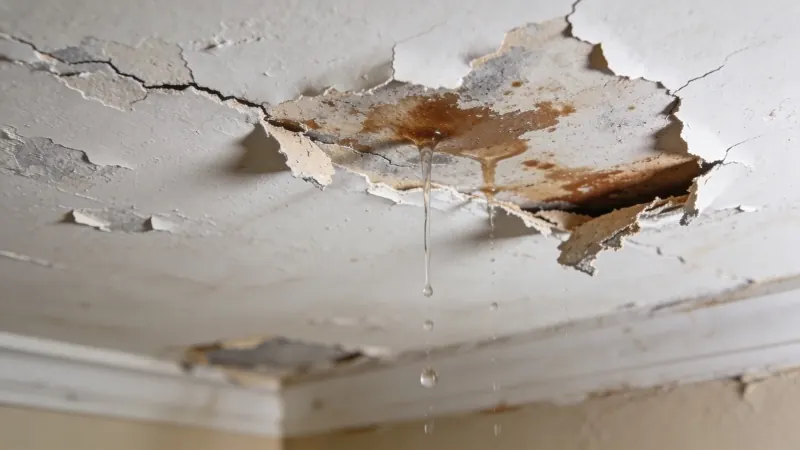
What Causes Water Damage in Ceiling Spaces
A ceiling is just the bottom layer of whatever is above it. That means the cause of ceiling water damage is always something happening on the other side of that drywall, whether it's a plumbing failure, a roof problem, or an HVAC issue. In our experience, these are the causes we see most often, ranked by frequency.
| Cause | Frequency | Typical Signs |
|---|---|---|
| Upstairs bathroom leaks | Most common | Stain below bathroom, often offset from source |
| Roof leaks | Common (top floor) | Stains after rain, water trails on rafters |
| AC condensation line leaks | Seasonal (summer) | Stain near HVAC, worse during cooling season |
| Burst/leaking pipes | Year-round | Sudden dripping, sagging, active water flow |
| Appliance failures (washer, water heater) | Occasional | Large stain, rapid onset |
Upstairs bathroom leaks
This is the number one cause of first-floor ceiling damage that we respond to. Bathrooms have more potential leak points per square foot than any other room in the house: supply lines to the toilet, sink, and shower. Drain connections behind the wall. The toilet wax ring seal at the floor. The shower pan or tub drain. Caulk failure around the tub surround.
A failed wax ring is one of the sneakiest. Every time someone flushes that upstairs toilet, a small amount of water seeps past the seal and onto the subfloor. It migrates through the subfloor plywood, saturates the ceiling joists, and eventually shows up as a stain on the first-floor ceiling 8 to 10 feet away from where you'd expect it.
We've traced ceiling stains in living rooms back to second-floor bathrooms that were 15 feet away horizontally because the water followed a ceiling joist before dripping down.
Shower pan failures are another major culprit. A cracked shower pan or deteriorated grout allows water to penetrate the subfloor every time someone showers. The damage accumulates slowly over weeks or months, and by the time you see the ceiling stain downstairs, the subfloor and framing above have been soaking for a long time.
Mark and Lisa's second-floor bathroom. They called us about a water stain on their kitchen ceiling that had appeared about three weeks earlier. The stain was directly below the upstairs guest bathroom, which they rarely used. We checked the toilet wax ring first. It was fine. The supply lines were dry. The shower hadn't been used in a month.
Our moisture meter readings pointed us to the toilet supply line connection at the shut-off valve. A slow drip, barely visible, had been running down the back of the valve body and onto the subfloor behind the toilet. It was probably leaking for six months.
The ceiling drywall in the kitchen was saturated across a 6-by-4-foot area, and we found active mold growth on the backside of the drywall and on three ceiling joists. What looked like a simple stain turned into a drywall replacement, joist treatment, and mold remediation job.
Roof leaks
On single-story homes or top-floor ceilings in multi-story homes, roof leaks are the primary cause. Missing or damaged shingles, cracked flashing around vent pipes and chimneys, deteriorated valley seals, and clogged gutters that cause water to back up under the roof edge.
Roof leaks don't always drip straight down. Water enters through a breach in the roofing material, hits the roof decking, and then travels along rafters and sheathing before finding a seam or penetration point to drip through.
A leak at the roof peak can produce a ceiling stain 10 feet away from the actual entry point. This is why patching the ceiling without finding and fixing the roof problem guarantees the stain will come back.
Ice dams in northern climates cause a specific type of roof leak. Ice forms along the eaves, preventing snowmelt from draining off the roof. Water pools behind the ice dam and backs up under the shingles, finding its way into the attic and down through the ceiling. According to FEMA, ice dams are one of the top causes of winter water damage in northern states.
AC condensation line leaks
Central air conditioning systems produce condensation as they cool air. That moisture collects in a drain pan under the evaporator coil and flows out through a condensation drain line, usually a 3/4-inch PVC pipe. When that line clogs with algae, sludge, or debris, the drain pan overflows.
Here's the problem: the air handler and evaporator coil are usually in the attic or a second-floor closet, directly above your ceiling. A clogged condensation line sends water directly onto the ceiling drywall from above.
During peak summer cooling, a residential AC unit can produce 5 to 20 gallons of condensation per day. A clogged line on a 95-degree day can overflow the drain pan in hours.
We respond to a spike in AC-related ceiling damage calls every summer between June and September. The fix for the condensation line itself is straightforward, but the ceiling damage from days of overflow can be significant. Insulation above the ceiling gets waterlogged, drywall sags, and mold starts growing in the warm, dark, wet attic space above.
Burst or leaking pipes above the ceiling
Supply lines, drain pipes, and sometimes radiant heating lines run through ceiling assemblies and joist bays above your head. A pipe fitting that fails, a copper joint that corrodes, or a frozen pipe that cracks in winter sends water directly into the ceiling space.
The Reyes family's Thanksgiving disaster. They came home after spending Thanksgiving at a relative's house. The heat had been set low while they were away, and a cold snap dropped temperatures below zero. A copper supply line in the ceiling joist bay above their dining room froze and split.
By the time they walked in three days later, the dining room ceiling had collapsed onto the table. Two adjacent rooms had saturated ceilings barely hanging on. The entire first floor had standing water. This was a full emergency water extraction job, followed by structural drying, drywall demolition across three rooms, and a complete ceiling rebuild. The frozen pipe had released water for roughly 72 hours.
Winter pipe bursts above ceilings are especially dangerous because the volume of water can be enormous before anyone notices. If you're leaving your home in cold weather, keep the heat at 55 degrees or above and open cabinet doors under sinks on exterior walls. For more on frozen pipe prevention and response, see our burst pipe water damage page.
Less common causes
These aren't everyday calls, but we see them regularly enough to mention:
- Washing machine supply lines on upper floors. Braided stainless steel supply hoses fail with age. A washing machine on the second floor with a burst supply line can dump 500 gallons per hour through the ceiling below.
- Water heaters in attics. Common in southern and southwestern homes. A tank failure releases 40 to 80 gallons onto ceiling drywall below.
- Bathroom exhaust fans vented improperly. Fans that vent into the attic instead of through the roof dump warm, moist air into the attic space, causing condensation on the underside of the roof decking. That moisture drips onto the insulation and ceiling below.
- Fire sprinkler leaks. Older sprinkler heads can corrode and develop slow leaks.
How to Find the Source of Ceiling Water Damage
Finding the source is the most critical step. Fix the ceiling without fixing the source, and you'll be doing the same repair again in three months.
Start directly above the stain
Go to the room, attic, or floor directly above the damaged area. Look for visible moisture, drips, or standing water. If there's a bathroom above, check every fixture:
- Toilet wax ring. Rock the toilet gently side to side. If it moves at all, the wax ring seal may be compromised. Check for moisture around the base with a paper towel.
- Supply line connections. Feel every supply line connection under the sink, behind the toilet, and at the shower valve. Run your finger along the pipe. Even a slight dampness is a problem.
- Shower pan and tub. Fill the tub or shower floor with an inch of water and let it sit for an hour. Check the ceiling below for new dripping.
- Drain connections. Run water in each fixture one at a time while someone watches the ceiling below for drips.
Trace the water path
Water in ceiling assemblies rarely drips straight down from the source to the stain. It follows the path of least resistance, which usually means running along ceiling joists, electrical wires, and pipe runs before finding a seam or low point to drip through.
If the stain is 10 feet from the nearest bathroom, that doesn't mean the bathroom isn't the source. It means the water traveled. Our technicians use thermal imaging cameras to trace moisture paths through ceiling assemblies.
The camera shows temperature differences that reveal wet materials you can't see or feel from below. A moisture meter pushed through a small test hole in the drywall tells us exactly how wet the materials above are.
Check the roof (top-floor ceilings)
For top-floor ceiling damage, get into the attic if you can do so safely. Look for daylight coming through the roof decking. Check for wet insulation, stains on the underside of the decking, or visible water trails on rafters.
From outside, look for missing shingles, damaged flashing around vent pipes, and debris-clogged valleys.
After heavy rain, check the attic within a few hours while any leak would still be active. Some roof leaks only happen during driving rain from a specific direction, which makes them hard to reproduce on a dry day.
Check the HVAC system
If you have an air handler or furnace in the attic, check the condensation drain pan and drain line. A full drain pan means a clogged line. Also check for condensation on ductwork, which happens when duct insulation deteriorates and warm, humid air contacts the cold duct surface.
When you can't find the source
Some ceiling leaks are intermittent or extremely hard to trace. A shower pan that only leaks when someone stands in a specific spot. A roof leak that only occurs during wind-driven rain from the southeast. A pipe fitting that drips only when water pressure spikes at 6 AM.
If you've checked everything visible and the source is still unknown, call (844) 426-5801. Our technicians bring thermal imaging cameras and pin-type moisture meters that can trace water paths through ceiling assemblies. We can map the moisture trail from the stain back to its origin point, even when the path takes multiple turns through the joist bays.
Water Coming Through Your Ceiling?
Our IICRC-certified team arrives within 60 minutes with thermal imaging and extraction equipment.
📞 Call (844) 426-5801Safety Concerns: When a Water Damaged Ceiling Becomes Dangerous
This is the section most homeowners skip, and it's the one that matters most. A water damaged ceiling isn't just ugly. It can be structurally unsafe, and the collapse risk is real.
Why wet ceilings collapse
Standard residential ceilings use 1/2-inch drywall (sometimes 5/8-inch) attached to ceiling joists or trusses with drywall screws spaced every 12 to 16 inches. Drywall is essentially a gypsum core sandwiched between two layers of paper facing. When water saturates drywall, three things happen:
- The weight increases dramatically. A dry 4-by-8-foot sheet of 1/2-inch drywall weighs about 52 pounds. Fully saturated, that same sheet can absorb enough water to weigh over 200 pounds. The screws that hold it up were engineered for 52 pounds, not 200.
- The paper facing delaminates. The paper coating that gives drywall its tensile strength separates from the gypsum core when wet. The screw heads pull through the soft paper instead of gripping the panel.
- The gypsum core softens. Wet gypsum loses its rigidity. The panel sags under its own increased weight, pulling away from the screws and joists above.
When all three things happen at once, the ceiling drops. We've seen single panels fall. We've seen 12-by-15-foot sections of ceiling come down in one piece. A falling section of saturated drywall with insulation on top is heavy enough to injure someone underneath. Falling drywall has put people in the emergency room.
Warning signs of imminent collapse
Get everyone out of the room if you see any of these:
- Visible sagging or bowing. The ceiling is no longer flat. It droops in the center like a bag filling with water.
- The ceiling flexes when pressed. If you push gently with your hand and the ceiling moves, the drywall is saturated and has lost structural integrity.
- Bubbling or swelling. The surface looks puffy or raised in sections.
- Active dripping from seams or screw holes. Water is finding exit points, which means the cavity above is full.
- Cracking sounds. Drywall screws pulling out of joists or paper facing tearing makes an audible cracking or popping sound.
Don't stand under a sagging ceiling to poke a drainage hole. Don't put a ladder under it. Don't try to prop it up. Get out of the room, close the door, and call us at (844) 426-5801.
Electrical hazards
Water dripping through a ceiling often contacts electrical wiring, junction boxes, and light fixtures. Ceiling-mounted lights, recessed cans, and ceiling fans are all wired through the joist bays where water collects.
If water is dripping through or near a light fixture, turn off the breaker for that room at the electrical panel before entering. Don't use the light switch to turn it off. Go to the breaker box.
Water in a junction box can energize surfaces you wouldn't expect, and a light switch doesn't break the connection to the fixture completely.
Mold risk in ceiling assemblies
Ceiling assemblies are among the worst locations for mold growth after water damage. Here's why: the warm air in your living space rises and heats the ceiling drywall. Moisture trapped above the drywall, in the insulation, and on the joists sits in a warm, dark, enclosed environment. That's exactly what mold needs.
Mold can begin colonizing within 24 to 48 hours of water exposure. According to the EPA, mold growth should be addressed promptly and the source of moisture must be eliminated. In ceiling assemblies, mold often grows on the top surface of the drywall (the side you can't see), on the paper facing of fiberglass insulation, and on the sides of ceiling joists.
If mold has established in your ceiling assembly, it needs to be handled under containment to prevent spore spread. Our mold remediation team follows IICRC S520 protocols for ceiling mold, including containment, HEPA filtration, material removal, and post-remediation air quality testing.
When a Water Stain on Ceiling Is Cosmetic vs. Structural
Not every water stain on a ceiling requires drywall replacement. Some stains are old, the source is long fixed, and the drywall underneath is perfectly solid. Others look minor on the surface but hide serious damage above. Here's how we assess the difference.
The touch test
Press the stained area gently with your fingertips. Solid, firm drywall that doesn't give or flex under pressure is a good sign. The stain may be purely cosmetic, meaning the drywall got wet at some point, dried out, and left mineral deposits and discoloration in the paper facing. That's what produces that characteristic brownish-yellow ring.
Drywall that feels soft, spongy, or crumbles under light pressure is compromised. The gypsum core absorbed water and didn't dry properly, or it dried but the gypsum recrystallized in a weakened state. This drywall needs to come out.
The moisture meter test
This is the test we rely on professionally. A pin-type moisture meter pushed into the drywall gives us an actual moisture content reading. Drywall below 1% moisture content on a pin meter is dry.
Readings above 1% tell us moisture is still present. Anything above 3% in drywall is actively wet and needs drying or removal.
We also push the pins through the drywall to read the moisture content of the joist or truss above. The drywall might read dry on the surface, but the framing above it could still be holding moisture at 20% or higher. Wood framing needs to be below 16% to be considered safe from mold growth, according to IICRC S500 standards.
Stain patterns and what they tell you
The shape and color of a ceiling stain gives us information:
- A defined brown ring with a lighter center. This usually means a single water event that has dried. The brown ring is the "tide mark" where dissolved minerals were deposited as the water evaporated from the edges inward.
- A uniform yellow or brown patch without a defined ring. Ongoing or recurring moisture exposure. The stain has been re-wet multiple times, which keeps the center discolored.
- Dark spots within the stain, especially black or dark green. This is likely mold growth on the surface of the drywall paper. Mold is a sign that moisture persisted long enough for colonization.
- Stain is growing or darkening over time. The source is still active. Don't paint over it until the source is found and fixed.
- Multiple stains or rings. Multiple water events from the same source. Each ring represents a separate wetting and drying cycle.
Cosmetic stain: criteria
A ceiling water stain is cosmetic when all of the following are true:
- The source of water has been identified and repaired
- The drywall feels firm and solid to the touch
- Moisture meter readings confirm the drywall and framing above are dry
- There's no visible mold growth on the surface
- The stain isn't growing or changing
If all five criteria are met, you can address the stain with a stain-blocking primer and paint. No drywall replacement needed.
Structural damage: criteria
The damage is structural and requires repair when any of the following are true:
- Drywall is soft, sagging, crumbling, or delaminated
- Moisture readings are elevated (drywall above 1%, framing above 16%)
- The source hasn't been identified or is still active
- Mold is visible on the ceiling surface
- The ceiling flexes or moves when pressed
When damage is structural, painting over the stain won't solve anything. The damaged drywall needs to be removed, the area above needs to be dried and treated, and new drywall needs to be installed.
Ceiling Water Damage Repair: Drywall Replacement vs. Patch Repair
Once the source is fixed and the area is dry, the repair approach depends on how much drywall was damaged.
Small area damage (under 4 square feet)
For minor damage affecting a small area, a patch repair works well. This involves cutting out the damaged section in a rectangular shape, installing a piece of new drywall backed by furring strips or a drywall patch clip, taping the seams with joint compound, and texturing to match.
A skilled drywaller can patch a 2-by-2-foot ceiling hole and make it nearly invisible. The key is feathering the joint compound wide enough that the seam doesn't create a visible ridge, and matching the surrounding texture exactly.
Medium area damage (4 to 32 square feet)
When damage spans a larger section but doesn't involve the entire ceiling, we cut back to the nearest joists on each side. This gives us solid framing to anchor the new drywall. A joist-to-joist replacement section integrates better structurally and is easier to tape and finish without visible seams.
For a room with 8-foot ceilings and standard 16-inch on-center joist spacing, a medium repair might involve removing a 4-by-8-foot section of drywall and replacing it with a full new sheet. The perimeter gets taped, mudded, and sanded across three coats before texturing and painting.
Full ceiling replacement
When damage is extensive, meaning the entire ceiling is compromised or damage is spread across most of the surface, replacing the whole ceiling is often more cost-effective than trying to patch multiple sections. Full replacement eliminates the challenge of matching repairs to the original surface and ensures no hidden damage is left behind.
Full ceiling replacement in a standard 12-by-15-foot room involves removing all existing drywall, inspecting the joists and insulation above, installing new 1/2-inch drywall (screwed every 12 inches on center to prevent future sagging), taping and finishing all seams, texturing the entire surface, and painting.
What needs to happen before any drywall goes up
This is where shortcuts cause problems. Before new drywall is installed on the ceiling:
- The leak source must be verified as fixed. Run the fixture above. Wait for rain if it was a roof leak. Confirm the repair holds.
- All materials must be dry. Joists, subfloor above, insulation. We check with moisture meters. If we're installing new drywall over wet framing, we're trapping moisture that will grow mold and damage the new drywall within months.
- Mold-contaminated materials must be treated or removed. If mold was present on the joists or the backside of the old drywall, the joists need antimicrobial treatment before enclosing the cavity again.
- Insulation should be replaced if saturated. Fiberglass insulation that was soaked loses its R-value and becomes a mold food source. Blow-in cellulose insulation that was wet often settles and clumps. Replace it.
For details on the professional drying process, see our structural drying page.
Ceiling Texture Matching: Getting the Repair to Disappear
One of the most frustrating parts of ceiling water damage repair is matching the existing ceiling texture. A structurally perfect drywall repair that has the wrong texture stands out like a patch on a quilt.
Common ceiling textures
- Knockdown. A splattered texture that's flattened with a knockdown knife, leaving irregular raised islands. Very common in homes built from the 1990s forward.
- Orange peel. A fine splattered texture that looks like the surface of an orange. Applied with a hopper gun and not flattened.
- Popcorn (cottage cheese). A thick, lumpy texture that was standard from the 1960s through the 1980s. If your home was built before 1980, popcorn texture may contain asbestos. Have it tested before disturbing it.
- Smooth. No texture at all. Requires Level 5 drywall finish, which is the hardest to execute because every imperfection shows.
- Skip trowel. A hand-applied texture using a curved drywall knife. Creates a stucco-like appearance with thin ridges.
- Swirl. A pattern created by pressing a brush into wet joint compound and twisting. Common in older homes.
Matching tips from our crew
Getting texture to match is part skill, part art. Our drywall team follows these principles:
Practice on scrap first. Before touching the ceiling, we practice the texture on a scrap piece of drywall leaning against the wall. We adjust the hopper pressure, mud consistency, and technique until the practice piece matches the existing ceiling.
Blend the edges. The transition between old and new texture is where repairs get noticed. We overlap the new texture onto the surrounding old texture by 2 to 3 inches and feather it so there's no hard line.
Match the mud consistency. Texture appearance changes dramatically with the thickness of the joint compound. Too thin produces a flat texture. Too thick produces heavy globs that don't match a fine orange peel.
Prime before texturing. New drywall absorbs moisture from the texture compound differently than the sealed surrounding ceiling. Priming the new drywall first ensures uniform absorption and texture appearance.
Popcorn ceiling considerations
Popcorn ceiling repair after water damage is particularly challenging. Old popcorn texture often contains different aggregate sizes than what is available today. The existing texture may have been painted multiple times, changing its appearance. And if the home was built before 1980, the original texture may contain asbestos.
Asbestos testing before disturbing popcorn ceiling texture isn't optional. According to the EPA, asbestos-containing materials that are in good condition and undisturbed are generally safe. But cutting, scraping, or sanding asbestos-containing popcorn texture releases fibers that are a serious health hazard. A certified lab can test a small sample in a few days.
For many homeowners with water-damaged popcorn ceilings, this becomes a decision point. Repair the popcorn texture (matching old to new is very difficult), or scrape the entire ceiling and apply a new texture. If the popcorn tests positive for asbestos, scraping requires a licensed abatement contractor.
Painting Over Water Stains: How to Do It So They Don't Bleed Through
If the drywall is sound and the damage is cosmetic, painting over a water stain is straightforward. But it requires the right primer. This is where a lot of homeowners waste time and money trying to cover stains with regular paint.
Why regular paint doesn't work
Water stains are caused by dissolved minerals, tannins from wood framing, and organic compounds that were carried to the ceiling surface as the water migrated. These substances are water-soluble.
When you apply latex paint (which is water-based) directly over a water stain, the moisture in the paint re-dissolves those compounds and they bleed through the new paint layer. You end up with a freshly painted ceiling that shows a yellow-brown ghost of the original stain within days or weeks.
The right primer makes all the difference
Stain-blocking primers create a barrier between the stain compounds and your topcoat. Two products work reliably on ceiling water stains:
Kilz Original (oil-based). This is the industry standard for water stain blocking. The oil-based formula seals water-soluble stain compounds completely. One coat is usually sufficient. It has a strong odor during application and requires mineral spirits for cleanup, but it works.
Zinsser BIN (shellac-based). Shellac is the most effective stain blocker available. BIN dries in 15 minutes, blocks virtually any stain, and can be topcoated within 45 minutes. It's our first choice for stubborn stains or stains that bled through an oil-based primer. The downside is the strong alcohol odor during application. Ventilate the room.
Zinsser Bulls Eye 1-2-3 (water-based). A low-odor alternative. It works on lighter stains but may not fully block heavy water stains or tannin bleed. For old, dark ceiling stains, go with Kilz Original or BIN instead.
The painting process
- Make sure the drywall is completely dry. Check with a moisture meter if you're not certain.
- Scrape off any loose or peeling paint around the stain.
- Lightly sand the area with 120-grit sandpaper to create a smooth surface.
- Apply one coat of stain-blocking primer (Kilz Original or Zinsser BIN) over the stain and 3 to 4 inches beyond its edges.
- Let the primer dry fully. Check manufacturer instructions, but figure 1 hour for Kilz Original, 45 minutes for BIN.
- Apply two coats of ceiling paint. Use the same sheen as the existing ceiling. Most ceilings are flat or matte.
- If you're painting just the stained area, feather the ceiling paint out well beyond the primed area to blend with the surrounding surface. For best results on a white ceiling, paint the entire ceiling.
Sandra's kitchen ceiling. She tried painting over a water stain from a resolved roof leak three times with regular ceiling paint. Each time, the stain bled through within a week. She called us, convinced she needed new drywall.
We checked the drywall with a moisture meter. Bone dry. Structurally perfect. The issue was the primer, not the drywall. We applied one coat of Zinsser BIN, waited 45 minutes, and put two coats of ceiling paint over it. The stain hasn't come back.
When Ceiling Water Damage Is an Emergency
Not every ceiling stain is a 2 AM crisis. But some ceiling water damage situations are genuine emergencies where waiting until morning or the weekend could result in a ceiling collapse, extensive secondary damage, or a safety hazard.
Call immediately if you see any of these
- Water is actively pouring or streaming through the ceiling. This is an active supply line break or major roof failure. The water won't stop on its own. Call (844) 426-5801 now.
- The ceiling is visibly sagging, bowing, or bulging. Saturated drywall is on the verge of collapse. Get everyone out of the room.
- Water is dripping from or near a light fixture, fan, or electrical outlet. This is an electrocution hazard. Turn off the breaker for that circuit and call us.
- You can hear water running inside the ceiling or walls but can't see the source. An active leak inside a concealed space will cause escalating damage every hour it runs.
- You come home to a flooded ceiling after being away. A pipe or appliance failure that has been running for hours or days is a full restoration job. The sooner extraction starts, the more you save.
Situations that can wait 24 to 48 hours
- A dry stain that hasn't changed in size or appearance. The source event may be over. Schedule an assessment within a day or two.
- A small, slow drip from a known source you have shut off. If you have turned off the water supply to the failed fixture, the dripping will stop once residual water in the ceiling drains out.
- An old stain you just noticed but has been there a while. Not an emergency, but should still be assessed to confirm the source is resolved and the drywall is sound.
Even non-emergency ceiling damage should be assessed promptly. The longer you wait, the greater the chance that hidden moisture in the ceiling assembly develops into a mold problem. Our team can do a moisture assessment within 24 hours of your call. Reach out at (844) 426-5801 and we'll set up a time.
Ceiling Sagging or Dripping? Don't Wait
Our emergency crew arrives within 60 minutes with thermal imaging and extraction equipment.
📞 Call (844) 426-5801The Professional Ceiling Water Damage Repair Process
When you call us for ceiling water damage, here's what happens step by step. Every job is different, but this is the general sequence.
Step 1: Source identification
Before we touch the ceiling, we find the source. There's no point in repairing damage from an active leak. We use thermal imaging to map moisture patterns, and pin-type moisture meters to test materials above the ceiling through small probe holes.
If plumbing is the suspected cause, we may coordinate with a licensed plumber to camera the drain lines or pressure-test the supply lines.
Step 2: Safety assessment
We evaluate the ceiling for collapse risk. If sections are sagging, we either carefully relieve the water by poking a drainage hole from a safe angle (not directly underneath), or we set up protective measures and remove the compromised section promptly. If water is near electrical components, we confirm the circuits are de-energized before proceeding.
Step 3: Controlled demolition
Damaged drywall is removed. For a patch repair, we cut back to the nearest joists. For larger damage, we remove full sheets. We carefully take down saturated insulation. Everything comes out clean so we can assess the condition of the framing above.
Step 4: Drying
With the ceiling open, we can direct air movers and dehumidifiers at the exposed joists, subfloor, and cavity space. Open-cavity drying is much faster and more effective than trying to dry through intact drywall. Typical drying time with the ceiling open is 2 to 3 days. We monitor daily with moisture meters and document the readings.
For more detail on our drying methods and equipment, see our structural drying page.
Step 5: Mold treatment (if needed)
If we find mold on the joists, subfloor, or surrounding surfaces, we treat it before closing the cavity. Surface mold on framing is treated with antimicrobial agents. If mold has penetrated the wood, we may sand or media-blast the affected areas. Extensive mold in the ceiling assembly may require full mold remediation with containment and air scrubbing.
Step 6: Insulation replacement
Wet insulation is replaced with new material. We typically use unfaced fiberglass batts for ceiling assemblies because they allow moisture to pass through rather than trapping it against the drywall. Insulation R-value is matched to existing or brought up to current code requirements.
Step 7: Drywall installation, taping, and finishing
New drywall is hung, screwed to joists at proper spacing (every 12 inches for ceilings), taped, and finished with three coats of joint compound. Each coat is allowed to dry and is sanded before the next. This takes 3 to 4 days total for the compound to cure between coats.
Step 8: Texture matching and painting
We match the existing ceiling texture using the techniques described above. After texturing, we apply stain-blocking primer and two coats of ceiling paint. The goal is a seamless repair where you can't tell which section is new.
Step 9: Documentation
Every step is photographed and documented. We record moisture readings at every stage. This documentation serves two purposes: it proves to you that the job was done correctly, and it gives your insurance adjuster everything needed to process the claim.
We handle thousands of insurance claims and know exactly what adjusters need to see. For guidance on the claims process, see our water damage insurance claim guide.
Ceiling Water Damage Repair and Insurance
Sudden and accidental ceiling water damage is typically covered by standard homeowners insurance policies. A burst pipe, a failed supply line, a sudden roof leak during a storm, or an appliance overflow that damages the ceiling below are all generally covered events.
What's typically not covered: gradual damage from a leak you knew about, deferred roof maintenance, or flooding from external sources (that requires separate flood insurance). Review your policy or talk to your agent if you're unsure. Our insurance claim guide covers what to expect from the process and how to document your damage.
We work directly with your insurance carrier. Our scope of work, photo documentation, moisture readings, and detailed repair records are formatted to meet adjuster requirements. We bill insurance directly in most cases. For a full understanding of restoration pricing, see our water damage repair cost guide.
Ceiling Water Damage Repair Costs at a Glance
| Repair Type | Typical Cost Range |
|---|---|
| Paint over small stain (primer + paint) | $200-$500 |
| Drywall patch repair (under 4 sq ft) | $500-$1,000 |
| Section replacement with texture matching | $500-$1,500 |
| Full ceiling replacement (single room) | $1,500-$4,000 |
| Emergency extraction + drying + repair | $3,000-$7,000+ |
| Mold remediation in ceiling assembly | $1,500-$5,000+ |
Most sudden and accidental ceiling water damage is covered by homeowners insurance. We bill your carrier directly and handle all documentation.
Frequently Asked Questions About Water Damage in Ceiling
A water stain itself isn't dangerous, but what it represents can be. A stain means water reached your ceiling at some point, and the source may still be active. The drywall, insulation, and framing above the stain may still hold trapped moisture that breeds mold. Any stain that feels soft, damp, or is growing in size needs professional assessment.
Yes. Standard half-inch drywall becomes extremely heavy when saturated. A 4-by-8-foot sheet weighs about 52 pounds dry and can exceed 200 pounds when fully soaked. When screw grip fails and the paper facing delaminates, the panel can drop without warning. If your ceiling is sagging or bubbling, leave the room and call (844) 426-5801.
Start directly above the stain. Check for bathrooms, HVAC units, or plumbing runs above that spot. Look for active drips, condensation on pipes, toilet wax ring failures, or shower pan leaks. On top-floor ceilings, inspect the roof for missing shingles, damaged flashing, or clogged valleys. Thermal imaging cameras can trace moisture paths that are invisible to the eye.
Only if the source is fixed and the drywall is completely dry and structurally sound. Use a stain-blocking primer like Kilz Original or Zinsser BIN before painting. Standard latex paint applied directly over a water stain will allow the discoloration to bleed through within weeks. If the drywall is soft, crumbling, or sagging, the damaged section needs to be cut out and replaced.
With professional drying equipment, ceiling drywall typically dries to acceptable moisture levels within 3 to 5 days. Without professional equipment, ceiling drywall can stay damp for weeks because gravity works against natural evaporation. Moisture wicks upward into insulation and pools on top of the drywall where air circulation is minimal.
Sudden and accidental ceiling water damage is typically covered. A burst pipe above the ceiling, a failed supply line, or an overflowing toilet upstairs would generally qualify. Gradual damage from a slow leak you knew about or roof damage from deferred maintenance is usually excluded. Our team documents everything your adjuster needs. See our insurance claim guide for details.
If the ceiling is actively bulging with trapped water, a controlled drain hole can help. Use a screwdriver or awl to puncture the lowest point of the bulge while holding a bucket underneath. This relieves weight and reduces the risk of a larger uncontrolled collapse. If the bulge is large or the ceiling is sagging across a wide area, evacuate the room and call a professional at (844) 426-5801.
Early signs include brownish-yellow stains or rings, peeling or bubbling paint, and slight discoloration. More advanced damage shows sagging or drooping drywall, visible mold spots (often dark green or black), crumbling texture, and active dripping. A ceiling that flexes or feels spongy when touched is holding water and needs immediate attention.
Painting over a small stain after the source is fixed might run $200 to $500. Replacing a section of drywall with texture matching typically costs $500 to $1,500. Full ceiling replacement in a room, including drying, drywall, texture, and paint, ranges from $1,500 to $4,000. See our cost guide for detailed breakdowns.
Don't Ignore Water Damage in Your Ceiling
A water stain on your ceiling is a message. It's telling you that water went somewhere it wasn't supposed to go. Maybe it was a one-time event and everything is fine. Maybe the source is still active and the damage is getting worse every day behind a surface that looks mostly the same.
After 15 years of ceiling water damage restoration, here's our honest advice. Don't paint over it and hope for the best. Don't ignore a small stain because it hasn't changed this week.
Get it assessed. Find the source. Confirm the drywall and framing above are dry and mold-free. Then decide whether it needs a coat of primer or a section of new drywall.
We're available 24/7 for emergencies and can schedule non-emergency assessments within 24 hours. Our technicians carry thermal imaging cameras and moisture meters on every truck because ceiling damage assessment is one of the most common calls we take.
Call (844) 426-5801 to talk to our team. We'll help you figure out what you're dealing with and what it takes to fix it right.
Water Damages Pros. IICRC certified. 24/7 emergency response. Direct insurance billing. Serving homeowners nationwide.