Your kitchen floor is underwater. A pipe behind the wall let go twenty minutes ago and now there's an inch of water spreading across the hardwood, soaking under the baseboards, and working its way toward the living room carpet. You're standing there with towels that are already soaked through, and the water just keeps coming.
This is the call we get more than any other. And after 15 years of running emergency water extraction jobs across the country, here's what we know: the difference between a $2,000 restoration and a $10,000 restoration is often decided in the first 60 minutes.
Call (844) 426-5801 right now. Our emergency crew is on the way in under 60 minutes with truck-mounted extraction equipment that removes hundreds of gallons per hour. We operate 24/7/365, and we don't charge extra for nights, weekends, or holidays.
This page covers everything you need to know about emergency water extraction: what happens during the first critical hour, the equipment we bring, our step-by-step extraction process, what you should do before we arrive, real cost ranges, and how to know when you need emergency extraction versus when it can wait.
What Happens in the First Hour After Water Damage
The first 60 minutes after a water event are the most consequential. In our experience, here's the damage timeline that plays out in homes across the country every single day:
Minutes 1-15: Water follows gravity and the path of least resistance. It moves across floor surfaces, seeps under baseboards, and starts saturating carpet pad.
If the source is on an upper floor, water is already traveling down through the subfloor and into the ceiling assembly below. Drywall begins wicking moisture upward from the floor line.
Minutes 15-30: Carpet padding acts like a sponge, absorbing several times its weight in water. Hardwood floorboards begin absorbing moisture at the edges, which is where cupping starts. Water that reached wall cavities begins saturating insulation and the backside of drywall. If the water is still flowing, it's now moving into adjacent rooms through doorways and under walls.
Minutes 30-60: By now, drywall can wick moisture 6-12 inches above the visible water line. Laminate flooring starts swelling at the seams. Water has penetrated the tack strip under carpeted perimeters.
Any furniture sitting in water is absorbing moisture into legs and base frames. Particleboard shelving and MDF trim are expanding and deteriorating.
Hours 1-4: Staining begins on walls and ceilings. Metal surfaces start showing signs of tarnish. Dyes from fabrics and carpets begin bleeding.
Wood furniture joints loosen as wood swells. Water has traveled further into wall cavities than most homeowners realize, often 2-3 rooms beyond the visible damage.
Hours 4-24: Mold spores, which are always present in indoor air, now have the moisture conditions they need to begin germinating. According to the EPA, mold can start growing on damp surfaces within 24 to 48 hours. At this point, what was a water extraction job is becoming a water extraction plus mold remediation job, and the cost just doubled.
This is why we built our entire operation around speed. When you call (844) 426-5801, we dispatch immediately. Not in the morning. Not when a crew becomes available. Right now.
Emergency Water Extraction Equipment: What We Bring to Your Home
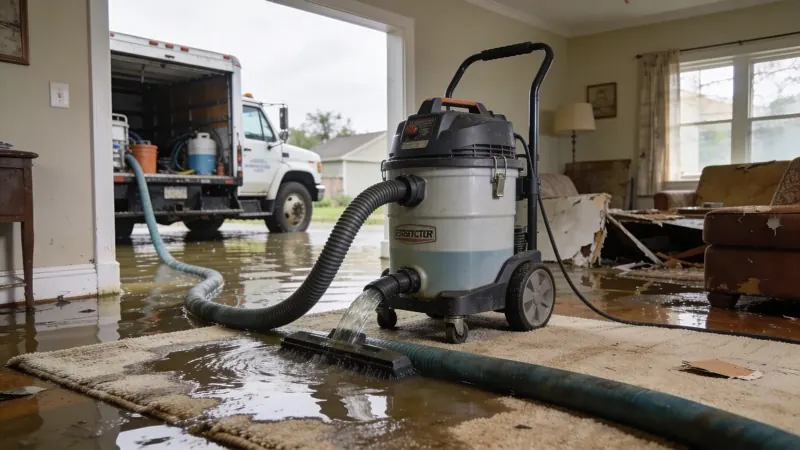
When our truck pulls up to your house, it's carrying more extraction power than most homeowners have ever seen. Understanding the equipment matters because it's the difference between professional extraction and trying to mop up a flood with bath towels.
Truck-Mounted Extractors
The backbone of any emergency water extraction job. Our truck-mounted units are powered by the vehicle's engine, which means they generate significantly more suction than anything you can plug into a wall outlet.
A truck-mounted extractor removes water at a rate of 500+ gallons per hour. To put that in perspective, a standard shop vac from a hardware store moves about 5 gallons per minute at peak capacity, but it fills up and needs emptying every few minutes. Our truck-mounted units discharge directly to the street or storm drain, allowing continuous extraction without interruption.
We run 2-inch vacuum hoses from the truck into your home. One technician operates the extraction wand, working systematically across the affected area, while the truck's engine powers the vacuum continuously. For a typical living room with an inch of standing water, the truck-mounted extractor clears it in 30-45 minutes.
Submersible Pumps
When you've got 6 inches, a foot, or 3 feet of standing water, like in a flooded basement, we deploy submersible pumps before the truck-mounted extractor. These electric pumps sit directly in the water on the floor and pump it out through discharge hoses to the exterior.
Our submersible pumps move 2,000-3,000 gallons per hour, depending on the model and the vertical lift required. For a basement with 2 feet of standing water, a submersible pump can drop the water level to an inch or two within a couple of hours. At that point, we switch to the truck-mounted extractor to pull the remaining water from the floor surface.
We carry both standard and high-capacity submersible pumps. For severe flooding, like storm surge or catastrophic pipe failure, we can deploy multiple pumps simultaneously.
Weighted Extraction Tools
Here's a piece of equipment most homeowners have never heard of. After the standing water is gone, a tremendous amount of water remains trapped in carpets, carpet pads, and soft flooring materials. Weighted extraction tools are designed specifically for this.
A weighted extraction tool looks like a wide, flat wand with a heavy base plate. The weight, typically 50-75 pounds, presses down on the carpet while the vacuum pulls water upward through the fibers and pad. A single pass with a weighted extractor removes 80-90% of the water from carpet and pad, which is far more than a standard wand achieves.
We use weighted extraction on every carpeted area. It's one of the most important steps in the process because leaving water in the pad means the pad becomes a mold incubator sitting under your carpet for days.
Portable Extractors
Not every area is accessible by the truck-mounted unit. Closets, bathrooms, hallways, and rooms far from the truck require portable extraction units. These are powerful, self-contained units on wheels that provide strong suction without needing a connection to the truck.
Portable extractors are also critical for second and third-floor extraction where running a 2-inch hose up a staircase isn't practical.
Thermal Imaging Cameras and Moisture Meters
Extraction isn't just about removing the water you can see. It's about finding and removing the water you can't see.
Our thermal imaging cameras detect temperature differentials in walls, ceilings, and floors that indicate moisture presence. A wet wall cavity shows up as a cooler area on the thermal image because evaporation creates a cooling effect.
After imaging, we confirm with pin-type and pinless moisture meters. These give us exact moisture content readings: anything above 16% in wood framing or 1% in drywall tells us there's water that needs to be addressed.
This combination of thermal imaging and moisture measurement creates what we call a moisture map. It shows every affected area in your home, including the ones that look completely dry from the outside. Without this step, water gets left behind in wall cavities and under floors, which is exactly where mold thrives.
Equipment Summary
| Equipment | Extraction Rate | Best For |
|---|---|---|
| Truck-mounted extractor | 500+ gal/hr | Bulk water removal from floors |
| Submersible pump | 2,000-3,000 gal/hr | Deep standing water (basements) |
| Weighted extraction tool | N/A (per-pass) | Carpet and pad water removal |
| Portable extractor | Varies | Closets, upper floors, tight spaces |
| Thermal imaging camera | N/A | Finding hidden moisture in walls/ceilings |
The Emergency Water Extraction Process: Step by Step
Every emergency water extraction follows the same systematic process. We developed this protocol over thousands of jobs and it aligns with IICRC S500 standards for professional water damage restoration. Here's exactly what happens from the moment you call.
Step 1: Emergency Dispatch (Minutes 0-5)
When you call (844) 426-5801, our dispatch team gathers three pieces of information: your address, the nature of the water event, and whether the water source has been stopped. That's it. We don't need a long conversation. We dispatch the closest available crew while we're still on the phone with you.
If you're not sure how to shut off the water source, we walk you through it on the call. Most residential shutoff valves are located near the water meter, in the basement, or in the crawl space. Turning the valve clockwise stops the flow.
Step 2: Arrival and Safety Assessment (Minutes 30-60)
Our crew arrives within 60 minutes. Before we touch a piece of equipment, we do a safety walkthrough. Three things we check immediately:
- Electrical hazards. Is standing water near outlets, the electrical panel, or plugged-in appliances? If there's any risk, we coordinate with an electrician or instruct you to shut off breakers before we enter the water.
- Structural stability. Has the ceiling absorbed enough water to sag? Are there signs of structural shifting? In severe cases, we bring in a structural assessment before starting work.
- Water category. This is critical. Category 1 water (clean, from a broken supply line) is handled differently from Category 2 (gray water from appliances or dishwashers) or Category 3 (black water from sewage backups or storm flooding). Category 3 requires full PPE (personal protective equipment) and a contamination protocol.
Step 3: Source Containment
If the water source is still active, stopping it is the first priority. We shut off supply valves, cap broken lines, or work with plumbers when the source requires repair beyond our scope. We also contain the affected area: closing doors, placing barriers, and preventing water from migrating into unaffected rooms.
Step 4: Bulk Water Extraction
Now the real work starts. For deep standing water, submersible pumps go in first. For surface-level water, we deploy the truck-mounted extractor immediately.
Our extraction technicians work the space systematically, starting from the area farthest from the truck and working back toward the access point. This prevents re-contamination of extracted areas. For large jobs, multiple technicians run extraction simultaneously across different zones.
During bulk extraction, we're also pulling waterlogged carpet pad. In most cases, carpet pad can't be saved after saturation, regardless of how fast we extract.
The carpet itself can often be saved if extraction happens within the first 12-24 hours, but the pad gets replaced. We carefully peel back the carpet, remove the saturated pad, and then extract from the subfloor beneath.
Step 5: Detailed Surface Extraction
After standing water is gone, we switch to detailed extraction. This is where weighted extraction tools earn their keep. We make multiple passes over every carpeted surface, pulling trapped water from the carpet fibers and any remaining pad material.
Hard surfaces like tile, vinyl, and hardwood get extracted with flat-surface tools designed to pull water from grout lines, seams, and the surface itself. Hardwood floors get special attention because water sitting in the joints between boards causes cupping and buckling that may become permanent if not addressed quickly.
Step 6: Moisture Mapping
With the visible water removed, we break out the thermal imaging camera and moisture meters. We scan every wall, floor, and ceiling surface in and around the affected area.
What we typically find: water has traveled further than anyone expected. A pipe burst in the kitchen often means moisture in the adjacent hallway walls, the bathroom on the other side of the shared plumbing wall, and sometimes the ceiling assembly of the room below. Drywall wicks moisture 12-24 inches above the visible water line, and water travels through wall cavities along the bottom plate.
We document every reading. This moisture map becomes the blueprint for the structural drying phase that follows extraction, and it's also essential documentation for your insurance claim.
Step 7: Initial Drying Equipment Setup
Before we leave from the extraction visit, we set up initial drying equipment. For a typical 2-3 room extraction, that means 4-6 high-velocity air movers positioned to push air across wet surfaces and into wall cavities, plus 1-2 LGR (Low Grain Refrigerant) dehumidifiers to pull moisture from the air.
We also apply antimicrobial treatment to all extracted surfaces. This provides a protective barrier against mold growth during the 3-5 day drying period. Antimicrobial treatment doesn't replace drying, but it gives us extra protection during the window when materials are still wet.
Step 8: Documentation
Throughout the entire extraction, we photograph everything. Before, during, and after. Moisture meter readings. Equipment placement. Affected materials. Damaged contents. This documentation is exactly what your insurance adjuster needs to process your claim, and it's one of the reasons our clients' claims get approved consistently.
Standing Water Right Now?
Our IICRC-certified crew arrives within 60 minutes with truck-mounted extraction equipment.
📞 Call (844) 426-5801When You Need Emergency Extraction vs. When You Can Wait
Not every water situation requires an emergency crew at 3 AM. Here's how we think about it after handling thousands of calls.
Call Immediately (Emergency)
- Standing water that's actively spreading. If water is pooling on the floor and growing, you need extraction now. Every minute adds to the damage scope and cost.
- Burst pipe or broken supply line. These deliver a massive volume of water in a short time. Even after you shut off the main, the water already released needs extraction.
- Sewage backup. Category 3 water is a health hazard. Don't attempt cleanup yourself. This requires professional PPE and contamination protocols.
- Storm flooding entering the home. Rising water from storms doesn't stop on its own timeline, and storm water is always Category 3.
- Water coming through the ceiling. This means water is accumulating above and the ceiling assembly is saturated. Delayed extraction risks a ceiling collapse.
- Fire sprinkler discharge. A single sprinkler head releases 15-25 gallons per minute. Even a brief activation produces significant water volume.
Call Within a Few Hours
- Appliance leak that's been contained. If your dishwasher leaked but you've stopped it and the water is limited to the kitchen, call us during reasonable hours. The damage won't escalate significantly in a few hours.
- Slow drip from a ceiling. The source is likely a slow pipe leak or condensation issue above. It needs attention, but it's not an emergency if the drip rate is manageable.
- Small toilet overflow (Category 1). A toilet overflow from a clogged bowl with clean water, no waste present, affecting a small bathroom area can wait a few hours if you've mopped up the surface water.
The Gray Area
A washing machine supply line failure that happened while you were at work is a good example of the gray area. By the time you get home, the water has been sitting for 6-8 hours. It's not actively spreading anymore, but the carpet, pad, subfloor, and walls have been absorbing water for half a day.
In our experience, this is still an emergency call. That 6-8 hours of absorption means water has penetrated deep into building materials. The mold clock started hours ago. Getting extraction and drying equipment running the same day makes a measurable difference in the final damage scope and restoration cost.
What You Should Do Before the Extraction Crew Arrives
You've called (844) 426-5801 and our crew is on the way. Here's what to do in the 30-60 minutes before we arrive. These steps can reduce damage and make the extraction process faster.
Shut Off the Water Source
If the water is coming from a plumbing failure, locate your main water shutoff valve and turn it off. Common locations:
- Basement or crawl space: Usually on the wall facing the street, near where the water main enters the home
- Utility closet or garage: In warmer climates, the shutoff is often in a utility closet, laundry room, or garage
- Near the street: Some homes have a shutoff at the curb or meter box. You may need a meter key to operate it.
Turn the valve clockwise until it stops. Run a faucet somewhere in the house to confirm water flow has stopped.
Shut Off Electricity to Affected Areas
Go to your breaker panel and flip the breakers for any rooms with standing water. This is non-negotiable. Water and electricity are a lethal combination, and no amount of property damage is worth the risk.
If your breaker panel is in the flooded area, don't attempt to reach it. Call your electrician or power company to disconnect power remotely.
Move What You Can
Get electronics, important documents, photo albums, and valuables off the floor and into dry areas. Lift furniture onto aluminum foil or plastic blocks to prevent staining on carpet. If furniture is too heavy to move, slip aluminum foil under the legs.
Don't try to move large waterlogged items like saturated sofas or mattresses. They're extremely heavy when wet and you risk injury. We'll handle those during extraction.
Take Photos and Video
Before you move anything, pull out your phone and document the damage. Walk through every affected area and record:
- The water source (if visible)
- Standing water levels
- Affected rooms and materials
- Damage to contents, furniture, and belongings
- Any visible damage to walls, ceilings, and floors
This documentation is critical for your insurance claim. The more evidence you have from the initial damage state, the stronger your claim.
Open Windows If Weather Permits
If it's not raining and the outdoor humidity isn't extreme, opening windows in the affected area helps start the air exchange process. This won't substitute for industrial drying equipment, but it's better than a sealed, humid room.
What NOT to Do
- Don't use your household vacuum on standing water. Regular vacuums aren't designed for water and you'll destroy the motor, or worse, create an electrical hazard.
- Don't pull up carpet yourself. Improper carpet removal can tear the material and make it unsalvageable. We've got tools and techniques that preserve the carpet during pad removal.
- Don't turn on the HVAC system. Your heating and cooling system circulates air throughout the house. If the return vents are in the wet area, running the system pulls moisture into the ductwork and distributes it everywhere.
- Don't place fans blowing directly on hardwood floors. Rapid surface drying of hardwood without controlled humidity causes cracking. Hardwood requires a specific drying protocol.
Common Emergency Water Extraction Scenarios
In 15 years of restoration work, we've seen just about every water emergency scenario. Here are the most common situations that lead to emergency water extraction calls, and what typically happens with each one.
Burst Pipes and Supply Line Failures
This is the number one reason homeowners call us. A burst pipe or failed supply line delivers a massive volume of water in a short period. A standard residential supply line operates at 40-80 PSI and flows at 2-5 gallons per minute. That's 120-300 gallons per hour pouring into your home.
Supply lines behind walls are the worst because you don't see the water until it's been running for a while. The drywall absorbs it, the wall cavity fills up, and eventually water starts pooling at the base of the wall or coming through the ceiling below. By then, the inside of that wall cavity is completely saturated.
Typical extraction scope: 2-4 rooms, 3-5 hours extraction time, $1,500-$4,000 including initial drying setup.
Appliance Failures
Washing machines, dishwashers, water heaters, and refrigerator ice makers all have water supply lines and internal components that eventually fail. Washing machine supply line failures are the single most common appliance-related water event we respond to, and they tend to be severe because the braided steel or rubber supply line operates under constant pressure.
A burst washing machine supply line can release 500+ gallons before someone discovers it, especially if it happens while you're at work or overnight. The laundry room floor floods, water runs under walls into adjacent rooms, and if the laundry room is on the second floor, the ceiling below gets soaked.
Typical extraction scope: 1-3 rooms, 2-4 hours extraction time, $1,000-$3,000 including initial drying setup.
Storm Flooding and Severe Weather
Storm flooding is different from a pipe burst in two important ways. First, the water is always Category 3, meaning contaminated. Stormwater carries sewage, chemicals, soil bacteria, and debris. Every porous material it touches, including carpet, pad, drywall, and insulation, must be removed, not dried.
Second, storm flooding often affects the lowest level of the home: the basement, the crawl space, or the ground floor in slab-on-grade construction. These areas can accumulate feet of standing water, requiring submersible pump deployment before standard extraction can begin.
Typical extraction scope: Varies widely. A basement with 12 inches of storm water might cost $2,000-$5,000 for extraction and contamination protocol. A ground-floor flood affecting the entire living area can run $5,000-$15,000 for extraction alone.
Sewage Backups
Sewage backups are the emergency nobody wants. Category 3 water containing human waste, bacteria, and pathogens. The health risk is real, and DIY cleanup isn't safe.
Sewage backups typically occur when the municipal sewer line is overwhelmed during heavy rain, when tree roots invade the main sewer lateral, or when the home's sewer line collapses or becomes blocked. The backup pushes waste water up through the lowest drains, usually basement floor drains, ground-floor toilets, or shower drains.
Typical extraction scope: $2,000-$5,000 for extraction with contamination protocol. Full restoration including demolition and rebuild typically $5,000-$12,000.
Fire Sprinkler Discharge
Commercial and residential fire sprinkler systems save lives and property from fire damage. But when they activate accidentally, or after a small fire that's quickly extinguished, the water damage from the sprinkler itself can be substantial.
A single residential fire sprinkler head discharges 15-25 gallons per minute. Even a 5-minute activation releases 75-125 gallons into one area. Commercial sprinkler systems can discharge even more volume.
Typical extraction scope: 1-3 rooms, 2-4 hours, $1,500-$4,000 depending on the duration of discharge and affected area.
Real Emergency Water Extraction Costs
We believe homeowners deserve straight answers about costs. Here are real ranges based on the work we do every day. These numbers include extraction and initial drying equipment setup. Full water damage restoration costs, which include the complete drying period, demolition, and rebuild, are higher.
Extraction-Only Cost Ranges
| Scenario | Typical Cost Range |
|---|---|
| Small area, one room, Category 1 water | $500-$1,500 |
| Multiple rooms, Category 1 water | $1,500-$3,000 |
| Basement flooding, submersible pump required | $1,500-$3,500 |
| Category 2 water (appliance overflow) | $1,000-$2,500 |
| Category 3 water (sewage/storm), small area | $2,000-$4,000 |
| Category 3 water, large area | $3,000-$6,000+ |
| Whole-floor extraction, multi-story damage | $2,500-$5,000+ |
What Drives Extraction Costs
- Volume of water. More water means more time and more equipment. A flooded basement with 2 feet of standing water costs more to extract than a kitchen with half an inch on the floor.
- Water category. Category 1 (clean water from supply lines) is the least expensive. Category 3 (sewage, storm water) costs more because of contamination protocols, PPE requirements, and the need to remove all contacted porous materials.
- Affected area size. Measured in square feet. A 200-square-foot room costs less than a 1,000-square-foot open floor plan.
- Accessibility. Crawl spaces, attics, and areas with limited access take longer and require specialized equipment.
- Time of damage. How long water has been sitting affects the scope. Water that's been sitting for 48 hours has penetrated deeper into materials and may require more extensive extraction and demolition.
The Insurance Factor
Here's the reality that matters most: the majority of emergency water extraction jobs are covered by homeowners insurance. Burst pipes, supply line failures, appliance malfunctions, and plumbing failures are classified as "sudden and accidental" events under standard HO-3 policies.
We work with every major insurance carrier in the country. We document the entire extraction process with timestamped photos, moisture readings, and detailed scope of work. We bill your insurance directly. In most cases, your out-of-pocket cost is your deductible, typically $500-$2,500.
What insurance typically doesn't cover:
- Natural flooding (requires separate flood insurance)
- Gradual damage from a leak you knew about but didn't fix
- Water damage from deferred maintenance (a roof you never repaired, gutters you never cleaned)
- Mold that resulted from failing to mitigate water damage promptly
For questions about coverage for your specific situation, check our water damage insurance claim guide or call us at (844) 426-5801. We've processed thousands of claims and can give you a realistic read on coverage before we start any work.
Why Speed Is the Deciding Factor in Water Damage Costs
We keep coming back to this point because it's the single most important thing homeowners need to understand: fast extraction dramatically reduces total restoration costs.
Here's a comparison we see play out constantly in the field:
Scenario A: Extraction within 2 hours of pipe burst.
The supply line behind the bathroom wall cracks at 7 PM. The homeowner hears it, shuts off the main, and calls us immediately. We arrive by 8 PM and begin extraction.
Water affected two rooms. Carpet pad is saturated but the carpet is salvageable. Drywall absorbed water to about 12 inches, within the normal flood cut range. No subfloor damage. No mold.
Extraction cost: $1,800. Full restoration including drying and drywall repair: $3,500.
Scenario B: Same pipe burst, extraction delayed 36 hours.
Same pipe, same failure. But this time the homeowner is out of town and doesn't discover it until the next evening. Water has been sitting for 36 hours.
Carpet and pad are destroyed. Drywall wicked moisture up 24 inches and is crumbling. Subfloor is swollen and soft. Mold has started germinating in the wall cavity (confirmed by post-extraction testing).
Extraction cost: $2,500. Full restoration including extended drying, mold remediation, subfloor replacement, full drywall replacement, and new carpet: $11,000.
Same pipe. Same failure. Same house. The difference: 34 hours and $7,500.
This isn't an outlier example. This is what we see every week. It's why our entire business model is built around getting a crew to your home within 60 minutes.
Every Minute Counts
Fast extraction dramatically reduces total restoration costs. Don't wait.
📞 Call (844) 426-5801After Extraction: What Comes Next
Emergency water extraction is the critical first step, but it's not the last step. Here's what follows extraction and why each phase matters.
Structural Drying (3-5 Days)
Extraction removes the water you can see and reach. Structural drying removes the moisture trapped inside building materials, wall cavities, subfloor assemblies, and concrete.
We position LGR dehumidifiers and high-velocity air movers strategically based on the moisture map from extraction day. These machines run 24 hours a day. Our technicians visit daily to take moisture readings and adjust equipment placement as drying progresses.
The job isn't done until every affected material reads below its dry standard. For wood framing, that's below 16% moisture content. For drywall, below 1%. For concrete, we compare to a dry reference sample of the same material in the same home.
Demolition (When Needed)
Some materials can't be dried -- they need to come out. Saturated carpet pad is always removed. Drywall that absorbed water above the 24-inch flood cut line, or any drywall contacted by Category 2 or 3 water, gets cut out and removed.
Wet insulation in wall cavities comes out. Baseboard trim that's absorbed water gets pulled.
We perform controlled demolition, cutting only what's necessary, protecting adjacent dry materials, and containing dust and debris. The removed materials are documented for your insurance claim.
Antimicrobial Treatment
Every extracted and exposed surface gets treated with professional-grade antimicrobial agents. This inhibits mold growth during the drying period and provides protection for structural components that remain in place.
Mold Assessment
If water has been sitting for more than 24-48 hours before extraction, we recommend mold testing once drying is complete. Air sampling and surface sampling confirm whether mold colonization has begun. If it has, mold remediation follows the IICRC S520 standard: containment, HEPA filtration, removal, treatment, and clearance testing.
Rebuild
Once everything is dry and any mold concerns are addressed, the rebuild phase begins. This includes replacing drywall, reinstalling insulation, painting, replacing flooring, reinstalling baseboards and trim, and any other repairs needed to return your home to pre-loss condition.
We handle the entire process from extraction through rebuild. One company, one team, one point of contact. You don't have to coordinate between an extraction company, a drying company, a mold company, and a general contractor. We do all of it under one roof, and that continuity matters for both the quality of work and the smoothness of your insurance claim.
Frequently Asked Questions About Emergency Water Extraction
We guarantee a 1-hour response time, 24/7/365. Our emergency crews are always on standby with fully loaded trucks. Call (844) 426-5801 and we dispatch immediately, whether it's 2 PM or 2 AM. Extraction begins the moment we arrive on-site.
Emergency water extraction typically costs $500-$3,000 depending on the volume of water, affected area size, and water category. Most sudden water damage is covered by homeowners insurance, and we bill your carrier directly. Most homeowners pay only their deductible.
We use truck-mounted extraction units that remove 500+ gallons per hour, submersible pumps for deep standing water, weighted extraction tools for carpets and pads, portable extractors for tight spaces, thermal imaging cameras for moisture mapping, and industrial dehumidifiers for initial drying setup.
You can safely remove surface water with towels or a wet/dry vacuum if the electricity is off in the affected area. Don't wade through standing water if the power is still on. Focus on shutting off the water source and moving valuables to dry areas. Our crew handles the heavy extraction with industrial equipment designed for the job.
Extraction itself typically takes 2-6 hours depending on the volume of water and size of the affected area. A single-room pipe burst might take 2-3 hours. A full basement flood can take 4-6 hours. Structural drying continues for 3-5 days after extraction is complete.
Yes, most homeowners insurance policies cover emergency water extraction for sudden and accidental events like burst pipes, appliance failures, and supply line breaks. Natural flooding requires separate flood insurance. We work with all major carriers, handle documentation, and bill your insurance directly.
Every hour that standing water remains increases damage exponentially. Within 24-48 hours, mold begins growing in saturated materials. Drywall absorbs water and loses structural integrity. Hardwood floors cup and buckle. Subfloor materials swell and delaminate. What starts as a $1,500 extraction job can become a $10,000+ restoration project.
Yes. For deep standing water, we deploy submersible pumps that sit on the floor and pump water out at high volume, moving 2,000-3,000 gallons per hour. Once the water level drops below pump intake, we switch to truck-mounted extractors and portable units. We handle everything from 1 inch of water to fully submerged basements.
Turn off the water source if you can. Shut off electricity to the affected area at the breaker panel. Move furniture, electronics, and valuables to dry areas. Take photos and video for your insurance claim. Don't use a regular household vacuum on standing water. Wait for our crew in a safe, dry area.
Yes. We provide emergency water extraction for commercial properties including offices, retail spaces, restaurants, warehouses, and multi-unit residential buildings. Commercial jobs get priority dispatch with multiple crews when needed. We provide dedicated project management and consolidated billing for property managers. Call (844) 426-5801 for commercial emergency response.
Stop the Damage Now: Call for Emergency Water Extraction
If you have standing water in your home right now, you already know you need help. You've read what happens in the first hour, you understand the equipment and process, and you know that every minute of delay adds to the damage and cost.
Here's what happens when you call (844) 426-5801:
- You talk to a real person, not a recording, not a phone tree.
- We dispatch the closest available crew within minutes.
- An IICRC-certified technician arrives at your door within 60 minutes with a truck loaded with extraction equipment.
- Extraction starts immediately. No paperwork first, no lengthy assessments. We stop the damage while we document.
- Before we leave, your home has drying equipment running and antimicrobial treatment applied.
- We handle your insurance documentation from day one.
Our crews are standing by 24/7/365 across 20+ metro areas nationwide. Pipe burst at midnight, washing machine failure while you're at work, storm flooding at dawn. It doesn't matter when it happens. We respond.
Call (844) 426-5801 now. We're on our way.
Water Damages Pros provides water damage restoration, emergency water extraction, flood damage restoration, structural drying, and mold remediation services nationwide. IICRC certified. Direct insurance billing. 24/7 emergency response.