The fire trucks have left. The flames are out. And now you're standing in front of your home trying to figure out what just happened and what comes next.
Here's what most people don't realize until they're living it: the fire itself is only one part of the damage. Smoke has traveled into rooms the flames never reached. Soot is coating surfaces you haven't even looked at yet. And the water from firefighting efforts—thousands of gallons pumped through hoses and sprinkler systems—is sitting in your walls, soaking through your floors, and creating a second disaster underneath the first one.
In our years of fire and smoke damage restoration work, we've walked through hundreds of fire-damaged properties. The pattern is almost always the same. The homeowner focuses on the burn area—the kitchen, the garage, wherever the fire started—and doesn't realize that smoke residue has reached every room in the house, that water damage from suppression is spreading behind the walls, and that the clock is ticking on secondary damage like mold growth and permanent staining.
That's why you need a restoration crew on-site as fast as possible. Call (844) 426-5801—our IICRC-certified Fire and Smoke Restoration Technicians (FSRT) respond 24/7 to secure your property, stop secondary damage, and begin the restoration process. We handle everything, from emergency board-up to final rebuild, so you're not juggling five different contractors during one of the worst weeks of your life.
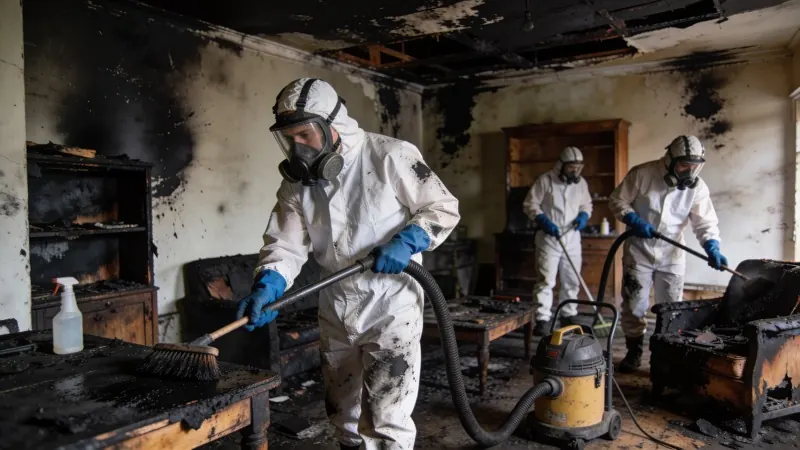
What Fire and Smoke Damage Actually Looks Like
Most people picture fire damage as charred walls and collapsed roofing. That's the dramatic stuff you see on the news. But in residential fires—the kind we respond to every week—the real damage is far more insidious.
The Three-Layer Problem
Every fire-damaged property has three layers of damage happening simultaneously, and missing any one of them leads to problems down the road.
Layer 1: Direct fire damage. This is the structural damage in and around the fire's origin point. Charred framing, melted wiring, destroyed cabinetry, collapsed ceiling assemblies. It's the most visible damage and, in some ways, the most straightforward to address—you demolish what's destroyed and rebuild it.
Layer 2: Smoke and soot damage. This extends far beyond the fire itself. Smoke is a pressurized gas that follows air currents through your entire HVAC system, into closets, behind walls, inside cabinets, and into rooms on the opposite end of the house from the fire. We've pulled smoke residue out of attic insulation in homes where the fire was contained to the kitchen. According to the National Fire Protection Association (NFPA), cooking equipment is the leading cause of home fires, and even a small kitchen fire generates enough smoke to affect an entire house.
Layer 3: Water damage from firefighting. This is the one that catches everyone off guard. A single fire hose delivers 150-250 gallons of water per minute. A 20-minute fire attack puts 3,000-5,000 gallons into your home. Add sprinkler discharge on top of that, and you've got a water damage situation that can rival a major pipe burst or flood event. That water saturates framing, subfloor, insulation, and drywall. If it's not extracted and dried within 24-48 hours, you're looking at mold growth on top of everything else.
We handle all three layers. That's the difference between a full-service fire restoration company and someone who just cleans soot off walls. When you call (844) 426-5801, you get a team that addresses fire, smoke, and water damage as a single coordinated restoration project.
A homeowner in one of our service areas called us after a grease fire in her kitchen. The fire itself was contained to the stovetop and the cabinets above it—maybe 40 square feet of actual fire damage. But by the time we completed our assessment, we found smoke residue in every room of the 2,200-square-foot home, soot coating the inside of every HVAC register, and over 800 gallons of water from the fire department's response pooling in the crawl space below the kitchen. The fire took four minutes. The water and smoke damage took three weeks to fully restore.
Types of Smoke Damage: Why It Matters for Restoration
Not all smoke is the same, and the type of smoke residue in your home determines exactly how it gets cleaned. Get the cleaning approach wrong, and you can permanently damage surfaces or drive smoke particles deeper into porous materials.
Our FSRT-certified technicians identify the smoke type during the initial assessment, because every cleaning method, chemical agent, and equipment decision flows from that classification.
| Smoke Type | Cause | Appearance | Difficulty |
|---|---|---|---|
| Wet smoke | Low-heat, smoldering fires | Thick, sticky, black | Most labor-intensive |
| Dry smoke | High-heat, fast-burning fires | Fine, powdery, light | Easier on surfaces, hides everywhere |
| Protein smoke | Cooking/organic fires | Nearly invisible, yellowish | Deceptive, strong odor |
| Fuel oil soot | Furnace puff-backs | Dense, black, oily | Spreads through entire HVAC |
Wet Smoke Residue
What causes it: Low-heat, smoldering fires that burn slowly. Fires in upholstered furniture, mattresses, and rubber or plastic materials commonly produce wet smoke.
What it looks like: Thick, sticky, black residue with a pungent, acrid smell. Wet smoke has a tar-like consistency and smears when you try to wipe it. It clings to surfaces and is extremely difficult to clean.
Why it's a problem: Wet smoke residue penetrates deeply into porous materials. It smears across surfaces during cleaning if the wrong technique is used. The odor is intense and persistent. Of the four smoke types, wet smoke is generally the most labor-intensive to remediate.
How we clean it: Specialized degreasing agents and chemical sponges. We never dry-wipe wet smoke residue because that grinds the oily particles into the surface. HEPA vacuuming first, then wet cleaning with alkaline-based solutions, followed by sealing with odor-blocking primer before any repainting.
Dry Smoke Residue
What causes it: High-heat, fast-burning fires fueled by paper, wood, and other natural materials.
What it looks like: Fine, powdery, dry residue that's lighter in color than wet smoke. It doesn't smear—it falls off surfaces as a fine dust. It gets into cracks, crevices, electrical outlets, and small openings.
Why it's a problem: Because it's so fine and powdery, dry smoke residue gets absolutely everywhere. It infiltrates HVAC ductwork, settles inside electronics, and fills every crack and joint in your home's construction.
How we clean it: HEPA vacuuming is the primary method—dry sponges and brushing first to avoid pushing residue into surfaces. Air scrubbers with HEPA filtration run continuously during cleaning to capture airborne particles. Ductwork cleaning is almost always required with dry smoke.
Protein Smoke Residue
What causes it: Organic materials burning at low heat—almost always from cooking fires.
What it looks like: Nearly invisible. Protein residue leaves a thin, yellowish-brown discoloration that's easy to miss on visual inspection. But you'll smell it immediately—a strong, rotten organic odor that permeates fabrics, upholstery, and painted surfaces.
Why it's a problem: Protein smoke is deceptive because you can't see it easily. Homeowners sometimes think the fire damage was minor because the surfaces look clean. But the odor is embedded in paint, varnish, fabric, and other porous surfaces.
How we clean it: Enzyme-based cleaners that break down organic compounds. Standard degreasers won't work on protein residue. Every painted surface typically needs cleaning followed by odor-blocking primer and repainting. Soft goods require professional ozone or hydroxyl treatment.
Fuel Oil Soot
What causes it: Furnace puff-backs and fuel oil system malfunctions.
What it looks like: Dense, black, oily residue that's similar to wet smoke but greasier. It coats everything connected to the HVAC system—walls near registers, ceilings, furniture, and curtains.
Why it's a problem: Fuel oil soot is chemically aggressive and can permanently stain porous surfaces if not addressed quickly. It spreads through the entire HVAC system, meaning every room with a register or return is affected.
How we clean it: Chemical degreasing agents specifically formulated for petroleum-based residue. Complete HVAC cleaning including ductwork, air handler, and all registers. All affected textiles require professional cleaning.
Why You Can't DIY Smoke Cleanup
Here's the reality: grab a rag and wipe that soot off your wall, and you've just made the problem worse. Wiping wet smoke residue grinds it into the paint. Using water on dry smoke turns it into a paste that stains permanently. Spraying household cleaners on protein residue sets the stain and locks in the odor.
Professional smoke damage cleanup starts with identifying exactly what burned, what type of residue it produced, and which cleaning protocol matches. Then it requires commercial-grade equipment—HEPA vacuums rated to capture particles down to 0.3 microns, air scrubbers, ultrasonic cleaning baths, and specialized chemical agents you won't find at any hardware store.
Smoke or Fire Damage? Act Now.
Every hour of delay increases damage. Our FSRT-certified team responds 24/7.
📞 Call (844) 426-5801The Fire Damage Restoration Process: Step by Step
Every fire restoration job follows a sequence. Skip a step or do them out of order, and the downstream problems multiply. Here's exactly how we approach fire and smoke damage restoration from the moment you call (844) 426-5801 to the day you move back in.
Step 1: Emergency Board-Up and Property Securing
Timeline: Same day as fire, within hours of your call.
Before any restoration work starts, the property has to be secured. Fires break windows. They burn through roofing. They blow out doors. An unsecured, fire-damaged property is a magnet for weather damage, vandalism, and theft.
Our board-up crew covers every opening—broken windows get plywood, damaged roofing gets heavy-duty tarps, and compromised entry points get temporary security barriers. We also set up temporary fencing when structural damage creates safety hazards.
This step isn't optional. Your insurance company expects you to take reasonable steps to prevent further damage to the property after a loss. Failing to secure the structure can give your carrier grounds to deny claims for secondary damage.
What we use: 5/8-inch CDX plywood for window and door openings, heavy-duty poly tarps with weighted anchors for roof protection, construction fencing for perimeter security.
Step 2: Water Extraction from Firefighting
Timeline: Begins immediately after board-up, typically same day.
This step surprises most homeowners. You just had a fire—why is the restoration company bringing in water extraction equipment? Because the fire department just put thousands of gallons of water into your home. Fire hoses, sprinkler systems, and firefighting foam all leave behind massive amounts of standing water.
If we don't extract it and begin structural drying within 24-48 hours, mold growth starts in those saturated materials—and now you have a fire, smoke, water, and mold problem all at once.
We bring in truck-mounted extractors and submersible pumps to remove standing water. Portable extractors handle carpets and hard-to-reach areas. Thermal imaging cameras identify water behind walls and in ceiling cavities that isn't visible from the surface.
After extraction, we set up industrial LGR dehumidifiers and high-velocity air movers—the same water damage restoration equipment and protocol we use on any water intrusion job. Daily moisture monitoring continues until all materials reach acceptable levels.
Step 3: Smoke and Soot Assessment
Timeline: Day 1-2, concurrent with water extraction.
While the water extraction crew works, our FSRT technicians conduct a complete smoke and soot assessment. This involves testing residue on surfaces throughout the property—not just in the fire area, but in every room.
We use chemical spot-testing to identify the smoke type (wet, dry, protein, or fuel oil) and assess the depth of penetration into different materials. We also evaluate the HVAC system for smoke infiltration, because if smoke entered the ductwork, it will recirculate soot and odor through the entire home every time the system runs.
This assessment determines the entire cleaning plan—which chemicals, which techniques, what order, and how many passes each surface will need. It also establishes which items can be restored and which need to be replaced.
Step 4: Air Quality Stabilization
Timeline: Begins Day 1, continues throughout restoration.
Smoke particles are a health hazard. Soot residue contains carbon monoxide, formaldehyde, acrolein, and other toxic compounds depending on what burned. These particles become airborne when disturbed during cleanup and pose respiratory risks to anyone in the structure.
We set up HEPA air scrubbers immediately—these machines cycle the air in the structure through hospital-grade filters, capturing particulates down to 0.3 microns. They run continuously throughout the entire restoration process. In severe cases, we also deploy negative air machines to create controlled airflow that prevents contaminated air from spreading to unaffected areas.
Step 5: Soot and Smoke Residue Removal
Timeline: Days 2-7, depending on severity and home size.
This is the labor-intensive core of smoke damage cleanup. Every affected surface in the home needs to be cleaned using the method matched to the type of smoke residue identified in Step 3.
Hard surfaces (walls, ceilings, trim):
- HEPA vacuum all surfaces first to remove loose particulate
- Apply chemical cleaning agents matched to residue type
- Hand-clean with sponges, cloths, and agitation tools
- Rinse and inspect
- Apply odor-blocking primer (such as Kilz or Zinsser) to seal any remaining micro-residue before repainting
Structural components (framing, subfloor, sheathing):
- HEPA vacuum exposed framing
- Sand surfaces where char or deep soot penetration exists
- Apply antimicrobial and odor-blocking sealant
- Encapsulate surfaces that will be covered by new drywall
HVAC system:
- Complete ductwork cleaning
- Replace all filters
- Clean air handler, blower, and coils
- Test system before putting it back into service
Step 6: Smoke Odor Elimination
Timeline: Days 5-14, overlapping with cleaning.
Cleaning soot off surfaces removes the visible residue, but smoke odor is a different problem entirely. Smoke particles are microscopic and they embed deep inside porous materials—carpet padding, insulation, fabric, raw wood, concrete. You can't scrub out an odor that's absorbed into the molecular structure of a material.
Thermal fogging: A thermal fogger heats a deodorizing solvent into a dense fog that mimics how smoke traveled through the structure. The fog penetrates the same cracks, cavities, and porous materials that smoke did. The deodorizing agent bonds with smoke molecules and neutralizes them at the chemical level.
Hydroxyl generators: These machines produce hydroxyl radicals—the same molecules that naturally purify outdoor air. Hydroxyls break down volatile organic compounds (VOCs) and odor-causing molecules on contact. Unlike ozone generators, hydroxyl units are safe to use while people are present.
Ozone treatment: Ozone generators produce high concentrations of O3 gas that oxidizes and destroys odor molecules. Ozone is extremely effective for severe smoke odor, but the property must be completely evacuated during treatment. We use ozone as a targeted treatment for the most stubborn cases.
Step 7: Content Cleaning and Pack-Out
Timeline: Begins Day 2-3, can extend weeks for large inventories.
Your furniture, clothing, documents, electronics, family photos, heirlooms—everything inside the home needs to be evaluated, inventoried, and either cleaned or replaced.
Pack-out process:
- We photograph and inventory every item—this documentation is critical for your insurance claim
- Items are categorized: restorable, questionable, and non-restorable
- Restorable items are carefully packed in clean containers
- Packed items transport to our climate-controlled cleaning facility
- Each item is cleaned using the appropriate method—ultrasonic cleaning for hard goods, ozone treatment for soft goods
- Cleaned items are stored until the home is ready for move-back
- Non-restorable items are documented for insurance replacement value
Step 8: Structural Repair and Rebuild
Timeline: 2-8 weeks depending on scope.
Once cleaning is complete and all affected materials have been addressed, the rebuild phase begins. This is general contracting work—framing, drywall, flooring, electrical, plumbing, painting, cabinetry, fixtures—to bring the home back to pre-loss condition.
The rebuild is managed under the same project scope as the restoration, so your insurance claim covers one continuous project from board-up through rebuild. Having one company handle the entire process eliminates gaps, miscommunication, and conflicting scopes.
Step 9: Final Inspection and Move-Back
Timeline: 1-2 days after rebuild completion.
Before we hand you the keys back, we conduct a final walkthrough that includes air quality verification, moisture verification on all materials affected by firefighting water, visual inspection of all cleaned and rebuilt areas, HVAC system testing, pack-back of restored contents to their original locations, and a complete documentation package for your insurance carrier.
Water Damage from Firefighting: The Hidden Second Disaster
This deserves its own section because, in our experience, firefighting water damage is often more extensive than the fire damage itself. And homeowners almost never see it coming.
A standard 1.75-inch fire hose flows at 150-185 gallons per minute. Most residential fire attacks last 15-30 minutes. That's 2,250-5,550 gallons of water, pumped under pressure into your home. Add overhead sprinkler discharge if your home has a suppression system, and the volume climbs further.
Where does all that water go? Everywhere. It pools on floors. It soaks through subfloor into the level below. It saturates wall cavities. It fills crawl spaces and basements. It collects in ceiling assemblies.
Here's what we typically find during the water extraction phase:
- First floor: Standing water 1-3 inches deep across multiple rooms, extending well beyond the fire area
- Subfloor and crawl space: Saturated to capacity, water pooling on vapor barriers or bare earth
- Wall cavities: Soaked insulation, wet studs, water wicking up drywall
- Second floor (if fire was below): Water migrating through ceiling assemblies, pooling on subflooring
- Basement: If the fire was above, water collects in the basement through penetrations, cracks, and gravity
If this water isn't extracted and dried using the same industrial protocols we apply to any water damage restoration project, the consequences are predictable: mold growth within 48 hours, structural weakening from prolonged saturation, and secondary damage that extends the project timeline and cost significantly.
A condo owner called us after a kitchen fire in his second-floor unit. The fire itself was contained to one wall of the kitchen—maybe $8,000 in fire damage. But the fire department's response put so much water into the unit that it cascaded through the floor into the first-floor unit below, which had zero fire damage but $22,000 in water damage to its ceilings, walls, and flooring. The water damage from firefighting cost nearly three times what the fire damage cost.
What Can Be Restored vs. What Needs Replacement
One of the most common questions we hear after a fire: "Can any of this be saved?" The answer depends on the material, the type and severity of smoke exposure, and the level of direct fire or heat damage.
| Material | Verdict | Notes |
|---|---|---|
| Structural wood (framing) | Restorable | Clean, sand, seal if not charred through |
| Drywall (smoke only) | Restorable | Clean, prime with odor-blocker, repaint |
| Hardwood flooring | Restorable | Sand and refinish unless heat-warped |
| Metal surfaces/fixtures | Restorable | Soot sits on surface, cleans well |
| Most personal belongings | Restorable | Ultrasonic cleaning, ozone treatment |
| Melted/heat-warped items | Replace | Can't restore shape or function |
| Insulation | Replace | Absorbs smoke, hidden odor reservoir |
| Severely charred framing | Replace | >50% cross-section burned |
| Porous items with deep smoke | Replace | Mattresses, thick foam, heavy padding |
Structural wood (framing, subfloor): If it's not charred through, wood framing can usually be cleaned, sanded, sealed, and reused. Surface char doesn't compromise structural integrity—the undamaged wood beneath it retains its strength.
Drywall (smoke-damaged, not fire-damaged): Drywall in rooms away from the fire that has smoke residue can often be cleaned, primed with odor-blocking sealer, and repainted. However, drywall that absorbed firefighting water or has char damage gets replaced.
Hardwood flooring: Smoke-damaged hardwood can often be sanded, sealed, and refinished. If heat warped the boards or water from firefighting caused cupping that doesn't flatten during drying, replacement becomes necessary.
Insulation: Fiberglass and cellulose insulation that absorbed smoke or water is non-restorable. It needs to be pulled and replaced. Insulation is one of the most common hidden reservoirs of smoke odor—leave old insulation in place, and the odor never fully goes away.
Health Risks of Smoke Residue
Smoke residue isn't just an aesthetic problem—it's a health hazard that persists until properly remediated. According to the Institute of Inspection, Cleaning and Restoration Certification (IICRC), smoke residue can contain hundreds of toxic compounds depending on the materials that burned.
What's in Smoke Residue
- Natural materials (wood, paper, cotton): Carbon monoxide, carbon dioxide, formaldehyde, acrolein, fine particulate matter
- Synthetic materials (plastics, foam, nylon): Hydrogen cyanide, hydrogen chloride, phosgene, dioxins, furans, isocyanates
- Treated wood and building materials: Arsenic compounds (from treated lumber), lead (from old paint), asbestos fibers (in pre-1980s homes)
- Electronics and appliances: Heavy metals, brominated flame retardants, PCBs from older components
Who's Most at Risk
Children, elderly adults, people with asthma or chronic respiratory conditions, and anyone with compromised immune systems face the highest risk from smoke residue exposure. Even healthy adults can develop respiratory irritation, headaches, and skin reactions from prolonged exposure to soot-contaminated environments.
Professional fire and smoke damage restoration follows IICRC S540 standards, uses air quality testing to verify results, and we don't sign off on a job until particulate levels are within safe thresholds.
Your Safety Comes First
Don't risk your health. Our certified team handles fire, smoke, and water damage start to finish.
📞 Call (844) 426-5801Insurance Coverage for Fire Damage
Fire damage is one of the most comprehensively covered perils in a standard homeowners insurance policy. Unlike water damage, where coverage depends on whether the damage was "sudden" versus "gradual", fire damage has broad coverage that includes the fire itself, smoke damage, and water damage from firefighting efforts.
What's Typically Covered
Dwelling coverage (Coverage A): Structural repairs and rebuild to your home's physical structure. This covers framing, roofing, drywall, flooring, electrical, plumbing, and all permanent fixtures.
Personal property coverage (Coverage C): Repair or replacement of your belongings damaged by fire, smoke, or firefighting water. This includes furniture, clothing, electronics, appliances, and personal items.
Additional living expenses (Coverage D): If your home is uninhabitable during restoration, your policy covers hotel costs, restaurant meals, and other expenses above your normal living costs.
Other structures (Coverage B): Detached garages, sheds, fences, and other structures on your property damaged by the fire.
The Claims Process After a Fire
- Notify your insurance company immediately. Most policies require "prompt" notification—within 24-72 hours.
- Document everything before cleanup begins. We take hundreds of timestamped photographs during our assessment, which become part of your claim file.
- Don't throw anything away. Even obviously destroyed items need to be documented for your claim. We inventory everything.
- Get the property secured. Your policy expects reasonable steps to prevent further damage. Board-up and tarping satisfy this requirement.
- Keep receipts for all out-of-pocket expenses. Hotel bills, meals, clothing purchases—these fall under additional living expenses.
How We Handle Your Insurance Claim
We work with every major insurance carrier in the United States. Our documentation package includes timestamped photographs of all damage, detailed scope of work with line-item costing, smoke and soot assessment reports, moisture readings and drying logs, content inventory with condition assessments, daily progress documentation, equipment placement logs, air quality test results, and final completion documentation.
We bill your insurance company directly. In most cases, you pay only your deductible. Our experience processing fire and water damage insurance claims means we know exactly what adjusters need and how to present documentation that supports full claim approval.
Fire Damage Restoration Cost
Fire and smoke damage restoration costs vary enormously depending on the severity of the fire, the size of the affected area, and the type of materials involved. Here are realistic ranges based on our project history:
| Severity | Cost Range | Typical Scope |
|---|---|---|
| Small (one area) | $3,000-$15,000 | Origin area fire damage, adjacent smoke, moderate water |
| Medium (multiple rooms) | $15,000-$50,000 | Multi-room fire/smoke, significant water, partial rebuild |
| Major (extensive structural) | $50,000-$150,000+ | Whole-house smoke, major rebuild, full pack-out |
| Total loss | Policy limits | Demolition and complete rebuild |
Cost Factors That Affect Your Bill
- Square footage affected by smoke: Smoke cleanup is charged per surface area—more rooms means higher cost
- Type of smoke residue: Wet smoke and fuel oil soot require more labor than dry smoke
- Content volume: More belongings to clean or replace increases the pack-out and content restoration cost
- Water damage extent: More firefighting water means more extraction, drying, and potential demolition
- Structural damage severity: Rebuilding framing and roofing costs significantly more than replacing drywall and paint
- Age of home: Older homes may have asbestos, lead paint, or outdated wiring that requires special handling
The majority of fire damage restoration is covered by homeowners insurance. We bill your carrier directly and handle all documentation. For most homeowners, the out-of-pocket cost is limited to their deductible.
Why Choose Water Damages Pros for Fire and Smoke Damage Restoration
IICRC FSRT-Certified Technicians: Our fire restoration crews hold the IICRC Fire and Smoke Restoration Technician (FSRT) certification—specialized training in smoke behavior, soot chemistry, cleaning methods for each smoke type, odor elimination technology, and fire damage assessment. Pair that with our Water Damage Restoration (WDR) and Applied Structural Drying (ASD) certifications, and our crew handles all three layers of fire damage with the same level of professional expertise.
One Company, Entire Project: Fire damage means fire cleanup, smoke cleanup, water damage restoration, content cleaning, and structural rebuild. We handle the entire process from board-up to rebuild to move-back. One project manager. One insurance scope. One company accountable for the result.
24/7 Emergency Response: Fire doesn't wait for business hours, and neither do we. Call (844) 426-5801 any hour of the day or night. The faster we respond, the more we can save.
Direct Insurance Billing: We work with every major insurance carrier. We document the damage to the standard adjusters require. We submit the scope and bill your insurance directly. In most cases, your only out-of-pocket cost is your deductible.
Take the Next Step
A fire changes everything in an instant. But the damage doesn't stop when the flames go out—smoke residue continues to corrode and stain surfaces. Firefighting water is soaking deeper into your structure right now. Soot particles are settling into HVAC ductwork and every porous surface in the house.
Every hour matters. The sooner a professional fire and smoke damage restoration team is on-site, the more we can save—structurally, personally, and financially.
Here's what happens when you call (844) 426-5801:
- We dispatch a crew immediately—24/7, any day of the year.
- Board-up and property securing begin within hours.
- Water extraction from firefighting starts the same day.
- Our FSRT-certified technicians assess all fire, smoke, and water damage.
- You receive a detailed scope of work and timeline.
- We contact your insurance company and begin the claims process.
- Restoration begins—from cleanup through complete rebuild.
- You move back into your home, restored to pre-loss condition.
You don't have to figure this out alone. We've restored hundreds of fire-damaged properties, and we'll walk you through every step.
Call (844) 426-5801 now. We're standing by.
Frequently Asked Questions About Fire and Smoke Damage Restoration
Timeline depends on severity. Board-up happens the same day. A small, contained fire with moderate smoke damage typically takes 2-4 weeks for complete restoration including cleanup, odor removal, and repairs. A major fire affecting large portions of the home can take 2-6 months including structural rebuild. Water extraction from firefighting begins immediately, and structural drying takes 3-5 days.
Yes, fire damage is one of the most comprehensively covered perils under standard homeowners insurance policies. Coverage typically includes structural repair (Coverage A), personal property replacement (Coverage C), additional living expenses while your home is uninhabitable (Coverage D), and damage caused by firefighting efforts including water damage. We bill your insurance directly and handle all claim documentation.
Many smoke-damaged items and surfaces can be professionally restored. Hard surfaces, metal fixtures, wood furniture, and most clothing can be cleaned and deodorized successfully. Drywall in rooms away from the fire can often be cleaned, sealed, and repainted. However, heavily saturated porous items like mattresses, some upholstered furniture, and insulation usually need replacement. Our technicians evaluate every surface and item individually.
Yes. Smoke residue contains toxic compounds including formaldehyde, acrolein, and fine particulate matter. If synthetic materials burned, the residue may also contain hydrogen cyanide, hydrogen chloride, and other hazardous chemicals. Soot particles (PM2.5 and smaller) penetrate deep into lungs and can trigger respiratory distress, headaches, and eye irritation. Children, elderly adults, and those with asthma or chronic respiratory conditions face the highest risk. Don't occupy a smoke-damaged home until professional remediation and air quality verification are complete.
Fire hoses deliver 150-250 gallons of water per minute. A typical 20-minute fire response puts 3,000-5,000 gallons into a home. Add sprinkler discharge and the volume increases further. This water saturates framing, subfloor, insulation, and drywall—and if it's not extracted within 24-48 hours, mold growth begins on top of your fire and smoke damage. That's why professional fire restoration always includes water extraction and structural drying.
Don't re-enter the structure until the fire department has cleared it as safe. Once cleared, contact your insurance company within 24 hours—most policies require prompt notification. Don't attempt to clean soot or smoke damage yourself. Improper wiping spreads residue and can cause permanent staining. Don't turn on the HVAC system, because it will circulate smoke particles through every room. Call a professional fire restoration company to secure the property and begin assessment.
We use three primary odor elimination technologies, often in combination. Thermal fogging heats a deodorizing solvent into a fog that penetrates the same porous materials smoke did, neutralizing odor molecules at the chemical level. Hydroxyl generators produce radicals that break down volatile organic compounds and are safe for use in occupied spaces. Ozone generators destroy stubborn odor molecules through oxidation but require complete evacuation during treatment. Severe cases require multiple cycles with all three technologies.
Wet smoke comes from low-heat, smoldering fires and produces thick, sticky, black residue that smears when wiped and penetrates deeply into porous surfaces. It's more difficult and labor-intensive to clean. Dry smoke comes from high-heat, fast-burning fires and produces fine, powdery residue that's easier to clean from flat surfaces but gets into every crack, crevice, and HVAC duct. The cleaning chemicals, techniques, and equipment are different for each type.
In most cases, no. Smoke residue poses active health risks, and the restoration process involves demolition, chemical cleaning agents, industrial equipment, and temporary utility disruptions. Your homeowners insurance typically covers additional living expenses (Coverage D)—hotel costs, meals, and temporary housing—while your home is being restored. Duration ranges from 2 weeks for small fires to several months for major restoration.
Costs vary by severity. A small, contained fire with moderate smoke damage: $3,000-$15,000. A medium fire affecting multiple rooms: $15,000-$50,000. Major structural fires: $50,000-$150,000+. The largest cost factors are square footage of smoke damage, volume of content needing cleaning or replacement, extent of firefighting water damage, and severity of structural rebuild required. Homeowners insurance covers the majority of fire restoration costs, and we bill your carrier directly.