Why Speed Matters for Water Damaged Hardwood
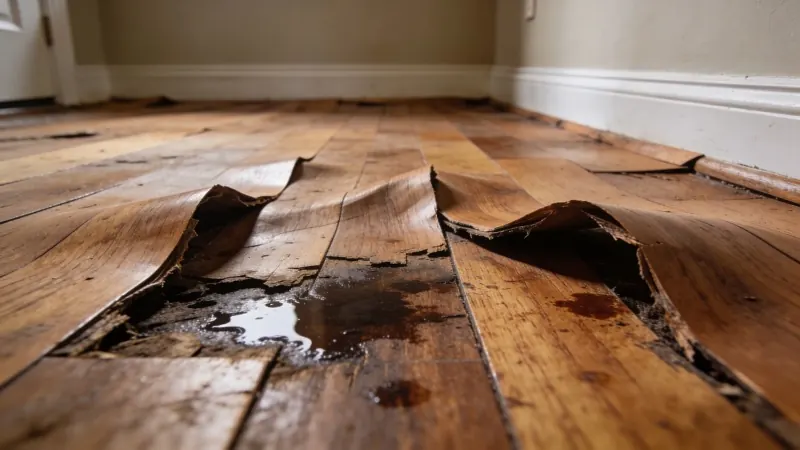
You walk into your dining room and the hardwood floor feels wrong under your feet. The boards aren't flat anymore. The edges are raised, the surface is wavy, and in the worst spots near the kitchen doorway, you can feel ridges where the boards have lifted up. Somewhere underneath, moisture has been working on your hardwood, and now you're staring at cupped, warped planks wondering whether the entire floor needs to be ripped out.
Water damaged hardwood floors are one of the most stressful damage types we respond to because the stakes are high. Hardwood is one of the most expensive flooring materials in a home, and homeowners are understandably anxious about whether their floors can be saved. In 15 years of restoration work, we've dried and saved hundreds of hardwood floors that looked like they were beyond help. We've also seen floors where the homeowner waited too long or tried to DIY the drying, and what could have been a refinishing job turned into a full replacement.
Here's the honest truth about water damaged hardwood floors: the outcome depends almost entirely on two factors. How quickly professional drying starts, and whether the right equipment is used. A fan blowing across the surface of wet hardwood does almost nothing. Specialty floor drying mats that pull moisture through the wood grain, combined with controlled dehumidification, are what save hardwood floors.
This guide covers everything you need to know about what happens to hardwood when it gets wet, the difference between cupping and buckling and crowning, how professional drying works on hardwood specifically, and when refinishing is enough versus when replacement is the only option. If you have water on your hardwood floors right now, call (844) 426-5801 and get our crew on site within 60 minutes. The first 24 hours are the difference between saving the floor and replacing it.
What Water Does to Hardwood: The Science Behind Cupping, Crowning, and Buckling
Wood is hygroscopic. That means it absorbs and releases moisture from its environment constantly. Your hardwood floor is in a state of equilibrium with the humidity in your home. When water gets introduced underneath or on top of the floor, that equilibrium gets disrupted, and the wood reacts physically.
Understanding these reactions is important because each one tells us something different about where the moisture is, how long it has been there, and what the likely outcome will be.
Cupping
Cupping is the most common reaction we see. The edges of each board rise higher than the center, creating a concave or "dished" profile across the face of the board. Run your hand across a cupped floor and you feel the ridges where board edges meet.
Cupping happens when the bottom of the board is wetter than the top. The bottom face absorbs moisture from a wet subfloor, expands, and pushes the edges of the board upward. The top face, protected by the finish, stays relatively dry and doesn't expand at the same rate.
Here's what most people don't realize about cupping: it's not necessarily permanent damage. Cupping is a symptom of a moisture imbalance, not a structural failure of the wood. If we dry the subfloor properly and allow the bottom of the board to release its excess moisture, many cupped boards will flatten on their own over the course of 1 to 3 weeks after the subfloor reaches target moisture levels.
The critical mistake we see homeowners and even some flooring contractors make is sanding a cupped floor before it's fully dry. When the board is cupped, the edges are high and the center is low. If you sand it flat while it's still cupped, you remove material from the high edges. When the moisture finally equalizes and the board tries to flatten, the edges drop back down but the center, which you didn't sand, is now higher. The result is crowning, and now you need to sand again or replace the boards.
Crowning
Crowning is the opposite of cupping. The center of the board is higher than the edges, creating a convex profile. Crowning happens in two situations.
First, as mentioned above, it happens when someone sands a cupped floor before it's dry. This is the more common scenario we see, and it's avoidable.
Second, crowning can occur when the top surface of the board absorbs more moisture than the bottom. This is less common with water damage events but does happen when significant water pools on the surface and the finish has cracks, wear patterns, or open joints that let water penetrate the top face while the subfloor remains relatively dry.
Crowning from premature sanding is particularly frustrating because it means the floor was savable, the drying worked, but the sanding was done too early. This is why we insist on moisture verification with calibrated meters before any sanding happens. The floor must reach its target moisture content throughout the full thickness of the board and the subfloor before anyone picks up a drum sander.
Buckling
Buckling is the most severe reaction and the most alarming to see. Boards actually lift off the subfloor, tenting upward and sometimes pulling their nails or staples out. A buckled hardwood floor looks like a small mountain range running across the room.
Buckling happens when the expansion from moisture absorption exceeds the space available. Hardwood floors are installed with an expansion gap along the walls, typically 1/2 inch to 3/4 inch, covered by the baseboard. When the entire floor absorbs enough moisture to expand beyond that gap, the boards have nowhere to go but up.
Buckled boards are under significant stress. The nails or staples that held them to the subfloor have pulled through or pulled out. The tongue-and-groove joints may have cracked.
In our experience, sections of a floor that have fully buckled usually need replacement. The boards themselves may not be structurally compromised, but the fastener holes are enlarged, the joints are damaged, and the boards won't lay flat again even after drying.
Limited buckling in a small area, where just a few boards tented up, sometimes resolves after drying and can be re-secured to the subfloor. But widespread buckling across a room is almost always a replacement situation.
Angela's kitchen flooding. Angela had a dishwasher supply line fail while she was at work. By the time she got home 8 hours later, water had been running across her oak hardwood kitchen floor the entire day. The floor was cupped throughout the kitchen, and near the dishwasher where the water was deepest, several boards had buckled and pulled their staples.
We extracted the remaining water, removed the baseboards, and deployed floor mat drying systems across the kitchen. After 6 days of monitored drying, the hardwood reached 9% and the subfloor reached 11%. Most of the cupped boards had flattened substantially. The 6 buckled boards near the dishwasher didn't recover. We replaced those 6 boards with matching oak, wove them into the existing floor, and refinished a 4-foot section to blend. Angela kept roughly 90% of her original kitchen floor.
How Professional Hardwood Floor Drying Works
Drying hardwood floors is a specialized process. It isn't the same as drying drywall or carpet. Hardwood requires controlled, even moisture removal that brings the wood back to equilibrium without causing additional stress that leads to cracking, checking, or further warping.
Floor mat drying systems
The primary tool for drying hardwood floors is a specialty floor drying mat system. The two most common systems in the industry are the Dri-Eaz FloorMat and the Injectidry HP-60 floor panels.
These systems work by creating a sealed chamber on top of the hardwood surface. The mat covers the wet flooring, and a vacuum pulls air through the mat and across the wood surface. This draws moisture out of the wood grain from above. Heated air from the vacuum process accelerates evaporation at the wood surface.
The advantage of mat drying over conventional air movers is control. An air mover pointed at hardwood dries the top surface fast, but the bottom of the board, the subfloor, and the areas between boards dry much slower. This uneven drying creates or worsens cupping. Floor mat systems apply consistent, even drying across the entire surface, pulling moisture through the wood grain at a controlled rate.
We typically cover as much of the affected area as possible with floor mats. In a kitchen with 200 square feet of wet hardwood, we might deploy 8 to 12 floor mats covering the majority of the surface. The mats run continuously, and we monitor moisture readings at multiple points across the floor daily.
Drying from below
Whenever we can access the underside of the floor, whether through a basement or crawl space, we position drying equipment below as well. Air movers directed at the underside of the subfloor accelerate drying from the bottom. This is critical because the bottom of the hardwood board and the subfloor are typically the wettest components, and they are the hardest to dry from above.
When we can dry from both above (floor mats on the hardwood surface) and below (air movers on the subfloor underside), drying time drops significantly and the results are more uniform. A floor that might take 7 to 10 days to dry from above only can often reach target moisture in 5 to 6 days with dual-side drying.
Subfloor considerations
The subfloor underneath your hardwood matters as much as the hardwood itself. Most hardwood floors in residential construction are installed over 3/4-inch plywood or 3/4-inch OSB subfloor panels.
Plywood subfloor handles water better than OSB. The cross-laminated layers resist swelling and delamination up to a point. Plywood that was wet briefly and dried properly usually survives structurally. Extended soaking can still cause delamination of the outer veneer layers.
OSB subfloor is more vulnerable. OSB swells when it absorbs water, and unlike plywood, it doesn't return to its original dimensions after drying. Swollen OSB creates humps under the hardwood that prevent the finished floor from laying flat.
We check subfloor condition carefully after drying. Minor swelling can sometimes be sanded down. Significant swelling means that section of subfloor needs replacement before the hardwood goes back down or new hardwood is installed.
Concrete subfloor is common in slab-on-grade construction. Hardwood installed over concrete uses either a glue-down method or a floating method over a moisture barrier. Water damage on concrete subfloors creates a trapping situation because concrete holds moisture for a very long time, and the moisture barrier between the concrete and the hardwood, if present, can trap water in both directions. Drying hardwood over concrete subfloor is the slowest scenario we deal with, often taking 7 to 10 days or more.
Moisture content targets
We don't declare a hardwood floor "dry" based on how it feels or looks. We use calibrated pin-type moisture meters to measure the moisture content of the hardwood at multiple points across the affected area, and we compare those readings to a dry reference, an unaffected area of the same flooring species and thickness.
The industry standard from IICRC S500 is that the affected material should be within 2 to 4 percentage points of the dry reference reading. If your dry reference reads 7%, the wet hardwood needs to reach 9% to 11% before it's considered at dry standard.
We also measure the subfloor independently. The subfloor has its own target, and it can lag behind the hardwood because moisture wicks downward. A hardwood floor that reads 9% while the subfloor underneath still reads 18% isn't done drying. That subfloor moisture will migrate back up into the hardwood and restart the cupping process.
Marcus's living room after the upstairs bathroom overflow. A toilet supply line failed in the upstairs bathroom while Marcus was at work. Water ran for 5 hours, flooded the bathroom, seeped through the subfloor, and came through the first-floor ceiling onto the living room hardwood floor below. When we arrived, we had two problems: ceiling water damage on the first floor and wet hardwood across a 300-square-foot living room.
We deployed 12 floor mats on the hardwood surface, 3 LGR dehumidifiers, and positioned air movers underneath from the basement. By day 7, hardwood was at 8% and subfloor at 10%. We advised Marcus to wait 3 weeks before making any sanding decisions. By week 2, the floor had flattened to the point where he chose not to refinish. He saved his entire living room floor.
Water on Your Hardwood Floors?
Our IICRC-certified technicians arrive within 60 minutes with specialty floor mat drying systems.
📞 Call (844) 426-5801Refinishing vs Replacement: The Decision Framework
This is the question every homeowner with water damaged hardwood floors wants answered. Here's the framework we use after 15 years of making this call on hundreds of floors.
When refinishing works
Refinishing is the right option when:
- The floor dried properly and cupping has resolved or is minor. Boards that are within 1/16 inch of flat across their width can be sanded level.
- The boards have sufficient thickness remaining. Solid 3/4-inch hardwood can typically be sanded 3 to 4 times over its lifespan. If the floor has never been refinished, there's plenty of material to work with.
- No permanent discoloration. Water staining on the surface can usually be sanded out. Dark black stains from tannin reaction with iron or from contaminated water penetrate deeper and may not sand out completely.
- The subfloor is structurally sound. Even if the hardwood is in great shape, a damaged subfloor underneath creates an unstable base.
- The wood isn't delaminated. Solid hardwood doesn't delaminate. But engineered hardwood can, and if the wear layer is separating from the plywood core, sanding will tear through the veneer.
Refinishing water damaged hardwood typically costs $3 to $8 per square foot, which includes sanding, staining (if desired), and applying new polyurethane finish. For a 200-square-foot room, that's $600 to $1,600. Compare that to replacement and the financial incentive to save the floor is obvious.
When replacement is necessary
Replacement is needed when:
- Boards are buckled and won't re-secure to the subfloor. Once nails or staples have pulled through, the holes are oversized and the same board can't be fastened in the same location.
- Cupping or crowning persists after the floor has reached target moisture content and equalized for 2 to 3 weeks.
- Black staining extends deep into the wood grain. If sanding to that depth would compromise the board thickness above the tongue, the board needs to go.
- The wood is soft, punky, or has started to rot. Prolonged water exposure can break down the wood fibers.
- The subfloor is damaged beyond repair. Swollen OSB or delaminated plywood means the hardwood has to come up anyway for subfloor replacement.
- Engineered hardwood has delaminated. Once the wear layer separates from the core, the plank is done. Engineered hardwood replacement runs $8 to $15 per square foot installed.
Partial replacement and weaving
When damage is limited to a section of the floor, we don't have to replace the entire room. Partial replacement involves removing the damaged boards and "weaving" new boards into the existing floor. The new boards are face-nailed and the nail holes are filled to match.
The challenge with partial replacement is matching. Finding the same species, width, thickness, and grade is essential. A blending refinish, where we sand and refinish the replacement area plus 2 to 3 feet of the surrounding original floor, helps the new and old wood blend together.
Solid Hardwood vs Engineered Hardwood: Different Vulnerabilities
Not all hardwood responds to water the same way. Understanding what you have affects the drying approach and the likely outcome.
| Factor | Solid Hardwood (3/4") | Engineered Hardwood |
|---|---|---|
| Thickness | 3/4-inch single piece | 1/8" to 1/4" veneer over plywood/HDF core |
| Water resilience | Higher -- absorbs and releases moisture evenly | Lower -- adhesive layers delaminate when saturated |
| Cupping behavior | Cups more dramatically, but recovers well with proper drying | More dimensionally stable, but delamination is irreversible |
| Sanding tolerance | 3 to 4 full sandings over lifespan | 1 to 2 light sandings maximum |
| Delamination risk | None -- single piece of wood | High -- layers separate when wet |
| Typical drying time | 5 to 7 days with floor mats | 3 to 5 days, but damage may already be done |
| Replacement cost | $8 to $15/sq ft installed | $6 to $14/sq ft installed |
| Best recovery scenario | Dried within 24 hours, cupping resolves, refinish | Dried within hours, no edge swelling or bubbling |
Solid hardwood (3/4-inch)
Solid hardwood is a single piece of wood, typically 3/4-inch thick. Oak, maple, cherry, walnut, and hickory are the most common species in residential flooring. Solid hardwood is more resilient against water damage than engineered hardwood for several reasons:
- It absorbs and releases moisture more evenly because the grain runs in one direction throughout the full thickness.
- It has enough material thickness to tolerate cupping and sanding.
- It doesn't delaminate because there's nothing to delaminate. It's a single piece.
- It can be refinished multiple times over its lifespan.
The weakness of solid hardwood is its tendency to move more aggressively with moisture changes. It cups and buckles more dramatically than engineered hardwood because the full thickness is expanding in the same direction.
Engineered hardwood
Engineered hardwood has a thin veneer of real hardwood (typically 1/8 inch to 1/4 inch) bonded to a plywood or HDF (high-density fiberboard) core. The cross-laminated core is more dimensionally stable than solid wood, which is why engineered hardwood is popular in areas with high humidity or over concrete subfloors.
The problem with water damage is the adhesive bonding those layers together. When water penetrates through the veneer into the core, the layers begin to separate. Edge swelling is the first sign. Then the veneer starts bubbling or lifting away from the core. Once delamination begins, it's irreversible. The plank has to be replaced.
Engineered hardwood also has limited sanding tolerance. The wear layer is the only part that can be sanded, and it's thin. Some engineered products have a 1/8-inch wear layer that can tolerate one light sanding. Others have a 1/4-inch layer that can handle two sandings. But you can't aggressively sand cupping out of engineered hardwood the way you can with solid 3/4-inch.
Dana and Steve's refinished basement. They had engineered hickory hardwood installed in their finished basement. Their sump pump failed during a spring rainstorm, and 2 inches of water sat on the engineered hardwood for about 12 hours. Within 48 hours of drying, delamination was visible on roughly 60% of the floor. We could save about 40% where exposure was shallower. The lesson: engineered hardwood in moisture-prone areas needs a fast response. Twelve hours of standing water was enough to cause irreversible delamination on a majority of the floor.
Common Causes of Water Damage to Hardwood Floors
Certain water damage scenarios are particularly dangerous for hardwood floors because of the volume of water involved or the duration of exposure.
Appliance failures
Dishwasher supply lines, refrigerator water lines, and washing machine hoses are the top three appliance-related causes of hardwood floor damage. These failures often happen while no one is home, which means the water runs for hours. A dishwasher supply line releasing water for 8 hours onto a hardwood kitchen floor can saturate the wood deeply enough that cupping begins within the first 2 hours and buckling starts by hour 6. For more on washing machine specific scenarios, see our washing machine flood guide.
Slow leaks from below
On second floors or upper levels, hardwood damage sometimes comes from below. A slow plumbing leak under the subfloor can wick moisture up through the subfloor and into the bottom of the hardwood. This type of damage is sneaky because there's no visible water on the floor surface. The first sign is usually cupping that seems to appear from nowhere, with no obvious water event.
Overwatering and spills
Not all hardwood water damage is catastrophic. Chronic overwatering of potted plants sitting on hardwood creates localized damage. Large spills that aren't cleaned up promptly can cause staining and finish damage. Pet urine, which is both acidic and moisture-rich, causes dark staining that penetrates deep into the wood grain.
Water from below the subfloor
Groundwater intrusion through a basement slab or crawl space moisture can cause chronic hardwood floor problems. The moisture migrates upward through the concrete, through the subfloor, and into the bottom of the hardwood. The floor cups and the homeowner doesn't understand why because they never had a flood or a leak. This isn't a water damage event. It's a moisture management problem that needs to be solved at the source.
Hardwood Floor Water Damage Costs: Realistic Numbers
The cost of dealing with water damaged hardwood floors varies significantly based on whether the floor can be saved or needs replacement.
Drying costs
Professional hardwood floor drying with floor mat systems: $1,500 to $3,500 depending on the affected area and the number of mat systems and dehumidifiers deployed. This includes daily monitoring, moisture documentation, and the drying equipment rental for the typical 5-to-7-day process.
Refinishing costs
Sanding and refinishing hardwood floors: $3 to $8 per square foot. The range depends on the condition of the floor after drying, how many coats of finish are applied, whether stain is involved, and regional labor rates.
- 200-square-foot room: $600 to $1,600
- 500-square-foot main floor: $1,500 to $4,000
Replacement costs
Full hardwood floor replacement: $8 to $15 per square foot installed, including materials, subfloor preparation, installation, and finishing.
- 200-square-foot room (solid oak): $1,600 to $3,000
- 500-square-foot main floor (solid oak): $4,000 to $7,500
- Engineered hardwood replacement: $6 to $14 per square foot depending on product quality
Subfloor replacement (when needed)
If the subfloor is damaged and needs replacement: $2 to $5 per square foot for materials and labor to remove the old subfloor and install new 3/4-inch plywood.
For comprehensive pricing information, see our water damage restoration cost guide.
What to Do Immediately If Water Is on Your Hardwood Floor
Speed determines outcome. Here's what to do before our crew arrives:
- Stop the water source. Shut off the water main, turn off the appliance, or stop the leak however you can.
- Remove standing water. Use towels, a mop, or a wet-dry vacuum to get as much water off the surface as quickly as possible. Don't use a steam mop.
- Remove area rugs and mats from the floor. Rugs trap moisture against the hardwood and accelerate absorption.
- Remove furniture from the wet area. Furniture legs sitting on wet hardwood create concentration points where moisture penetrates faster, and metal furniture legs can leave rust stains.
- Don't turn on floor heating. Heated floors accelerate drying of the top surface while the bottom stays wet, which worsens cupping.
- Don't point fans directly at the hardwood. This causes the top surface to dry faster than the bottom, which drives cupping. Wait for professional floor drying equipment.
- Call (844) 426-5801. The sooner professional drying equipment is on that floor, the better the odds of saving it.
For more on immediate steps after water damage, see our water damage cleanup guide.
Every Hour Counts for Your Hardwood
IICRC-certified technicians with specialty floor mat drying systems. On site within 60 minutes.
📞 Call (844) 426-5801Frequently Asked Questions About Water Damaged Hardwood Floors
It depends on how quickly drying begins and the severity of the damage. Hardwood that was wet for less than 24 hours and dried properly with professional equipment can often be saved. The floor may cup during drying but flatten as it reaches equilibrium. If boards remain warped, buckled, or delaminated after reaching target moisture content, those sections need replacement. Speed of response is the single biggest factor in saving hardwood floors.
With professional floor mat drying systems and industrial dehumidifiers, hardwood floors typically reach acceptable moisture levels in 5 to 7 days. Thicker planks, like 3/4-inch solid hardwood over a concrete subfloor, can take 7 to 10 days. Without professional equipment, hardwood floors can take weeks to dry and will likely sustain permanent damage because the slow drying allows uneven moisture release, which causes cupping and warping.
Cupping is when the edges of a hardwood board rise higher than the center, creating a concave shape. It happens because the bottom of the board absorbs moisture faster than the top. Cupping during the drying process is normal and expected. Many cupped boards will flatten on their own as moisture equalizes. If cupping persists after the floor reaches its target moisture content, light sanding and refinishing can restore a flat surface, as long as enough material thickness remains.
If the boards dried properly and the cupping resolved or is minor enough to sand flat, refinishing is the better option. It costs $3 to $8 per square foot compared to $8 to $15 per square foot for replacement including materials and labor. Replace when boards remain buckled, are delaminated, show permanent staining that sanding can't reach, or have been previously refinished so many times that insufficient thickness remains for another sanding.
Not always. Short-term water exposure with rapid professional drying often results in full recovery. Long-term exposure, standing water for days, or contaminated water typically cause permanent damage. Black staining from tannin reaction, delamination of the wood layers, and severe buckling where boards tent up off the subfloor are usually permanent. The key factor is how fast drying begins after the water event.
Professional drying of hardwood floors using floor mat systems typically costs $1,500 to $3,500 depending on the affected area. If refinishing is needed after drying, add $3 to $8 per square foot. Full replacement of water damaged sections runs $8 to $15 per square foot including materials, installation, and finishing. A 200-square-foot kitchen floor replacement could cost $2,000 to $3,000 total. See our cost guide for complete pricing details.
Sometimes, but only if moisture is removed properly from below the floor. Cupping occurs because the bottom of the board is wetter than the top. As the subfloor dries and moisture equalizes through the board, many cupped boards do flatten. This process takes 1 to 3 weeks after the subfloor reaches its target moisture level. Boards that remain cupped after full equalization won't flatten further without sanding. Never sand cupped floors before they are fully dry because you'll create crowning when the remaining moisture releases.
Engineered hardwood is more vulnerable to water damage than solid hardwood because the cross-laminated plywood core delaminates when saturated. Short exposure with fast drying sometimes allows engineered planks to survive. Once you see edge swelling, surface bubbling, or layers separating, those planks need replacement. Engineered hardwood can't be sanded as aggressively as solid hardwood, so cupping corrections through sanding are more limited.
Yes, and this is one of the most important steps that gets overlooked. Removing baseboards allows air circulation along the expansion gap at the wall perimeter. It also exposes the edge of the subfloor and the bottom of the drywall for drying and inspection. Trapped moisture behind baseboards keeps the floor perimeter wet and prevents even drying. Our crews remove baseboards as a standard part of hardwood floor drying.
Save Your Hardwood Floors Before Permanent Damage Sets In
Water damaged hardwood floors can often be saved, but the window is narrow. Every hour that water sits on or under your hardwood, the wood absorbs more moisture, cupping worsens, and the odds of needing full replacement go up. Professional floor mat drying systems are the difference between a refinishing job and a $10,000 replacement.
If you have water on your hardwood floors, don't rely on fans and hope. Call (844) 426-5801 now. Our IICRC-certified technicians arrive within 60 minutes with specialty hardwood drying equipment. We monitor moisture content daily until your floors reach dry standard, and we document everything for your insurance claim.
Your hardwood floors are one of the most valuable features in your home. Let us give them the best chance at recovery. Call today or learn more about our full structural drying services.