You notice a dark patch spreading across the drywall in your basement. The musty smell has been getting worse for weeks. Or maybe your home inspector just called with bad news during a sale. Whatever brought you here, you need answers, not a sales pitch.
In 15 years of mold remediation work, our IICRC-certified technicians have treated mold in thousands of homes across the country. We've opened up walls that looked perfect from the outside and found Stachybotrys colonies covering every stud bay. We've also inspected homes where homeowners panicked over bathroom caulk mildew that took 20 minutes to clean.
The point is this: mold problems range from minor surface issues to serious structural contamination, and the right response depends entirely on what you're actually dealing with. This page covers exactly what professional mold remediation involves, what it costs, what types of mold we encounter most often, and when you genuinely need professional help versus when you can handle it yourself.
If you already know you have a mold problem and want a professional assessment, call (844) 426-5801. Our crew will inspect the affected area, collect samples if needed, and give you a straight answer on what needs to happen next.
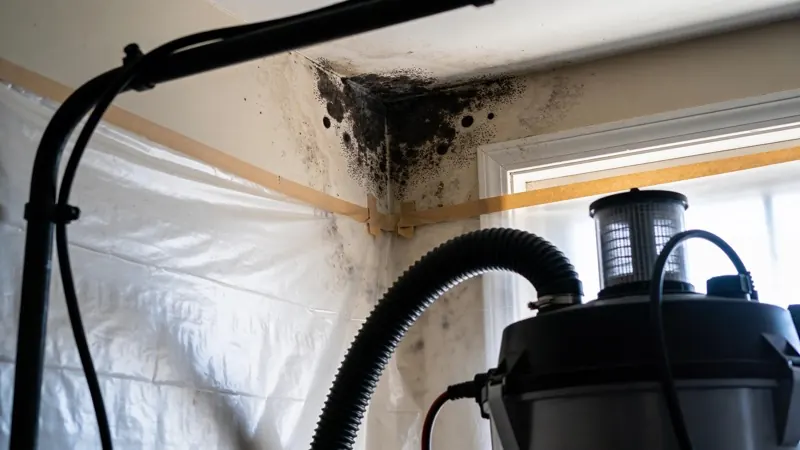
What Mold Remediation Actually Means (And Why It Matters)
A lot of homeowners search for "mold removal" when what they really need is mold remediation. The distinction matters because it affects what you're paying for and whether the problem actually gets solved.
Mold removal means physically taking mold off a surface. You can buy a bottle of concrobium at the hardware store and wipe mold off a bathroom wall. That's mold removal.
Mold remediation is the full professional process governed by IICRC S520 standards. It includes inspection and testing, containment of the affected area, HEPA air filtration, removal of contaminated materials, antimicrobial treatment of structural components, post-remediation clearance testing, and addressing the moisture source that caused the growth in the first place. Remediation doesn't just make the mold disappear from view. It restores the indoor environment to safe conditions and prevents the mold from returning.
Here's why that matters in practical terms. We responded to a home in 2024 where the homeowner had paid a handyman to "remove" black mold from a basement wall. The handyman scraped the visible mold off the drywall surface, applied bleach, and painted over it. Three months later, the mold was back, worse than before.
When we opened the wall, the entire stud cavity was colonized. The backside of the drywall, the insulation, and the studs all had active Stachybotrys growth. The handyman had addressed what was visible and left the actual problem untouched.
That homeowner ended up paying twice — once for the failed removal and once for proper remediation. The remediation job cost $6,800 because the contamination had spread during those three months.
Professional mold remediation follows ANSI/IICRC S520 standards for a reason. The process is designed to contain the contamination, prevent cross-contamination to clean areas, remove the mold and the materials it has colonized, and verify through testing that the space is safe for occupancy.
If you're dealing with mold in your home and want it handled correctly the first time, call (844) 426-5801 to schedule a mold inspection.
Common Types of Mold We Find in Homes
Not all mold is the same. Different species behave differently, grow in different conditions, and pose different health risks. Here are the types our technicians encounter most frequently during water damage restoration projects and dedicated mold inspections.
Stachybotrys Chartarum (Black Mold)
This is the one everyone worries about, and for good reason. Stachybotrys produces mycotoxins, specifically satratoxins, that can cause serious respiratory problems with prolonged exposure. It appears as a dark black or dark green growth with a slimy or wet texture when actively growing.
Stachybotrys needs consistently high moisture to thrive. We find it after sustained water intrusion: behind walls with long-term plumbing leaks, in basements with chronic moisture problems, in crawl spaces with standing water, and in homes where water damage went untreated for weeks or months.
The CDC recommends that Stachybotrys be removed by trained professionals. Our protocol for Stachybotrys remediation includes full containment with negative air pressure, HEPA filtration, Tyvek suits and P100 respirators for our crew, complete removal of all colonized materials, and pre- and post-remediation air quality testing.
Aspergillus
Aspergillus is the most common indoor mold genus, with over 180 species. Colors range from green to yellow to white to brown. You'll find it on walls, in HVAC ductwork, on food, and on virtually any organic surface with enough moisture.
Most Aspergillus species are relatively harmless to healthy individuals. But Aspergillus fumigatus and Aspergillus niger can cause aspergillosis, a lung infection, in people with weakened immune systems or pre-existing lung conditions. We find Aspergillus in nearly every post-water-damage inspection.
Penicillium
Penicillium appears as blue, green, or white fuzzy growth, often on water-damaged building materials, wallpaper, carpet, and insulation. It spreads rapidly and produces a strong musty odor. In our experience, Penicillium is often the first genus to colonize after a water damage event because it thrives at lower moisture levels than Stachybotrys.
Cladosporium
Cladosporium is an olive-green to brown or black mold that grows on both porous and non-porous surfaces. It can grow at cooler temperatures than most other molds, which is why we frequently find it in basements, attics, and HVAC systems.
Chaetomium
Chaetomium is a cotton-like mold that starts white and darkens to gray, brown, or black over time. It has a distinctive musty smell. We commonly find it on severely water-damaged drywall. Chaetomium and Stachybotrys often colonize the same materials, so where you find one, look for the other.
Alternaria
Alternaria appears as dark brown or black growth with a velvet-like texture. It's the most common allergenic mold and a known trigger for asthma attacks. We find it in bathrooms, under sinks, around leaking windows, and anywhere with chronic dampness.
Common Mold Types at a Glance
| Mold Species | Appearance | Typical Locations | Health Risk Level |
|---|---|---|---|
| Stachybotrys (black mold) | Dark black/green, slimy | Behind walls, basements, crawl spaces | High (mycotoxins) |
| Aspergillus | Green, yellow, white, brown | Walls, HVAC, food, organic surfaces | Moderate to high |
| Penicillium | Blue, green, white fuzzy | Water-damaged materials, carpet, insulation | Moderate (mycotoxins in some species) |
| Cladosporium | Olive-green to brown/black | Basements, attics, HVAC systems | Low to moderate |
| Chaetomium | Cotton-like, white to black | Severely water-damaged drywall | Moderate |
| Alternaria | Dark brown/black, velvety | Bathrooms, sinks, leaking windows | Moderate (top allergen) |
Health Risks of Mold Exposure
We aren't doctors, and we don't give medical advice. But after 15 years in this industry, we've seen the health effects of mold exposure firsthand, and the EPA and CDC document these effects extensively.
Respiratory Effects
Mold exposure primarily affects the respiratory system. Symptoms include persistent coughing, wheezing, shortness of breath, nasal congestion, sore throat, and sinus infections that keep coming back. People with asthma often experience worsening symptoms or more frequent attacks when living in a home with elevated mold levels.
What we typically see: homeowners notice their respiratory symptoms improve when they leave the house for a few days (vacation, business trip) and return when they come home. That pattern is a strong indicator of indoor air quality issues, and mold is often the cause.
Allergic Reactions
Mold is one of the most common indoor allergens. Allergic reactions to mold include sneezing, runny nose, red and watery eyes, skin rashes, and itchy throat. These symptoms can occur with exposure to any mold species, not just the mycotoxin producers.
Mycotoxin Exposure
Certain mold species, particularly Stachybotrys and some Aspergillus and Penicillium species, produce mycotoxins. Prolonged exposure to mycotoxins can cause headaches, fatigue, difficulty concentrating, dizziness, and in severe cases, neurological symptoms. The risk increases with the duration and level of exposure.
Who Is Most at Risk
Some people are more vulnerable to mold-related health effects:
- Children and infants
- Adults over 65
- People with asthma or other respiratory conditions
- People with weakened immune systems (chemotherapy, HIV/AIDS, organ transplant recipients)
- People with chronic lung disease or COPD
- People with mold allergies
If anyone in your household falls into these categories and you suspect mold, don't wait. Call (844) 426-5801 for a professional mold inspection. Getting the air tested gives you hard data on what you're breathing.
Concerned About Mold in Your Home?
Our AMRT-certified technicians provide professional mold inspections with air quality testing.
📞 Call (844) 426-5801Step-by-Step Mold Remediation Process
Our remediation process follows ANSI/IICRC S520 standards. Every job is different in scale, but the steps are consistent because each one serves a specific purpose in making the space safe again.
| Step | What Happens | Why It Matters |
|---|---|---|
| 1. Inspection & Testing | Air/surface samples, moisture mapping | Identifies species and scope |
| 2. Containment | Poly sheeting, negative air pressure | Prevents cross-contamination |
| 3. HEPA Filtration | Air scrubbers running continuously | Captures airborne spores |
| 4. Material Removal | Drywall, insulation, carpet removed | Mold grows into porous materials |
| 5. Antimicrobial Treatment | EPA-registered agents on structural surfaces | Kills residual mold, prevents regrowth |
| 6. HEPA Vacuuming | All surfaces vacuumed | Removes settled spores |
| 7. Clearance Testing | Post-remediation air samples | Proves the space is safe |
| 8. Rebuild | Mold-resistant materials installed | Restores and protects the space |
Step 1: Mold Inspection and Testing
Before we touch anything, we need to know what we're dealing with. Our AMRT-certified (Applied Microbial Remediation Technician) inspector examines the property, identifies visible mold growth, checks for moisture sources using thermal imaging cameras and moisture meters, and collects samples.
We typically collect two types of samples:
- Air samples — Cassettes are placed in affected areas and in a control area (outside or an unaffected room) to measure airborne spore concentrations. A lab analyzes the samples and identifies the species and spore counts. This establishes the baseline we compare against after remediation.
- Surface samples — Tape lifts or swab samples from visible mold growth to identify the specific species. Knowing whether you have Stachybotrys versus Penicillium versus Cladosporium determines the safety protocols and the urgency of the work.
Testing typically costs $300-$600 depending on the number of samples collected. We recommend a minimum of three air samples (one in the affected area, one in an adjacent area, and one outside for control) plus surface samples from visible growth.
Step 2: Containment
Once we know the scope, we isolate the affected area before any demolition or disturbance begins. Containment prevents mold spores from spreading to clean areas of your home during remediation.
The containment process involves:
- Sealing the work area with 6-mil polyethylene sheeting from floor to ceiling
- Sealing HVAC vents, doorways, and any openings to adjacent spaces
- Establishing negative air pressure using HEPA-filtered negative air machines. This means air flows into the containment area, not out of it. Any spores disturbed during demolition stay inside the containment zone.
- Setting up a decontamination chamber for our crew to enter and exit the containment without carrying spores into clean areas
This step is one of the biggest differences between professional remediation and DIY attempts. Without proper containment, disturbing mold growth sends millions of spores airborne, and they land on surfaces throughout your home.
Step 3: HEPA Air Filtration
HEPA (High Efficiency Particulate Air) air scrubbers run continuously throughout the entire remediation. These units filter particles down to 0.3 microns, which captures mold spores (typically 1-30 microns in diameter). We position scrubbers inside the containment area and often in adjacent rooms as an added precaution.
Step 4: Removal of Contaminated Materials
This is the core of the physical work. Mold-contaminated porous materials must be removed because mold grows into them. You can't clean mold out of drywall, insulation, carpet, or ceiling tiles. The hyphae (root structures) penetrate the material.
What typically gets removed:
- Drywall — Cut at least 2 feet beyond the visible mold growth, because hyphae extend beyond what you can see
- Insulation — All insulation within the contaminated stud bays
- Carpet and pad — If mold has colonized the backing or pad
- Ceiling tiles — Porous and can't be adequately cleaned
- Baseboards and trim — If colonized
- Any other porous material with active growth
Non-porous and semi-porous materials (wood studs, concrete, metal) can usually be cleaned and treated rather than replaced. All removed materials are bagged in 6-mil poly bags inside the containment area and carried out through a designated exit path.
Step 5: Antimicrobial Treatment
After removal of contaminated materials, we apply EPA-registered antimicrobial agents to all exposed structural surfaces. This kills residual mold that survived the physical removal and creates a protective barrier that inhibits regrowth.
We use commercial-grade antimicrobials registered with the EPA for mold remediation and safe for occupied spaces once dried. For wood framing, we sometimes use a combination approach: sanding or media blasting to remove surface mold, followed by antimicrobial application.
Step 6: HEPA Vacuuming
Every surface in the containment area gets HEPA vacuumed. Walls, floors, ceiling, ledges, pipes, ductwork — everything. This removes settled spores and particulate matter that the air scrubbers have not captured.
Step 7: Post-Remediation Clearance Testing
This step is non-negotiable. After the physical work is complete and the containment is still up, we collect post-remediation air samples from the same locations as the pre-remediation samples. The samples go to an independent lab.
For clearance, post-remediation spore counts inside the remediated area should be comparable to or lower than the outdoor control sample and the pre-remediation control areas. If the numbers don't pass, we go back in and re-treat until they do. The containment doesn't come down until the air clears.
This is what separates remediation from removal. Anyone can tear out moldy drywall. Clearance testing proves the environment is actually safe.
Step 8: Rebuild
Once clearance testing passes, we rebuild the demolished areas. We recommend mold-resistant products for the rebuild:
- Mold-resistant drywall (paperless or fiberglass-faced) instead of standard paper-faced drywall
- Mold-resistant insulation (closed-cell spray foam or fiberglass batts without paper facing)
- Mold-resistant paint with antimicrobial additives for an additional layer of protection
The rebuild phase also includes addressing the original moisture source. If the mold grew because of a plumbing leak, that leak gets fixed. If it grew because of poor ventilation in a crawl space, we recommend ventilation improvements. Remediation without fixing the moisture source is temporary at best.
How Much Mold Remediation Costs
Mold remediation typically costs $1,500 to $15,000+ depending on the size of the affected area and complexity of the job. Factors like accessibility, mold species, and whether structural materials need replacement all affect the final number. See our water damage restoration cost guide for detailed pricing breakdowns by project size and material type.
| Project Size | Area | Typical Cost | Timeline |
|---|---|---|---|
| Small | Under 30 sq ft | $1,500 - $5,000 | 1-3 days + rebuild |
| Medium | 30-100 sq ft | $5,000 - $8,000 | 3-5 days + rebuild |
| Large | 100+ sq ft / multiple rooms | $8,000 - $15,000+ | 5-10 days + rebuild |
Insurance Coverage for Mold
Whether your insurance covers mold remediation depends on the cause. Sudden events like burst pipes are typically covered, while mold from neglect or gradual leaks isn't. Many policies cap mold coverage at $5,000 to $10,000. Our water damage insurance claim guide breaks down exactly what is and isn't covered and how to file.
When You Need Professional Mold Remediation
Not every mold situation requires professional remediation. The EPA recommends that homeowners can handle mold cleanup on hard surfaces for areas smaller than about 10 square feet (roughly a 3-foot by 3-foot patch). Beyond that, or in any of the situations below, you need certified professionals.
You Need Professionals When:
- Mold covers more than 10 square feet — The EPA threshold. Larger areas require containment and professional protocols.
- Mold is inside wall cavities — You can't effectively treat mold behind drywall without demolition, containment, and air filtration.
- You see or suspect Stachybotrys (black mold) — Mycotoxin-producing mold requires full PPE and strict containment.
- Mold is in your HVAC system — Mold in ductwork distributes spores throughout your entire home every time the system runs.
- Someone in the household has health symptoms — Respiratory issues, persistent allergies, headaches, or fatigue that improve when away from home.
- Mold keeps coming back after cleaning — Recurring mold means the moisture source has not been addressed.
- You're buying or selling a home — Mold found during inspection needs professional testing and remediation with documented clearance.
- The mold resulted from sewage backup or flood water — Category 3 water contamination requires professional handling regardless of mold area size.
Real Situations We Have Responded To
The bathroom renovation discovery. A homeowner pulled out a bathroom vanity during a remodel and found black mold covering the wall behind it. The vanity had been leaking slowly from a loose P-trap for what looked like two years. Mold had colonized the drywall, the studs, and had spread into the adjacent bedroom wall cavity.
What started as a bathroom renovation became a $7,200 mold remediation job plus rebuild. The homeowner's insurance covered it because the P-trap failure was sudden and accidental, even though the leak went undetected.
The rental property basement. A property manager called us about a basement apartment where the tenant was complaining about respiratory issues. Our air quality testing showed Aspergillus and Penicillium spore counts at 12 times the outdoor control level. The source was exterior grading that directed rainwater toward the foundation, combined with a failed sump pump. Remediation cost $9,500.
The post-hurricane delayed response. After a hurricane, a family evacuated and didn't return for six weeks. By the time they got back, Stachybotrys had colonized most of the first floor. The project required full remediation of approximately 1,400 square feet. Cost was $18,000 for remediation alone, with an additional $22,000 for rebuild.
Schedule a Mold Inspection
Our AMRT-certified technicians assess, test, and provide honest scoping with clear pricing.
📞 Call (844) 426-5801The Connection Between Water Damage and Mold
About 80% of the mold remediation jobs we handle start with water damage. The link between the two is direct: mold needs moisture to grow, and water damage provides it.
When we respond to emergency water extraction calls, preventing mold is one of the primary goals. If we can get extraction equipment running and structural drying started within the first 24 hours, we prevent most mold situations entirely. The problems start when there's a delay.
The Mold Growth Timeline After Water Damage
Hours 0-24: Water saturates building materials. Drywall wicks moisture upward, often 12-24 inches above the visible water line. Wall cavities trap moisture. This is the critical window for extraction.
Hours 24-48: Mold spores that are already present in the air begin germinating on wet surfaces. The growth is microscopic. You won't see anything yet. Temperature above 60 degrees and relative humidity above 60% accelerate germination.
Hours 48-72: Colonies establish. In aggressive cases with warm temperatures and contaminated water (Category 2 or Category 3), visible growth may appear on surfaces. The musty smell begins.
Days 3-7: Established colonies produce spores that become airborne and spread to other areas of the home, including through the HVAC system. What was a localized water damage problem becomes a mold problem in rooms that were never wet.
Weeks 1-4: Without intervention, mold colonizes all available organic material in the wet zone and begins colonizing adjacent areas through airborne spore distribution.
This timeline is why we emphasize speed in every water damage response. A $3,000 water extraction and drying job done in the first 24 hours prevents a $6,000-$15,000 mold remediation job done three weeks later. For comprehensive information, see our water damage repair cost guide.
Mold Prevention After Water Damage
If you have had water damage in your home, even if it looks dry now, here's what actually prevents mold from developing. These aren't generic tips. These are the specific actions that make the difference based on thousands of water damage restoration projects.
Professional Drying Within 24 Hours
This is the single most effective mold prevention measure. Industrial LGR dehumidifiers and high-velocity air movers create conditions that pull moisture out of building materials far faster than natural evaporation. A consumer-grade dehumidifier removes maybe 4-5 gallons of moisture per day. Our LGR units pull 15-20 gallons per day and target the specific humidity ranges where mold growth stalls.
Monitor Moisture Until Dry Standard Is Met
"It feels dry" isn't a standard. We take daily moisture readings with calibrated pin-type and pinless moisture meters. Wood framing needs to reach below 16% moisture content. Drywall needs to reach below 1% on a relative scale. Concrete has its own thresholds. We document every reading, and the drying equipment stays in place until every material meets its dry standard.
Antimicrobial Treatment During Drying
After extraction, we apply antimicrobial agents to affected surfaces as a preventive measure. This doesn't replace drying — nothing replaces drying — but it provides a chemical barrier against colonization during the 3-5 day drying period.
Address the Water Source
Mold prevention is pointless if the water source isn't fixed. If a pipe broke, it needs to be repaired. If the sump pump failed, it needs to be replaced. If the roof leaked, it needs to be patched. We see homeowners invest in mold remediation and then suffer a recurrence because the underlying water intrusion was never resolved.
Improve Ventilation in Problem Areas
Bathrooms, kitchens, basements, crawl spaces, and laundry rooms are chronic moisture sources. Running exhaust fans during and 30 minutes after showering, venting dryer exhaust outside (not into the attic or crawl space), and maintaining adequate airflow in basements and crawl spaces all reduce the ambient moisture that mold needs.
Maintain Indoor Humidity Below 60%
The EPA recommends keeping indoor relative humidity between 30% and 60%. A whole-house dehumidifier or standalone units in problem areas (basement, crawl space) can maintain these levels. A simple hygrometer from any hardware store lets you monitor humidity levels throughout your home.
Mold in Specific Locations
Different areas of the home present different mold challenges. The remediation approach, cost, and prevention strategy vary based on where the mold is growing.
Basement Mold
Basements are the number one location for residential mold growth. The combination of below-grade construction, proximity to groundwater, limited air circulation, and frequent water intrusion creates ideal mold conditions.
Basement mold remediation often involves the foundation walls, and you can't just tear out a foundation. Our approach includes removing all finished materials from affected walls, treating the exposed foundation and framing with antimicrobial agents, addressing the moisture source, and rebuilding with mold-resistant materials and a vapor barrier between the foundation and the new wall assembly.
Crawl Space Mold
Crawl spaces are out of sight and out of mind until the musty smell reaches the living space above. We find mold on floor joists, subfloor sheathing, and the underside of insulation in crawl spaces with inadequate vapor barriers, poor ventilation, standing water, or plumbing leaks.
Crawl space remediation is labor-intensive because of limited access. After remediation, we recommend encapsulation with a heavy-duty vapor barrier, a crawl space dehumidifier, and proper drainage to prevent recurrence.
Attic Mold
Attic mold typically results from condensation issues, not water intrusion. Warm, humid air from the living space rises into the attic and condenses on the cold underside of the roof sheathing.
Remediation involves treating the mold on the wood surfaces (usually media blasting or sanding followed by antimicrobial application) and then correcting the ventilation problem. Proper soffit ventilation, ridge vents, and ensuring bathroom exhaust fans vent to the outside (not into the attic) address the root cause.
HVAC System Mold
Mold in your HVAC system is particularly concerning because every time the system runs, it distributes spores throughout the entire house. Mold grows in ductwork, on evaporator coils, in drain pans, and on air handler components when condensation or humidity provides the necessary moisture.
HVAC mold remediation requires specialized equipment and techniques, including duct cleaning with HEPA vacuums, coil cleaning, drain pan treatment, and sometimes duct replacement. We always test the air supply after HVAC remediation to confirm spore counts are acceptable.
Bathroom Mold
Surface mold on bathroom grout, caulk, and around tub enclosures is common and usually a maintenance issue rather than a remediation job. Regular cleaning with appropriate products handles surface mold.
When bathroom mold becomes a remediation issue is when it has penetrated behind tile, behind the shower surround, into the wall cavity behind the vanity, or under the flooring. Slow leaks from shower pans, toilet flanges, and supply line connections are the usual culprits.
Frequently Asked Questions About Mold Remediation
Mold remediation typically costs $1,500-$5,000 for small areas (under 30 square feet) and $5,000-$15,000 or more for larger contaminations. The main cost factors are the size of the affected area, the type of materials involved, accessibility, and whether structural demolition is required. Most jobs we handle fall in the $3,000-$8,000 range.
A properly completed mold remediation should include post-remediation verification testing (clearance testing). An independent third-party inspector collects air and surface samples to confirm that mold spore levels have returned to normal background levels. You should receive a written clearance report showing the lab results. If the remediation company skips clearance testing, or insists on doing the testing themselves rather than using an independent inspector, that's a red flag.
Small mold remediation projects (under 30 square feet) take 1-3 days. Medium projects (30-100 square feet) take 3-5 days. Large-scale remediation covering 100+ square feet or multiple rooms can take 5-10 days. This doesn't include the rebuild phase, which adds another 3-7 days depending on the scope of demolished materials.
Mold removal refers to physically taking mold off surfaces. Mold remediation is the full professional process: inspection, testing, containment, removal, antimicrobial treatment, HEPA filtration, clearance testing, and addressing the moisture source. Remediation follows IICRC S520 standards and ensures the environment is safe, not just visually clean.
The EPA recommends DIY cleanup only for areas smaller than 10 square feet, and only if you're not sensitive to mold. Anything larger, any mold inside wall cavities or HVAC systems, or any situation involving Stachybotrys (black mold) should be handled by certified professionals. Improper handling spreads spores to unaffected areas and can make the problem significantly worse.
Mold spores can begin germinating within 24-48 hours of water exposure, given the right conditions: temperatures above 60 degrees, relative humidity above 60%, and an organic food source like drywall paper or wood. Visible colonies typically appear within 3-7 days. This is why fast water extraction and structural drying are critical after any water damage event.
Stachybotrys chartarum, commonly called black mold, produces mycotoxins that can cause respiratory problems, chronic coughing, eye irritation, headaches, and fatigue. People with asthma, allergies, or compromised immune systems are at higher risk. The CDC recommends professional removal. That said, any mold exposure at significant levels can affect health, so the color of the mold should not be the only factor in determining urgency.
Yes. Pre-remediation testing establishes a baseline by identifying the mold species present and measuring airborne spore concentrations. This determines the scope of work and safety protocols needed. Post-remediation testing then compares against that baseline to confirm the remediation was successful. Without testing, there's no objective way to verify the job was done right.
Common signs include a persistent musty or earthy smell, visible discoloration on walls or ceilings (black, green, white, or brown patches), peeling or bubbling paint, warped baseboards, worsening allergy symptoms indoors, and condensation on windows or walls. Hidden mold behind drywall often announces itself through smell before it becomes visible.
The single most effective prevention step is fast professional drying. Extract standing water within the first few hours, run industrial dehumidifiers and air movers for 3-5 days, and verify all materials reach acceptable moisture levels using calibrated meters. Apply antimicrobial treatment to affected surfaces. Monitor the area for 2-4 weeks after drying for any signs of growth.
Take Action on Mold in Your Home
Mold doesn't fix itself, and it doesn't get better with time. Every week you wait, the colonization spreads further into your building materials, the spore counts in your air increase, and the remediation scope and cost grow.
If you have seen mold, smelled mold, or had water damage that was not professionally dried, here's what to do: don't disturb it. Don't spray bleach on it (bleach doesn't kill mold on porous materials and the moisture in bleach can actually feed the growth). Don't try to scrape it off.
Call (844) 426-5801 and schedule a mold inspection. Our AMRT-certified technicians will assess the situation, collect samples if warranted, identify the moisture source, and give you a clear scope of work with honest pricing. We follow IICRC S520 standards on every job, we test before and after to prove the remediation worked, and we handle your insurance claim documentation if the mold resulted from a covered event.
We answer the phone 24/7. Mold doesn't wait for business hours, and neither do we.