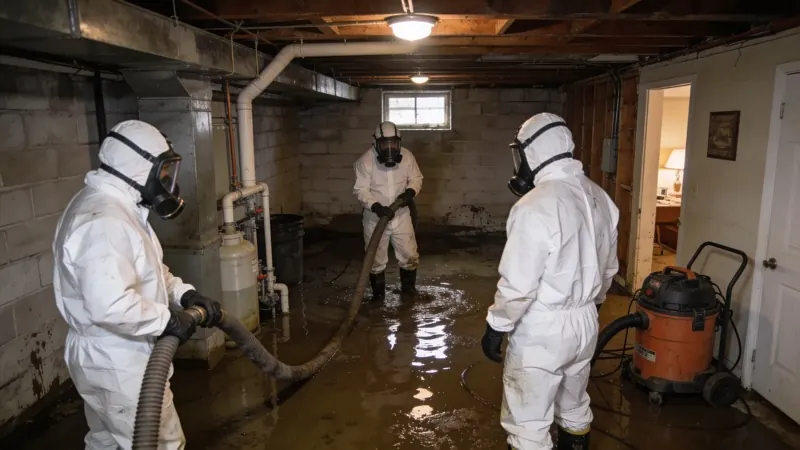
Why Sewage Backup Demands Professional Cleanup
You smell it before you see it. That unmistakable sewer gas odor hits you at the top of the basement stairs, and when you reach the bottom, dark water is pooling across the floor. Bits of debris float in it. The toilet in the basement bathroom is overflowing, and the floor drain is gurgling up something that should never be inside your home.
This is raw sewage. And it's one of the most dangerous situations your house can face.
In 15 years of restoration work, our crews have handled hundreds of sewage backup cleanup jobs. We'll tell you straight: this isn't something you can handle with a mop and a bottle of bleach. Raw sewage is a Category 3 biohazard under IICRC S500 standards. It contains bacteria, viruses, and parasites that can make you seriously ill through skin contact, inhalation, or ingestion. The contamination protocols required to make your home safe again are beyond what any homeowner can do without professional equipment and training.
If you have sewage backing up into your home right now, call (844) 426-5801 immediately. Our biohazard-certified crews respond 24/7, arrive within 60 minutes, and bring the PPE, extraction equipment, and EPA-registered biocides needed to handle Category 3 contamination safely. Don't enter the affected area. Don't attempt cleanup. Let us get there first.
This guide covers everything you need to know about sewage backup cleanup: what makes it dangerous, how professional restoration works, what causes backups, how to prevent them, and what your insurance does and doesn't cover.
Why Sewage Backup Is a Category 3 Biohazard
Not all water damage is the same. The IICRC (Institute of Inspection, Cleaning and Restoration Certification) classifies water damage into three categories based on contamination level. Sewage backup sits at Category 3, the most hazardous classification.
| Category | Source | Contamination Level | DIY Possible? |
|---|---|---|---|
| Category 1 (Clean) | Broken supply line, faucet | None | Yes, if small |
| Category 2 (Gray) | Dishwasher, washing machine | Moderate | Limited |
| Category 3 (Black) | Sewage, flooding | Severe biohazard | No - professional only |
Category 1 is clean water from a broken supply line or faucet. Category 2 is gray water from dishwashers, washing machines, or toilet overflow without solids. Category 3 is grossly contaminated water that contains or has contacted human waste, and it includes all sewage backups regardless of how they look or smell. For a deeper explanation of all three categories, see our water damage categories guide.
What makes Category 3 water so dangerous is what it carries. Raw sewage isn't just dirty water. It's a concentrated biological soup of pathogens that municipal wastewater treatment plants spend millions of dollars processing before it becomes safe.
Bacteria in Raw Sewage
The bacterial load in raw sewage is staggering. According to the Centers for Disease Control and Prevention (CDC), sewage commonly contains:
- E. coli (Escherichia coli) including pathogenic strains that cause severe gastrointestinal illness, kidney failure, and in rare cases, death. Concentration in raw sewage can exceed millions of colony-forming units per 100 milliliters.
- Salmonella species that cause salmonellosis, typhoid fever, and paratyphoid fever. Symptoms include severe diarrhea, fever, and abdominal cramps lasting 4-7 days.
- Campylobacter bacteria, one of the most common causes of bacterial diarrheal illness in the United States. A frequent resident of sewage from human and animal waste.
- Clostridium species including C. perfringens, which produces toxins causing food poisoning symptoms, and C. tetani, the bacterium responsible for tetanus.
- Leptospira bacteria that cause leptospirosis. This one concerns us particularly because it enters through skin cuts or abrasions, which is why PPE for sewage work includes full-body Tyvek suits with no exposed skin.
Viruses in Sewage
Viral contamination is arguably even more concerning because viruses have lower infectious doses than bacteria. You need to ingest or inhale fewer viral particles to become ill.
- Hepatitis A virus survives in sewage and contaminated water for weeks. It causes liver inflammation, jaundice, fatigue, and can be debilitating for months. The EPA has documented Hepatitis A transmission through sewage-contaminated water sources.
- Norovirus is extremely contagious and resistant to many common disinfectants. It's the leading cause of gastroenteritis outbreaks in the US and thrives in sewage environments.
- Rotavirus primarily affects children and can cause severe dehydration. It persists in sewage-contaminated environments for extended periods.
- Adenoviruses cause respiratory illness, conjunctivitis, and gastroenteritis. They are remarkably stable in the environment and resist many standard cleaning products.
Parasites in Sewage
Parasitic organisms in sewage are particularly resilient. Many form protective cysts that survive normal cleaning and even some chemical treatments.
- Giardia lamblia causes giardiasis, a parasitic infection of the small intestine resulting in severe diarrhea, gas, greasy stools, and dehydration. Giardia cysts can survive in water for months.
- Cryptosporidium causes cryptosporidiosis and is notoriously resistant to chlorine-based disinfectants. This is one reason we use EPA-registered quaternary ammonium and hydrogen peroxide-based biocides rather than household bleach.
- Ascaris (roundworm) eggs can survive in soil and on surfaces for years. A single gram of raw sewage can contain thousands of helminth eggs.
This is why we tell every homeowner the same thing: don't touch it, don't walk through it, don't try to clean it up yourself. The health risks are real and documented. Call (844) 426-5801 and let our biohazard-trained crew handle it safely.
A Houston Basement Sewage Job That Taught Us a Lesson
Back in 2019, we got a call from a homeowner in a Houston suburb who had tried to clean up a basement sewage backup himself over a weekend. He wore rubber boots and dish gloves. He used a shop vac. He sprayed bleach everywhere.
When he called us the following Monday, he had a 102-degree fever, vomiting, and severe diarrhea. His doctor confirmed a bacterial infection likely contracted from sewage exposure. When our crew arrived, his shop vac was sitting in the garage, still full of raw sewage, actively off-gassing. The basement smelled clean from the bleach, but our ATP (adenosine triphosphate) swabs on the concrete floor showed contamination levels ten times higher than acceptable limits.
We ended up doing the full Category 3 protocol anyway: demo, biocide, drying, rebuild. The bleach had done nothing to address the contamination that had soaked into the concrete pores, the base of the wall studs, and the subfloor from below. That homeowner spent three days in the hospital and then paid for professional restoration he could have had from the start.
The lesson: bleach isn't a biocide. Bleach kills surface bacteria on non-porous surfaces, but it doesn't penetrate porous materials, it off-gasses toxic chlorine fumes in enclosed spaces, and it breaks down quickly. Professional sewage cleanup requires hospital-grade, EPA-registered biocides designed specifically for Category 3 contamination.
PPE Requirements for Sewage Backup Cleanup
Personal Protective Equipment (PPE) isn't optional when handling raw sewage. That's one of the primary reasons sewage cleanup requires professionals. The PPE needed for a sewage backup job is significantly more extensive than what we wear for a Category 1 pipe burst.
What Our Crews Wear on Every Sewage Job
Full-body Tyvek suit with taped seams. Tyvek is a non-woven synthetic material that prevents liquid penetration while remaining breathable enough to work in. We tape the wrists and ankles where the suit meets gloves and boot covers to eliminate any skin exposure points. On particularly heavy sewage jobs in hot weather, we rotate crews every 45-60 minutes because heat stress in full PPE is a real concern.
N95 respirator minimum, P100 preferred. In confined spaces like basements and crawl spaces, we use powered air-purifying respirators (PAPRs) with P100 HEPA cartridges. Sewage off-gasses hydrogen sulfide, methane, and ammonia, all of which can cause respiratory distress.
In enclosed spaces with poor ventilation, hydrogen sulfide concentrations can reach levels that cause headaches, dizziness, and at high concentrations, loss of consciousness. We monitor air quality with portable gas detectors before sending anyone into a confined sewage environment.
Chemical-resistant gloves, double-layered. We use heavy-duty nitrile or butyl rubber outer gloves over a thinner inner nitrile liner. The inner layer provides an additional barrier in case the outer glove gets punctured by debris, nails, or staples during demolition.
Rubber boot covers or dedicated rubber boots. Steel-toed when structural demolition is involved. These get decontaminated or disposed of after every job.
Eye protection. Splash-resistant safety goggles, not just safety glasses. Sewage splashes during extraction and demolition, and pathogen entry through the mucous membranes of the eyes is a documented transmission route.
Why Homeowner PPE Falls Short
We've seen homeowners attempt sewage cleanup wearing rain boots, kitchen gloves, and a dust mask from the hardware store. That setup leaves your arms, face, and chest exposed to splashing. It provides zero respiratory protection against aerosolized pathogens. And those thin kitchen gloves tear on the first nail or staple you encounter during demolition.
Professional sewage backup cleanup isn't a rubber-gloves-and-mop job. It requires biohazard-level protection.
Sewage Backup Emergency?
Our IICRC-certified biohazard crews respond 24/7 with full PPE and EPA-registered biocides.
📞 Call (844) 426-5801The Professional Sewage Backup Cleanup Process
When you call (844) 426-5801 for a sewage backup, here's exactly what happens and why each step matters.
Step 1: Safety Assessment and Containment
Before anyone enters the affected area, we assess two things: electrical safety and structural safety. Standing sewage water and live electrical outlets are a lethal combination. We confirm the power is off to the affected area, or we have the utility company disconnect it.
We then establish a containment perimeter. Sewage contamination doesn't stop at the visible water line. Aerosols, tracked contamination, and splashing can spread pathogens beyond the flooded zone. We use plastic sheeting and negative air pressure (HEPA-filtered air machines that keep airflow moving from clean zones into the contaminated zone) to prevent cross-contamination into unaffected areas of the home.
Step 2: Sewage Extraction
Truck-mounted extraction units handle the bulk of the standing sewage. For basements, we use submersible pumps first to bring levels down, then switch to truck-mounted extractors for the remaining water in carpet, pad, and on hard surfaces.
One critical difference from clean water extraction: all extracted sewage goes into sealed containment on our trucks for proper disposal at a licensed facility. We don't pump sewage into storm drains or onto landscaping. That's an EPA violation and a public health hazard.
For a more detailed overview of our extraction equipment and process for other types of water, see our emergency water extraction page.
Step 3: Contaminated Material Removal (Demolition)
This is where sewage cleanup diverges sharply from other water damage categories. With a Category 1 clean water event, we can often save drywall, carpet, and other porous materials through proper drying. With Category 3 sewage, the rule is simple: every porous material that sewage touched gets removed and discarded.
That means:
- All carpet and carpet pad. No exceptions. Carpet fibers absorb sewage and can't be disinfected to safe levels. The pad underneath is even worse; it acts like a sponge that holds contamination.
- Drywall to a minimum of 24 inches above the visible water line. Drywall wicks moisture upward through capillary action, and where the moisture went, the contamination went. We use moisture meters to verify the actual wicking height because it often exceeds what you can see.
- All fiberglass batt insulation in wall cavities below the cut line. Fiberglass insulation absorbs contaminated water like a wick and can't be cleaned.
- Baseboards, trim, and any particleboard or MDF shelving. Engineered wood products swell, delaminate, and harbor contamination in their compressed layers.
- Upholstered furniture, mattresses, box springs, and fabric items. If sewage water contacted it and it's porous, it goes.
- Cardboard boxes and their contents if exposed. Paper products absorb contamination and are impossible to decontaminate.
Non-porous materials get treated differently. Concrete floors, metal framing, glass, ceramic tile, and some sealed hardwood can be cleaned and treated with biocide. But "cleaned" doesn't mean wiped down. It means pressure washed or scrubbed with EPA-registered products and then treated with a biocide application.
A Chicago Sewage Job in a Finished Basement
A couple in the Chicago suburbs called us after their sewer main backed up during a heavy spring rainstorm. They had a beautifully finished basement: laminate flooring, full drywall, built-in bookshelves, a wet bar, and a home theater setup.
The sewage was only two inches deep. Two inches. The homeowner told us he figured it was "not that bad" because the water level was so low.
Here's what two inches of raw sewage required us to remove: all the laminate flooring and its foam underlayment (both porous), all drywall up to 30 inches from the floor (wicking carried contamination well above the two-inch water line), all fiberglass insulation in those wall cavities, every baseboard and piece of trim, the fabric-covered home theater seats, an area rug, and most of what was stored in open cardboard boxes.
The built-in bookshelves were solid wood with a sealed finish. We were able to save those with aggressive biocide treatment. The wet bar had a tile backsplash and sealed granite countertop, so the upper portions survived. But the MDF cabinet bases were shot.
Two inches of sewage generated over 4,000 pounds of contaminated debris. The homeowner couldn't believe it. But that's the reality of Category 3 contamination: you're not saving porous materials. You're protecting the people who live in the home.
Step 4: Biocide Treatment
After demolition, exposed structural components need treatment. The studs, subfloor, concrete slab, remaining framing -- anything that was contacted by sewage and was not removed gets treated.
We use EPA-registered biocides, not bleach. The products we apply are hospital-grade quaternary ammonium compounds and stabilized hydrogen peroxide solutions rated for broad-spectrum kill of bacteria, viruses, fungi, and parasites.
The application process matters as much as the product. We apply biocide in two rounds:
- Initial knockdown application immediately after demolition. This is a heavy spray or fog that coats all exposed surfaces. The contact time (dwell time) required varies by product, typically 10-15 minutes for quaternary ammonium products.
- Second application after surfaces dry. A lighter application that ensures any bacteria that survived the first round or were exposed during the drying process are eliminated.
Between rounds, HEPA air scrubbers run continuously. Demolition and biocide application aerosolize contaminants and chemical vapors, and HEPA filtration captures particulates down to 0.3 microns.
Step 5: Structural Drying
Once extraction, demolition, and biocide treatment are complete, the remaining structure needs to dry. Exposed studs, subfloor, concrete, and any other materials that stayed in place still contain moisture from the sewage event.
The drying process for sewage jobs follows the same science as any structural drying project. For an in-depth look at how psychrometry, LGR dehumidifiers, and air movers work together, see our structural drying page. The key difference on a sewage job is that air scrubbers stay running alongside the drying equipment to maintain air quality throughout the process.
Typical drying time after a sewage backup: 3-5 days for wood framing and subfloor, 5-7 days if concrete slab drying is required. We take daily moisture readings and document everything for your records and your insurance claim.
Step 6: Verification and Rebuild
Before we rebuild, we verify that the structure is both dry and clean. Moisture meters confirm structural components are below acceptable thresholds (below 16% moisture content for wood framing). ATP (adenosine triphosphate) testing swabs on surfaces confirm biological contamination has been reduced to safe levels.
Then comes the rebuild: new drywall, new insulation, new flooring, new trim. On sewage jobs, we recommend mold-resistant drywall (paperless drywall with fiberglass facing instead of paper facing) for any below-grade applications. If the basement was prone to one sewage backup, the conditions that caused it may recur, and mold-resistant materials provide an additional layer of protection.
What Causes Sewage to Back Up Into Your Home
Understanding why sewage backups happen helps you prevent them. In our experience, the causes break down into five main categories.
Tree Root Intrusion
This is the single most common cause of residential sewer line blockages in the United States. Tree roots are drawn to the moisture and nutrients in sewer pipes. They enter through tiny cracks, joint separations, or deteriorated sections, and once inside, they grow rapidly.
A root mass inside a sewer pipe acts like a net, catching grease, paper, and debris until the pipe is fully blocked. The sewage has nowhere to go but back toward your house.
Clay tile sewer lines, common in homes built before the 1970s, are especially vulnerable because the joints between pipe sections develop gaps as the ground shifts over decades. PVC pipes are more resistant to root intrusion but not immune, especially at connection points.
Signs of root intrusion: slow drains throughout the house (not just one fixture), gurgling sounds from drains and toilets, and recurring backups that happen gradually rather than all at once.
Municipal Sewer System Overflows
Combined sewer systems, which handle both household sewage and stormwater runoff in a single pipe, are still common in older cities across the Northeast and Midwest. During heavy rainfall, these systems can be overwhelmed. When the municipal main exceeds capacity, the pressure backs sewage up through the lowest connected drain in your home, which is usually a basement floor drain or a basement toilet.
According to the EPA, there are approximately 772 communities in the US with combined sewer systems, and they experience an estimated 23,000 combined sewer overflow events per year. If you live in an older city with combined sewers, you're at elevated risk during any significant rain event.
This is the scenario where a backwater valve makes the biggest difference. More on that in the prevention section below.
Grease Buildup and Debris Accumulation
Cooking grease poured down kitchen drains doesn't stay liquid. It cools, congeals, and sticks to the inside of your sewer pipe. Over time, layers of grease accumulate and narrow the pipe diameter.
Add to that the "flushable" wipes that are anything but (they don't break down like toilet paper and catch on grease deposits), and you have a blockage building over months or years until the pipe is completely obstructed.
In our experience, grease-related blockages tend to cause slower-onset backups compared to root blockages. You'll notice drains running slower for weeks or months before the full backup occurs. If you catch it early, a professional drain cleaning can clear the grease before it causes a sewage event.
Collapsed or Deteriorated Sewer Lines
Older sewer pipes, particularly clay tile and Orangeburg (a bituminous fiber pipe used from the 1860s through the 1970s), deteriorate over time. Orangeburg pipe was essentially compressed tar paper, and most of it has reached or exceeded its useful life. When these pipes collapse or lose structural integrity, sewage flow is blocked.
Cast iron sewer pipes from the mid-20th century can also develop problems. Internal corrosion narrows the pipe diameter over decades, and eventually the pipe walls can rust through entirely.
A sewer line camera inspection is the definitive way to identify pipe condition and plan either repair or replacement.
Sewer Line Bellies and Offsets
Ground settlement can cause sections of your sewer line to sag, creating low spots called "bellies" where sewage pools instead of flowing toward the municipal main. These pooling areas collect debris and develop blockages over time.
Joint offsets occur when ground movement shifts one section of pipe out of alignment with the next, creating a lip inside the pipe that catches waste material. Both conditions are invisible from above ground and require camera inspection to identify.
A Denver Sewer Line Camera Inspection That Saved a Homeowner Thousands
A homeowner in a 1962 Denver ranch house called us after their second sewage backup in eight months. Both times, a plumber had come out, snaked the line, and the problem cleared temporarily.
We recommended a sewer line camera inspection before doing the cleanup. Our plumbing partner ran a camera from the cleanout to the municipal connection, about 65 feet. At the 40-foot mark, we found the problem: a mature cottonwood root had entered through a cracked clay tile joint and had grown to nearly fill the pipe. The plumber's snake had been punching through the root mass each time, opening a temporary channel that the roots quickly filled again.
The homeowner had the damaged section of clay tile replaced with PVC and installed a backwater valve at the same time. Total plumbing cost was about $4,500. That sounds like a lot until you consider they had already spent roughly $8,000 on two sewage cleanup jobs, and without the repair, they were going to keep having backups every few months.
The camera inspection cost $250-$400. It was the best money they spent on the whole project.
Sewer Line Camera Inspection: Finding the Source
If you have experienced a sewage backup, we strongly recommend a sewer line camera inspection before or immediately after cleanup. Cleaning up the mess without identifying the cause is like treating symptoms without diagnosing the disease. You'll end up doing it again.
How Camera Inspection Works
A waterproof camera head, about the diameter of a quarter, is attached to a flexible push rod. The camera feeds real-time video to a monitor at the surface. The push rod has distance markings so the technician knows exactly how far down the line any problem is located.
The camera enters through a cleanout access point (a capped pipe usually located in your basement, crawl space, or outside near your foundation). The technician pushes the camera through the entire sewer lateral from your house to the municipal main, documenting everything it finds.
What the Camera Reveals
- Root intrusion: Roots appear as hair-like or massive growths entering the pipe at joints or cracks. The camera shows the location, severity, and which joints are compromised.
- Grease accumulation: Visible as yellowish or brownish coating narrowing the pipe interior.
- Pipe condition: Cracks, corrosion, deterioration, and collapse are all visible. The camera can distinguish between a minor joint separation and a complete structural failure.
- Bellies and offsets: Standing water in a belly is clearly visible. Joint offsets show as misalignment between pipe sections.
- Pipe material identification: Clay tile, cast iron, PVC, ABS, and Orangeburg all have distinct visual characteristics that help determine the best repair approach.
Camera Inspection Cost
A sewer line camera inspection typically runs $250-$450. Some plumbing companies offer it included with a drain cleaning service. Given that a single sewage backup can cost $5,000-$15,000 to clean up, the camera inspection is one of the most cost-effective diagnostic tools available.
After a backup, we coordinate with our plumbing partners to schedule camera inspection concurrent with or immediately following our cleanup. This way you get both the restoration and the root cause diagnosis handled in a single engagement.
Backwater Valve: The Best Prevention Against Sewage Backup
If there's one investment we recommend to every homeowner who has experienced a sewage backup -- or who lives in an area with combined sewer systems, aging infrastructure, or heavy tree cover near their sewer line -- it's a backwater valve.
How a Backwater Valve Works
A backwater valve (also called a backflow prevention valve or sewer check valve) installs on your main sewer line, typically near where it exits your foundation or at a basement cleanout. The valve contains a gate or flap that opens to allow sewage to flow out from your home toward the municipal main, but closes automatically if pressure reverses and sewage tries to flow back in.
Think of it as a one-way door for sewage. Water goes out. Nothing comes back.
Types of Backwater Valves
Normally open (gravity) valves are the most common residential type. The gate rests open during normal operation and closes when backflow pressure pushes against it. They require periodic maintenance (checking the flap for debris and ensuring it seats properly) but are reliable and relatively inexpensive.
Normally closed valves stay shut and open only when water flows from the house side. These are more aggressive in preventing backflow but can cause issues if they malfunction in the closed position, as they would block normal sewage outflow.
Gate valves with manual override allow the homeowner to manually close the sewer line before a predicted heavy rain event. Some municipalities with combined sewer systems actually recommend these.
Installation Cost and Considerations
Backwater valve installation typically costs $1,000-$3,000 depending on the complexity of access to your sewer line. If there's an accessible cleanout in the basement, the installation is straightforward and falls on the lower end. If the plumber needs to excavate to reach the sewer line, costs increase.
Some municipalities and insurance companies offer rebates or incentives for backwater valve installation. Several cities in the Midwest and Northeast that have older combined sewer systems offer rebates of $500-$1,500 toward installation costs. Check with your local public works department.
Maintenance
The valve needs inspection once or twice per year. This involves opening the access cover and checking that the flap or gate is clean, free of debris, and seats properly. Most homeowners can do this visual inspection themselves.
If the valve hasn't activated in a while, pour a bucket of water into it to verify it opens and closes properly.
Sewage Backup and the Sewer Backup Insurance Endorsement
Here's where a lot of homeowners get a costly surprise: standard homeowners insurance doesn't cover sewage backup damage.
Read that again. Your standard HO-3 homeowners policy, the one that covers burst pipes and appliance overflows, almost certainly excludes sewer backup and drain backup. It's listed as an exclusion in most standard policies.
What You Need: The Sewer Backup Endorsement
To get coverage for sewage backup damage, you need a specific sewer backup endorsement (sometimes called a sewer and drain backup rider) added to your homeowners policy. This is a separate add-on that must be requested and paid for.
The cost is remarkably low for the protection it provides: typically $40-$70 per year depending on your insurer and coverage limits. Coverage limits are usually $5,000, $10,000, $15,000, or $25,000.
Given that a moderate sewage backup cleanup costs $5,000-$15,000 and a major one can exceed $15,000-$25,000, the math is straightforward. Pay $50 per year for the endorsement, or risk paying $10,000+ out of pocket for cleanup.
What the Endorsement Covers
- Damage caused by sewage or water backing up through drains, sewers, or sump pumps
- Cost of professional cleanup and restoration
- Replacement of damaged property (carpet, drywall, personal belongings)
- Some policies cover the cost of the sewer line repair itself, though many don't
What It Doesn't Cover
- Damage from flooding (external water coming in from outside, which requires separate flood insurance)
- Negligence or failure to maintain your sewer line
- Repeated backups you failed to address (insurers expect you to fix the cause after the first event)
- Amounts above your endorsement coverage limit
Our Recommendation
If you don't have a sewer backup endorsement on your homeowners policy, call your insurance agent and add one today. If you do have one, verify your coverage limit. A $5,000 limit might have been adequate a decade ago, but with current restoration costs, we recommend $15,000-$25,000 in coverage.
For broader guidance on navigating the insurance process after water damage, including documentation requirements and working with adjusters, see our water damage insurance claim guide.
Health Hazards: What Sewage Exposure Can Do to You
The health risks of sewage exposure are well-documented and real, and understanding them explains why professional sewage backup cleanup protocols exist.
Routes of Exposure
Direct skin contact is the most common route during improper DIY cleanup attempts. Cuts, scrapes, or cracked skin allow pathogens direct entry into the bloodstream. Even intact skin can absorb certain pathogens with prolonged exposure. Leptospira bacteria, for example, can penetrate unbroken skin.
Inhalation of aerosolized sewage particles is a significant risk, especially during cleanup activities that disturb sewage water (sweeping, mopping, using fans). The act of spraying water during cleanup creates fine droplets that carry bacteria and viruses into the air. In enclosed spaces like basements, the concentration builds quickly.
Ingestion happens more often than people realize. You don't need to deliberately swallow sewage water. Touching a contaminated surface and then touching your face, eating or drinking without thoroughly washing your hands, or inhaling aerosolized droplets that settle in your mouth and throat are all ingestion routes.
Specific Health Risks
The CDC and EPA have documented the following health effects from sewage exposure:
Gastrointestinal illness is the most common outcome. E. coli, Salmonella, Campylobacter, Norovirus, and Giardia all cause varying degrees of nausea, vomiting, diarrhea, and abdominal cramping. Most cases resolve within a week, but severe cases, particularly in children, elderly individuals, and immunocompromised people, can require hospitalization for dehydration.
Respiratory infection can result from inhaling sewage bioaerosols. Bacterial pneumonia and upper respiratory infections have been documented in workers exposed to sewage environments without proper respiratory protection.
Skin infections including cellulitis, wound infections, and dermatitis can occur from sewage contact, particularly if the skin has any breaks, abrasions, or existing conditions like eczema.
Hepatitis A has a 15-50 day incubation period, meaning symptoms can appear weeks after exposure. This delayed onset is particularly insidious because the homeowner may not connect the illness to the cleanup event.
Leptospirosis from Leptospira bacteria causes fever, headache, muscle aches, and in severe cases can progress to kidney damage, liver failure, meningitis, and respiratory distress.
Who Is Most at Risk
Children, elderly adults, pregnant women, and anyone with a weakened immune system (from chemotherapy, HIV/AIDS, organ transplant medications, or autoimmune conditions) are at highest risk for severe illness from sewage exposure. If any members of your household fall into these categories, it's even more critical to keep them completely away from the affected area and leave cleanup to professionals.
What Must Be Removed After a Sewage Backup
The demolition scope on a sewage job is extensive, and this is often the biggest shock for homeowners. Understanding what has to go and why can help you prepare mentally and financially.
Porous Materials: All Must Be Removed
The fundamental rule of Category 3 sewage cleanup is that all porous materials contacted by sewage must be removed and disposed of. Porous materials absorb contamination into their structure, and no amount of surface cleaning or biocide treatment can reach contaminants that have penetrated into the material itself.
Carpet and carpet pad. The pad is the bigger problem. Carpet pad is designed to be absorbent, and once sewage saturates it, the pad becomes a concentrated reservoir of bacteria. Even if the carpet pile feels dry on top, the pad underneath is holding contamination. Both go.
Drywall. Standard drywall is a paper-faced gypsum board. The paper facing absorbs moisture aggressively, and gypsum is porous by nature. We cut drywall to a minimum of 24 inches above the visible high-water mark. On jobs where we measure the actual wicking height and find it exceeds 24 inches, we cut higher.
Insulation. Fiberglass batt insulation in wall cavities below the cut line comes out. Spray foam insulation (closed-cell) that's fully adhered to the wall can sometimes be saved and treated because closed-cell foam is technically non-porous, but we evaluate this on a case-by-case basis.
Baseboards, door casings, and trim at the affected level. Most residential trim is either solid wood (can sometimes be saved if sealed and not saturated) or MDF (always removed). We default to removal unless the trim is high-quality solid wood that the homeowner wants to try salvaging.
Personal property. Upholstered furniture, mattresses, stuffed animals, clothing that was submerged, books, papers, photos (unless behind sealed glass), cardboard boxes and contents. If it's porous and it was in the sewage water, it can't be safely decontaminated.
Non-Porous Materials: Clean and Treat
Not everything has to be thrown away. Non-porous materials can be cleaned, treated with biocide, and retained:
- Concrete slab and block foundation walls. Scrubbed and treated with biocide. Concrete is porous at a micro level, so biocide treatment must be thorough and include adequate dwell time.
- Metal framing, ductwork, and piping. Cleaned and treated.
- Ceramic and porcelain tile. Tile surfaces clean well. Grout lines (which are porous) get additional biocide treatment.
- Glass, sealed stone countertops, and stainless steel. Cleaned and treated.
- Sealed hardwood. If the finish is intact and the wood has not absorbed sewage through exposed end grain or failed finish, sealed hardwood can sometimes be saved with aggressive biocide treatment and careful monitoring during drying.
Sewage-Specific Mold Risk
Sewage backup creates a uniquely accelerated mold risk. The combination of moisture from the water event, organic nutrients in the sewage itself, and warm indoor temperatures provides everything mold needs to colonize faster than a typical clean water event.
In standard Category 1 water damage, mold colonization typically begins within 24-48 hours. With Category 3 sewage, the organic load in the water provides an extra food source for mold. We've documented visible mold growth within 24 hours on sewage-contaminated drywall in summer conditions (75-85 degrees Fahrenheit, 70%+ relative humidity).
This accelerated timeline is one more reason that speed matters on sewage calls. Every hour of delay increases both the contamination scope and the mold risk.
For homeowners who are dealing with mold that developed after a sewage event, our mold remediation team handles containment, removal, and clearance testing following IICRC S520 standards. But prevention through rapid sewage cleanup is always the better path.
Sewage Backup Cleanup Cost
We believe in transparent pricing, so here are the realistic cost ranges for professional sewage backup cleanup in 2026.
Cost by Scope
| Scope | Area | Cost Range | Timeline |
|---|---|---|---|
| Small (single bathroom) | Under 100 sq ft | $3,000-$5,000 | 5-7 days |
| Medium (partial basement) | 100-400 sq ft | $5,000-$10,000 | 1-2 weeks |
| Large (full basement) | 400-1,000+ sq ft | $10,000-$20,000+ | 2-3 weeks |
Small area (single bathroom, under 100 sq ft): $3,000-$5,000. A toilet overflow or drain backup confined to one bathroom. Extraction, removal of contaminated flooring and lower drywall section, biocide treatment, drying, and basic rebuild.
Medium area (large room or partial basement, 100-400 sq ft): $5,000-$10,000. Floor drain backup in a finished basement affecting one or two rooms. Full demolition protocol, biocide treatment, structural drying, and rebuild of drywall, flooring, and trim.
Large area (full basement, 400-1,000+ sq ft): $10,000-$20,000+. Full basement sewage event affecting an entire finished lower level. Extensive demolition, multiple biocide applications, week-plus drying time, and complete rebuild. If the backup damaged HVAC equipment, water heater, or electrical systems in the basement, the cost can exceed $20,000.
What Drives Sewage Cleanup Costs Higher
- Finished vs. unfinished space. A finished basement with drywall, flooring, built-ins, and fixtures costs significantly more to restore than an unfinished utility basement with bare concrete walls.
- Depth of sewage. More sewage means more extraction time, higher wicking on walls, and more material to demolish.
- Extent of contamination spread. Sewage that has been tracked into hallways, up stairs, or into HVAC returns increases the scope.
- Personal property loss. Contents restoration or replacement adds to the overall cost.
- Cause repair. The sewer line repair or replacement that caused the backup is a separate cost from the cleanup.
For broader context on water damage restoration costs across all categories and scenarios, see our comprehensive cost guide.
Need Sewage Backup Cleanup?
IICRC-certified biohazard crews. 24/7 emergency response. Direct insurance billing.
📞 Call (844) 426-5801Frequently Asked Questions About Sewage Backup Cleanup
Standard homeowners insurance typically doesn't cover sewage backup damage. You need a specific sewer backup endorsement or rider added to your policy, usually costing $40-$70 per year with coverage limits of $5,000-$25,000. Check your policy or call your agent to confirm you have this endorsement before a backup occurs.
Professional sewage backup cleanup typically costs $3,000-$15,000 depending on the affected area and severity. A small bathroom backup might run $3,000-$5,000. A basement-wide sewage backup affecting 500+ square feet can cost $8,000-$15,000 or more including demolition, biocide treatment, structural drying, and rebuild.
No. Raw sewage is a Category 3 biohazard containing E. coli, Salmonella, Hepatitis A, and parasites. Professional cleanup requires full PPE (Tyvek suits, N95 or P100 respirators, chemical-resistant gloves), EPA-registered biocides, and contamination protocols per ANSI/IICRC S500 standards. DIY cleanup puts your health at serious risk.
Sewage extraction and contaminated material removal typically takes 1-2 days. Biocide treatment and structural drying takes an additional 3-5 days. Full restoration including rebuild takes 1-3 weeks total depending on the scope. A small bathroom backup may be completed faster, while a whole-basement event takes the full timeline.
The most common causes are tree root intrusion into sewer lines, municipal sewer system overflows during heavy rain, grease and debris buildup in drain pipes, collapsed or deteriorated older sewer lines, and combined sewer system overload. A sewer line camera inspection can identify the exact cause and location of the blockage.
All porous materials contacted by sewage must be removed and discarded. This includes carpet, carpet pad, drywall (cut to minimum 24 inches above the water line), insulation, baseboards, particleboard shelving, upholstered furniture, mattresses, and any fabric or paper items. Non-porous materials like concrete and metal can be cleaned and treated with biocide.
Yes. A backwater valve (also called a backflow prevention valve) is installed on your main sewer line and allows sewage to flow out but prevents it from flowing back in. Installation costs $1,000-$3,000 depending on access and existing plumbing. It's the single most effective prevention measure against sewer backups from municipal overflows.
Yes. Raw sewage is classified as Category 3 water under IICRC S500 standards, the most contaminated category. It contains pathogenic bacteria (E. coli, Salmonella), viruses (Hepatitis A, Norovirus), parasites (Giardia, Cryptosporidium), and other biological hazards. Professional biohazard cleanup with proper PPE and EPA-registered disinfectants is required.
Yes, sewage backup creates an extremely high risk for mold growth. The combination of moisture, organic nutrients in sewage, and warm indoor temperatures accelerates mold colonization. Mold can start growing within 24-48 hours of a sewage event. Rapid professional cleanup and structural drying is critical to preventing secondary mold damage.
Don't attempt to clean it yourself. Turn off electricity to the affected area at the breaker panel. Don't walk through sewage water. Keep children and pets away. Open windows for ventilation if safe to do so. Call a professional sewage cleanup company immediately. Call Water Damages Pros at (844) 426-5801 for 24/7 emergency sewage backup cleanup.
Protect Your Home. Call Now.
Sewage backup is one of the worst things that can happen inside a home. The contamination is real. The health risks are documented. The damage to your property is extensive. But it's also fixable, and the faster you act, the less it costs and the less damage your home sustains.
If you're dealing with a sewage backup right now, stop reading and call (844) 426-5801. Our IICRC-certified biohazard crew responds 24/7, arrives within 60 minutes, and brings the full PPE, extraction equipment, and EPA-registered biocides required for Category 3 sewage restoration. We document everything for your insurance claim, including working with your carrier on sewer backup endorsement coverage.
If you have had a past sewage backup and want to prevent it from happening again, start with two steps: get a sewer line camera inspection to identify the cause, and install a backwater valve to protect against future events. Then call your insurance agent and make sure you have a sewer backup endorsement on your policy.
Your home is your biggest investment. Raw sewage doesn't belong inside it. Let us get it out and make your home safe again.
Water Damages Pros | (844) 426-5801 | 24/7 Emergency Sewage Backup Cleanup | water-damagespros.com