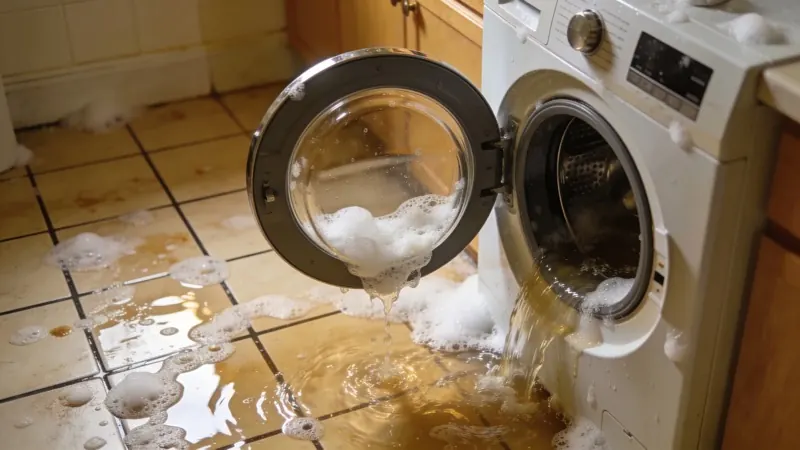
You come home from a Saturday afternoon grocery run and the first thing you notice is water seeping under the laundry room door into the hallway. You open the door and the floor is covered. The washing machine is sitting in 2 inches of standing water. The supply hose behind the unit has ruptured, and water has been flowing at full pressure for the entire 90 minutes you were gone.
Or maybe it's worse than that. Maybe the laundry is on the second floor, and you discover the flood because water is dripping through the kitchen ceiling below.
A washing machine flooded house is one of the most common emergency calls we get, and after 15 years of handling these situations, we can tell you that washing machine floods produce some of the most expensive water damage we see in residential properties. It's not because washing machines use a lot of water per cycle. It's because the failures that cause floods, particularly supply hose bursts, deliver water at full municipal pressure for as long as the supply is open. That can mean hundreds or thousands of gallons if nobody is home to shut it off.
This guide covers the specific failure modes that cause washing machine floods: supply hose ruptures, drain hose disconnections, internal pump failures, and the unique risks of front-load versus top-load machines. We'll walk through what happens to your home when each type of failure occurs, why second-floor laundry installations are particularly high-risk, and what the cleanup and restoration process looks like for each scenario. If your washing machine just flooded your house, shut off the water supply valves behind the washer (or the main water shutoff if you can't reach them), and call (844) 426-5801. Our crew arrives within 60 minutes with extraction equipment that removes water hundreds of times faster than towels and a shop vac.
| Failure Type | Water Volume | Water Category | Typical Cost | Severity |
|---|---|---|---|---|
| Supply hose burst | 240-360 gal/hour (continuous) | Category 1 (clean) | $3,000-$15,000+ | Catastrophic |
| Drain hose disconnection | 15-30 gal per cycle | Category 2 (gray water) | $1,500-$5,000 | Moderate to severe |
| Front-loader door seal leak | 15-25 gal per load | Category 2 (gray water) | $1,500-$4,000 | Moderate |
| Internal pump failure | Varies | Category 2 (gray water) | $1,500-$4,000 | Moderate |
| Top-loader overflow | Full tub volume | Category 1-2 | $1,500-$5,000 | Moderate to severe |
| Standpipe backup | 15-20 gal/min overflow | Category 2 (gray water) | $2,000-$6,000 | Severe |
Supply Hose Failures: The Most Destructive Washing Machine Flood
Supply hose failure is the number one cause of catastrophic washing machine floods, and it's also the most preventable. The supply hoses connect your home's hot and cold water supply to the washing machine. They are under constant pressure, typically 40 to 80 PSI, whether the washer is running or not.
Why rubber supply hoses fail
Standard rubber supply hoses are the ones that come pre-packaged with most washing machines. They are reinforced with a braided fabric layer inside the rubber for strength. When new, they handle household water pressure without issues.
The problem is they deteriorate from the inside. Water pressure constantly stresses the inner wall. Hot water from the hot supply line softens and weakens the rubber over time.
Mineral deposits build up at connection points and create stress concentrations. The rubber dries out and cracks where it bends, particularly where the hose curves out of the supply box connection on the wall.
According to the Insurance Information Institute, washing machine supply hose failures are one of the top five sources of residential water damage claims in the United States. The institute recommends replacing rubber hoses every 3 to 5 years. In practice, we rarely find homeowners who have ever replaced them. We pull failed hoses off washing machines that are 8, 10, 12 years old with the original rubber hoses still attached.
A rubber hose doesn't always burst dramatically. Sometimes it develops a pinhole leak at a weakened spot and sprays a fine mist against the wall behind the washer. That mist keeps the wall wet for weeks before anyone notices, and by the time they find it, the drywall and insulation behind the washer are soaked and mold has started growing. But the catastrophic failures, the ones where the hose splits open or separates from the coupling, produce the worst damage because water flows uncontrolled at full pressure.
The math on supply hose failure volume
Municipal water pressure in most US homes runs between 40 and 80 PSI. At 50 PSI through a 3/4-inch supply hose opening, the flow rate is roughly 4 to 6 gallons per minute. That's 240 to 360 gallons per hour.
If you're home and hear the hose burst, you can shut off the valves within a few minutes. Total water: maybe 20 to 30 gallons. Manageable.
If you're at work and the hose bursts at 9 AM and you get home at 5 PM, that's 8 hours of uncontrolled flow. At 5 gallons per minute: 2,400 gallons. That's enough water to flood the laundry room, flow down the hallway, soak the adjacent bedroom carpet, saturate the subfloor, seep through to the basement, and cause damage across multiple rooms and potentially multiple levels.
We've responded to supply hose failures where the homeowner was on a weekend trip. Two full days of water flow. The damage in those situations is extensive and expensive.
Robert and Cindy's Monday morning disaster. They left for a long weekend on Friday afternoon. Their washing machine was in a second-floor hallway closet. At some point over the weekend, the hot water supply hose, an original rubber hose that was 9 years old, burst at the coupling where it connected to the supply valve.
When they arrived home Monday evening, water had been running for an estimated 60+ hours. The second-floor hallway was saturated. Water had flowed into the master bedroom, soaking the carpet and pad. It had seeped through the subfloor and was dripping through the first-floor ceiling in the living room and kitchen.
The first-floor ceiling drywall was sagging in multiple areas. The living room carpet was saturated from the ceiling drips. Water had reached the basement through the first-floor subfloor.
Our scope included: extraction of standing water on the second floor and first floor, removal of carpet and pad in the hallway and master bedroom (both were beyond saving after 60+ hours of saturation), removal of saturated ceiling drywall on the first floor, structural drying on all three levels, mold remediation on the backside of first-floor ceiling drywall and the second-floor subfloor where mold had started within the 60-hour window, insulation replacement in the first-floor ceiling cavities, and full drywall and ceiling replacement on the first floor. The insurance claim exceeded $15,000, and a $20 braided stainless steel supply hose would have prevented the entire thing.
Braided stainless steel hoses: the $25 prevention
Braided stainless steel supply hoses have an inner rubber core reinforced by a woven stainless steel outer shell. The stainless braid prevents the hose from expanding and bursting under pressure. The burst strength of a braided stainless hose is several times higher than a standard rubber hose.
They cost $15 to $25 per hose at any hardware store. Replacing both hoses takes about 10 minutes with a pair of pliers and an adjustable wrench. We recommend braided stainless steel hoses on every single washing machine job we do.
Some manufacturers sell auto-shutoff supply hoses that have a built-in flow sensor. If the hose detects a flow rate above normal (indicating a burst or major leak), it automatically shuts off the water. These cost $30 to $60 per hose and add another layer of protection.
Washing Machine Flood? Act Now.
Our IICRC-certified crew arrives within 60 minutes with industrial extraction equipment.
📞 Call (844) 426-5801Drain Hose Failures: Slower but Still Damaging
Supply hose failures get the most attention because of the volume of water involved. But drain hose failures cause their share of washing machine floods, and they come with an additional concern: the water isn't clean.
How drain hose failures happen
The drain hose carries wash water and rinse water from the washing machine to the household drain, typically a standpipe or a laundry sink. The drain hose is usually held in place by a clamp or simply hooked over the edge of the standpipe or sink.
Common failure modes include:
- The hose works its way out of the standpipe. Washing machine vibration, especially during the spin cycle, can gradually shift the machine and loosen the drain hose from the standpipe. If the hose pops out during a drain cycle, 15 to 30 gallons of wash water dumps onto the floor.
- The hose clamp fails. If the drain hose connects to the washer's pump with a hose clamp, a loosened or corroded clamp can let the hose slip off during the high-pressure drain phase.
- The standpipe is clogged. Lint, soap buildup, and debris can clog the standpipe over time. When the washer tries to pump water out and the standpipe can't handle the flow, water backs up and overflows out of the top of the standpipe.
- The drain hose is kinked or cracked. A kink restricts flow and can cause backup. Cracks from age or UV exposure (if exposed) allow water to leak during every drain cycle.
Water category concerns with drain failures
When a supply hose bursts, the water is Category 1: clean, potable water from your household supply. Clean water is the easiest to deal with during restoration because porous materials like carpet and pad can sometimes be dried and saved.
Drain water is different. Wash water contains detergent, soil from clothing, body oils, and organic matter. The IICRC classifies this as Category 2 water (gray water). Category 2 water that sits for more than 48 hours can escalate to Category 3 (contaminated water), which requires more aggressive restoration protocols.
The practical impact: if your washing machine flood came from a drain failure during the wash cycle, carpet padding that absorbed the gray water typically needs to be replaced rather than dried. Drywall that absorbed gray water below the flood line usually needs to be cut out. The contamination level changes the scope and cost of restoration.
Front-Load vs Top-Load Washers: Different Risks
The type of washing machine you have affects how it fails and where the water goes.
Front-loader specific risks
Front-load washers use a horizontal drum and a rubber gasket (boot seal) around the door opening to create a watertight seal. This design creates failure modes that top-loaders don't have.
Door seal failures. The rubber boot seal takes constant mechanical stress as the door opens and closes, and it sits in contact with detergent, hot water, and lint during every cycle. Over time, the rubber tears, deforms, or develops mold and residue buildup that prevents it from sealing properly. Foreign objects — coins, underwire from bras, hair clips, small socks that slip between the drum and the seal — can tear the gasket or create gaps.
A front-loader leaking from the door seal releases water during the wash and rinse cycles, typically 15 to 25 gallons per load. The water comes out at the front base of the machine. In many installations, this means the water flows forward onto the laundry room floor and out the door before anyone notices.
Drain pump failures. Front-loaders use a drain pump to push water up and out of the machine because the drain is at the bottom. If the pump housing cracks, the pump seal fails, or the pump impeller jams, water can leak from the bottom of the machine during every drain cycle. These leaks often go under the machine and aren't visible until the water migrates out from underneath.
What we typically see. Front-loader leaks tend to be smaller in volume per event but chronic. A failing door seal might leak a cup or two of water per load for weeks before the homeowner realizes the floor under and behind the machine is wet. By then, the subfloor under the washer is saturated, the drywall behind it may be wet, and mold has had time to establish in dark, enclosed spaces.
Top-loader specific risks
Top-load washers have a vertical drum and no front-facing seal. Their failure modes are different.
Overflow. Top-loaders fill from the top. If the water inlet valve sticks open and the float or pressure switch fails to shut it off, the machine overfills and water pours over the top. Modern top-loaders have overflow protections, but older machines, particularly models from the 1990s and early 2000s, relied on a single pressure switch with no backup.
Internal hose failures. Top-loaders have internal hoses connecting the inlet valves to the tub and the tub to the pump. These internal hoses deteriorate over time and can split or separate from their connections. An internal hose failure inside the machine deposits water into the base of the machine, which flows out from under the unit.
Tub seal failure. The main tub seal on a top-loader prevents water from leaking past the drive shaft at the bottom of the tub. When this seal fails, water leaks from the bottom of the machine during fill and wash cycles. Tub seal failures are more common on machines that are 8 to 15 years old.
Second-Floor Laundry Installations: The Highest-Risk Scenario
Second-floor laundry rooms are increasingly common in newer construction. Architects and homeowners like the convenience of having the washer and dryer near the bedrooms where dirty laundry is generated. From a water damage perspective, putting a washing machine on the second floor is the highest-risk appliance placement in the house.
Why second-floor floods are worse
Gravity. When a washing machine floods on a first-floor laundry room with a concrete slab underneath, the water stays on one level. It damages the laundry room and maybe adjacent rooms, but the water has limited vertical travel.
When the same flood happens on the second floor, the water soaks through the subfloor, enters the ceiling cavity below, saturates the first-floor ceiling drywall and insulation, and drips through onto the first-floor living space. Now you have water damage on two levels: the second-floor laundry area and everything below it.
We've responded to second-floor washing machine floods where the water traveled through the first-floor ceiling into a finished basement, creating damage on three levels from a single supply hose failure.
The damage pattern for second-floor floods
In a typical second-floor washing machine flood, here's what we find:
Second floor (origin): Standing water in the laundry area. Water migration down the hallway and into adjacent rooms, following the path of least resistance. Saturated subfloor under and around the washer. Wet baseboards and drywall along the water path.
First floor (below): Ceiling water damage below the laundry area. Water dripping through light fixtures, HVAC vents, and drywall seams. Saturated ceiling drywall that's sagging or at risk of collapse. Water damage to the floor below the drip points, whether that's carpet, hardwood, or tile with grout. Wet walls where water ran down from the ceiling.
Basement (if applicable): If the first-floor subfloor is saturated and water migrates through, the basement ceiling shows the same pattern. Three-level damage from one washing machine.
Gary and Michelle's second-floor laundry disaster. Their second-floor laundry closet had the original rubber supply hoses from when the house was built 11 years prior. The cold water supply hose burst where the rubber had cracked at the bend, right where the hose curved out of the wall-mounted supply box.
Gary was working from home in his first-floor office when he heard dripping. He looked up and water was coming through the recessed light fixture in the ceiling. He ran upstairs and found the laundry closet ankle-deep in water.
By the time he got the supply valve shut off and called us, the damage spanned both floors. Second floor: laundry closet subfloor saturated, water had flowed under the master bedroom door and wet approximately 40 square feet of carpet. First floor: ceiling drywall below the laundry was visibly sagging, water had dripped onto the home office hardwood floor below.
Our restoration scope: extraction on both floors, carpet and pad removal in the master bedroom (saturated for over 2 hours, Category 1 water but pad was not salvageable at that saturation level), ceiling drywall removal in the home office where the drywall was delaminating, hardwood floor drying with floor mat systems in the office, structural drying on both floors with industrial dehumidifiers and air movers, and insulation replacement in the ceiling cavity. The total claim was around $8,500. Gary now has braided stainless steel supply hoses and an automatic shut-off valve.
Washing machine drain pans
A washing machine drain pan is a shallow metal or plastic tray that sits underneath the washer. It's connected to a drain line that routes any leaked water to a floor drain or plumbing drain. In a second-floor installation, a properly plumbed drain pan catches small leaks and overflow before the water reaches the subfloor.
Drain pans aren't a catch-all solution. A burst supply hose at full pressure overwhelms a standard drain pan in minutes because the volume exceeds the pan's capacity and drain flow rate. But for slow leaks, drain hose disconnections, and overflow situations, a drain pan buys you time and may prevent the water from ever reaching the subfloor.
Some building codes require drain pans for second-floor washing machine installations. Even where it's not required, we strongly recommend them for any second-floor laundry. The pan and drain line installation costs $100 to $300, which is nothing compared to a multi-level flood restoration.
The Washing Machine Flood Restoration Process
Here's what happens from the moment you call us to the completion of restoration.
Immediate response
When you call (844) 426-5801, our dispatch team asks three key questions: Is the water still running? What floor is the washer on? Is water coming through the ceiling anywhere? These answers tell us what equipment to bring and how many crew members the job needs.
We arrive within 60 minutes. On a typical washing machine flood affecting the laundry room and adjacent spaces on one floor, we bring a truck-mounted extraction unit and a full complement of drying equipment.
Water extraction
Extraction starts immediately. Our truck-mounted units remove standing water at hundreds of gallons per hour. Portable weighted extractors go over carpet to pull water from the carpet fibers and pad. We use hand tools to extract water from corners, closets, and behind appliances.
For second-floor floods with ceiling involvement, we extract water from the upper floor first to stop the flow to the level below. Then we address the first-floor damage.
Moisture mapping
After extraction, we map the moisture using thermal imaging and pin-type moisture meters. This is critical because washing machine flood water follows the path of least resistance, and it always goes further than you think. Water runs under baseboards, behind cabinets, into wall cavities through electrical outlets, and along subfloor seams.
Our moisture map identifies every area that needs drying. It's also the documentation your insurance adjuster uses to verify the scope of damage. Without professional moisture mapping, hidden wet areas get missed, and that's where mold grows. For details on how we map and monitor moisture, see our structural drying page.
Material decisions
Based on the moisture mapping and the water category, we make material-by-material decisions:
- Carpet. Category 1 water, carpet can often be saved if extraction happens within 24 hours. Carpet pad is more vulnerable and may need replacement even with Category 1 water if saturation was prolonged. Category 2 water: pad is replaced, carpet is cleaned and sanitized.
- Drywall. If the water line on drywall is below 24 inches from the floor, we typically perform a flood cut: cutting out the bottom 24 inches of drywall, removing the wet insulation behind it, and drying the wall cavity. Drywall above the cut line is dried in place.
- Hardwood floors. We deploy floor mat drying systems. See our hardwood floor water damage guide for the detailed process.
- Baseboards. MDF baseboards that absorbed water swell and don't recover. They get replaced. Solid wood baseboards can sometimes be dried and reused.
- Cabinets. Particleboard cabinet boxes swell and delaminate when wet. Plywood cabinet boxes can often be dried and saved. Cabinet toe kicks are almost always particleboard and usually need replacement.
Structural drying
After extraction and material removal, we set up industrial drying equipment. A typical one-floor washing machine flood requires 3 to 6 air movers and 1 to 2 LGR dehumidifiers. Second-floor floods with ceiling damage below may need double that equipment count.
We monitor moisture daily. The drying process for a washing machine flood usually takes 3 to 5 days for a single floor. Multi-floor jobs can take 5 to 7 days.
Repair and restoration
Once everything is at dry standard, the rebuild phase begins. Drywall replacement and texture matching, carpet and pad reinstallation, baseboard replacement, painting, and any cabinet or flooring repairs. We coordinate all of this and document the completed work for your insurance claim.
Insurance Claims for Washing Machine Floods
Washing machine floods produce some of the most straightforward insurance claims in water damage restoration, which is a silver lining in an otherwise frustrating situation.
Why claims are usually approved
Standard homeowners insurance covers "sudden and accidental" water damage from appliance failures. A washing machine supply hose bursting is the textbook definition of sudden and accidental. There's no gray area. The hose failed, water flooded the home, and the damage resulted from a covered peril.
Drain overflows and mechanical failures that cause leaks are also covered under the same principle, as long as the damage was not gradual or the result of long-term neglect.
What to document
- The failed component. Keep the burst hose, the disconnected drain hose, or whatever failed. Photograph it before and after removal. Some adjusters want to inspect the failed component.
- The water damage. Photograph every affected area before cleanup begins. Water on the floor, water stains on walls, ceiling damage below (if applicable), and any damaged contents (furniture, electronics, personal items).
- Timestamps. Note when you discovered the flood, when you shut off the water, and when you called for professional help. This establishes the timeline.
Our team adds professional documentation including moisture readings, thermal images, scope of work, equipment logs, and daily drying reports. We bill your insurance carrier directly in most cases. For a complete guide on navigating the claims process, see our water damage insurance claim guide.
The maintenance exception
Insurance covers sudden failures, not maintenance neglect. If an adjuster finds evidence that the supply hose had visible deterioration, cracking, or bulging that the homeowner ignored, or if a slow leak had been dripping for weeks and was never addressed, the carrier may push back on the claim.
This is another reason to replace rubber supply hoses proactively and to address small leaks immediately. A $25 hose replacement is a lot better than a denied insurance claim on a $10,000 restoration.
Need Help With a Washing Machine Flood?
IICRC-certified technicians. 60-minute response. Direct insurance billing.
📞 Call (844) 426-5801Preventing Washing Machine Floods
Prevention is simple and inexpensive relative to the damage a flood causes. Here's what we recommend to every homeowner:
Replace rubber supply hoses with braided stainless steel
We've said this multiple times in this guide because it's the single most important prevention step. Braided stainless steel hoses at $15 to $25 each are the cheapest protection against the most expensive washing machine failure. Replace both hot and cold hoses. Do it today. Don't wait for the existing hoses to fail.
Turn off supply valves when not washing
If you close the supply valves when the washer isn't in use, a hose failure can't flood your home because there's no water pressure in the lines. This is the belt-and-suspenders approach that many homeowners follow after experiencing a washing machine flood. It takes 10 seconds to turn two valves.
Automatic shut-off valves are an alternative. These mount on the supply line and include a floor sensor. If the sensor detects water on the floor, the valve closes automatically. Products like the FloodStop or Watts IntelliFlow range from $100 to $300 installed and provide automated protection.
Install a drain pan (especially on second floors)
A properly plumbed drain pan catches small leaks and buys time on larger ones. For second-floor installations, a drain pan is essential. Connect the pan drain to a nearby plumbing drain so captured water is routed away.
Inspect drain hose connections
The drain hose should be secured in the standpipe and can't vibrate loose. A hose clamp or zip tie securing the drain hose to the standpipe prevents it from walking out during the spin cycle. The drain hose should not extend more than 8 inches into the standpipe, as that can cause siphoning.
Maintain front-loader door seals
If you have a front-load washer, wipe the door seal (boot gasket) after every load to remove moisture and lint. Inspect it monthly for tears, deformation, and foreign objects lodged in the folds. Leave the door slightly open between loads to allow the seal and drum to dry, which reduces mold and odor buildup.
Know your supply valve locations
Make sure everyone in the household knows where the washing machine supply valves are and how to turn them off. In a flood, the 30 seconds it takes to shut off the water makes the difference between a manageable cleanup and a catastrophic multi-room restoration.
What to Do Right Now If Your Washing Machine Is Flooding
If you're reading this because water is spreading across your floor right now, here are the steps in order:
- Shut off the supply valves behind or above the washing machine. Turn both knobs clockwise until they stop. If you can't reach them or they are stuck, go to the main water shutoff for the house.
- Kill the power. Go to the breaker panel and shut off the breaker for the laundry room. Don't reach behind the washer to unplug it if you're standing in water.
- Contain the water. Use towels to block doorways and prevent water from reaching adjacent rooms, especially if those rooms have hardwood or carpet.
- Remove water from the surface. Use a wet-dry vacuum, mop, or towels. Every gallon you remove before our crew arrives is a gallon less that soaks into the subfloor and walls.
- Move valuables. Get electronics, documents, and irreplaceable items off the floor and to a dry area.
- Document. Photograph the water, the source of the leak, and all affected areas.
- Call (844) 426-5801. Our emergency crew arrives within 60 minutes with industrial extraction equipment. We handle the rest.
For a detailed guide on immediate water damage response, see our water damage cleanup page.
Frequently Asked Questions About Washing Machine Floods
Yes, in most cases. A washing machine supply hose burst, drain overflow, or mechanical failure that causes sudden water damage is considered a covered peril under standard homeowners insurance policies. The key word is sudden. If a supply hose has been slowly dripping for weeks and you ignored it, the carrier may classify that as a maintenance issue and deny the claim. Report the damage promptly, document everything, and save the failed component.
A burst supply hose connected to a fully open supply valve delivers water at full household pressure, typically 40 to 80 PSI. That translates to 4 to 8 gallons per minute of continuous flow. If no one is home for 8 hours, a single burst supply hose can release 1,900 to 3,800 gallons of water into your home. Even a drain hose disconnection during a wash cycle releases 15 to 30 gallons per load, depending on the washer capacity.
Absolutely. Rubber supply hoses are the number one cause of washing machine floods. They deteriorate from the inside out due to water pressure, heat, and mineral deposits. Industry recommendations say rubber hoses should be replaced every 3 to 5 years, but most homeowners never replace them. Braided stainless steel hoses have a burst strength several times higher than rubber, last significantly longer, and cost around $15 to $25 per hose. It's one of the cheapest protections you can buy.
Mold can begin growing on wet building materials within 24 to 48 hours. The hidden areas behind and under the washing machine, inside wall cavities where the supply box sits, and underneath the subfloor are the most vulnerable because moisture lingers there without airflow. If your washing machine flood happened more than 24 hours ago and you haven't started professional drying, call for assessment immediately. For general signs of hidden water damage in your home, see our signs of water damage guide.
It depends on where in the wash cycle the leak occurred. Supply hose water is Category 1 (clean water) because it comes from the potable water supply. Wash water during the cycle is Category 2 (gray water) because it contains detergent, dirt, and organic matter from clothing. Drain water is also Category 2. If wash water sat for more than 48 hours or mixed with sewage from a backed-up drain, it escalates to Category 3 (contaminated), which changes the restoration approach significantly.
A washing machine flood affecting one to two rooms with Category 1 water typically costs $1,500 to $4,000 for extraction, drying, and repairs. Second-floor laundry floods that damage the floor below can run $4,000 to $10,000 due to ceiling damage, multi-floor drying, and more extensive material replacement. Costs increase with Category 2 water because porous materials like carpet padding may need replacement rather than drying. See our cost guide for full pricing details.
Yes. The rubber gasket or boot seal around a front-loader door is a common failure point. Small objects like coins, hair pins, and bra underwires get lodged in the seal and cause tears or deformation that prevents a watertight closure. Detergent residue and mold buildup on the gasket can also prevent proper sealing. A front-loader leak during the wash cycle can release 15 to 25 gallons per load onto the floor, often underneath the machine where it goes unnoticed until the water spreads.
Shut off the water supply valves behind the washer immediately. Turn off electricity at the breaker to the laundry area and any rooms below where water is dripping through the ceiling. Don't walk through standing water near electrical outlets. Place buckets under ceiling drip points on the first floor. Call (844) 426-5801 for emergency response. Second-floor floods require fast extraction to prevent ceiling collapse below and minimize multi-floor damage.
Replace rubber supply hoses with braided stainless steel hoses. Turn off supply valves when the washer isn't in use, or install an automatic shut-off valve that detects leaks and closes the water supply. Install a washing machine drain pan under the unit, especially on second floors. Inspect the drain hose connection regularly and make sure it's secured to the standpipe or drain. Check the door seal on front-load washers monthly for tears, buildup, and foreign objects.
Don't Let a Washing Machine Flood Become a Mold Problem
A washing machine flood is stressful, but it's manageable when you act fast. The water from a supply hose burst is clean. The damage is usually limited to one or two floors. And the insurance claim is typically straightforward because appliance failures are clearly "sudden and accidental."
Where washing machine floods become expensive, drawn-out restoration projects is when homeowners wait too long to get professional drying equipment in place. The water that soaked into your subfloor, seeped behind your baseboards, and saturated your wall cavities doesn't dry itself with a box fan. Within 24 to 48 hours, mold can start growing in those hidden spaces. What could have been a $3,000 restoration becomes a $10,000 mold remediation job.
Call (844) 426-5801 now. Our IICRC-certified team arrives within 60 minutes, extracts the water, maps the moisture, and sets up industrial drying equipment. We monitor your home daily until everything reaches dry standard, and we handle the insurance documentation so you can focus on your family.
Replace those rubber supply hoses while you're at it. And if you want to understand the full scope of what water damage restoration involves, from extraction through rebuild, we've got you covered.