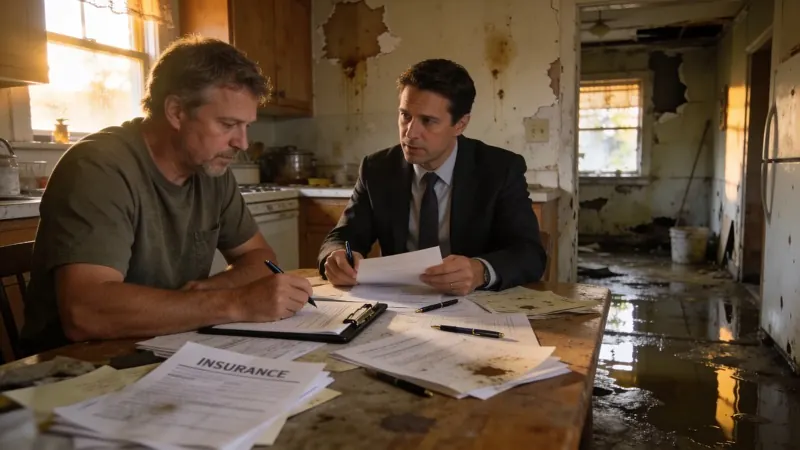
Will My Insurance Cover This?
Last Tuesday, a homeowner in Phoenix called us at 11 PM. A supply line behind her upstairs bathroom wall had been leaking for hours before she noticed water dripping through the first-floor ceiling. By the time she found it, the kitchen ceiling was sagging, the living room carpet was soaked, and she was standing in her hallway wondering how she was going to pay for all of this.
Her first question wasn't about drying equipment or mold. It was: "Will my insurance cover this?"
After handling thousands of water damage insurance claims across the country, we hear that question multiple times a day. The answer is almost always "it depends", and the specifics of what it depends on are exactly what most homeowners don't understand until they're standing in a flooded house at midnight. Filing a water damage insurance claim the right way, documenting damage correctly, and knowing what your policy actually says can mean the difference between a $15,000 restoration covered by your carrier and a $15,000 bill sitting on your kitchen counter.
This guide covers everything we've learned from working both sides of the insurance process, as the restoration company documenting damage and as the advocate helping homeowners get their claims approved. If you're dealing with water damage right now, call (844) 426-5801, our team arrives within 60 minutes and we document everything your adjuster needs from the moment we walk in.
Does Homeowners Insurance Cover Water Damage?
The short answer: standard homeowners insurance (an HO-3 policy, which is what roughly 80% of American homeowners carry) covers sudden and accidental water damage. But "sudden and accidental" is a phrase that does a lot of heavy lifting in insurance law, and the line between covered and not covered is thinner than most people realize.
| Water Damage Source | Covered by Standard HO-3? | Notes |
|---|---|---|
| Burst pipes / supply line failures | Yes | Must be sudden, not corroded over time |
| Appliance malfunctions | Yes | Water heater, dishwasher, ice maker failures |
| Accidental overflow (bath, sink) | Yes | Accidental only |
| Storm damage to structure letting water in | Yes | Wind-driven rain through broken window/roof |
| Firefighting water damage | Yes | Water used to extinguish a covered fire |
| Gradual leaks / slow seepage | No | Classified as maintenance issue |
| External flooding (river, storm surge) | No | Requires separate flood insurance (NFIP) |
| Sewer / drain backup | No (unless endorsed) | Add endorsement for $40-$75/year |
| Sump pump failure | No (unless endorsed) | Add endorsement separately |
| Neglected maintenance | No | Carrier argues homeowner fault |
| Mold (secondary) | Limited | Often capped at $5,000-$10,000 |
What's typically covered
Your standard homeowners policy generally covers water damage from:
- Burst pipes and supply line failures. A pipe freezes and cracks overnight, a washing machine supply line ruptures while you're at work, a toilet supply line fails and floods your bathroom. The damage was sudden. You didn't cause it through neglect. Your policy pays.
- Appliance malfunctions. Your water heater tank fails, the dishwasher line breaks, the refrigerator ice maker line splits. As long as the failure was sudden and not the result of years of ignored maintenance, you're covered.
- Accidental overflow. You start running a bath, get a phone call, and forget about it. The tub overflows and soaks through the floor into the room below. Covered. It was accidental.
- Storm damage to the structure that lets water in. A tree branch punches through your roof during a storm and rain pours in. Wind-driven rain enters through a window broken by debris. Your policy covers the water damage because a covered peril caused the entry point.
- Firefighting water damage. The fire department puts out a kitchen fire and drenches your home in the process. Water damage from extinguishing a covered fire is covered.
- HVAC and AC condensation line failures. Your AC's condensate drain line clogs and overflows, sending water across your ceiling. If it happened suddenly, your carrier should cover it.
What's NOT covered -- and this is where claims fall apart
These exclusions exist in virtually every standard HO-3 policy, and they account for the majority of denied water damage claims we encounter:
- Gradual damage and slow leaks. If a pipe under your sink has been dripping for six months and finally rots out the cabinet floor and subfloor beneath it, that's not sudden. Adjusters look for signs of long-term water exposure -- staining patterns, rust, mineral deposits, softened wood -- to determine whether damage was truly sudden.
- Flooding from external sources. Your standard homeowners policy doesn't cover flood damage. If a river overflows, storm surge enters your home, or surface water pools and enters through your foundation, you need separate flood insurance through the National Flood Insurance Program (NFIP) or a private flood insurer.
- Sewer and drain backup (unless you have the endorsement). Sewage backing up through your floor drains or toilets is excluded from standard policies. Most carriers offer a "sewer and drain backup" endorsement for an additional $40-$75 per year. If you don't have it, call your agent and add it.
- Sump pump failure (unless endorsed). Similar to sewer backup, typically excluded but available as an endorsement. If you have a basement with a sump pump and don't have this endorsement, you're gambling.
- Neglected maintenance. Your roof has been leaking for two years and you never fixed it. Your gutters are clogged. A known plumbing issue you never addressed finally causes major damage. Your carrier will argue, and win, that you failed to maintain your property.
- Mold (with significant limitations). Most policies cover mold remediation only when the mold resulted directly from a covered water damage event, and many cap mold coverage at $5,000-$10,000.
- Earth movement. Water damage caused by foundation shifting, earthquakes, or landslides is excluded.
One thing we tell every homeowner: read your policy's "exclusions" section before you need it. If you're unsure whether your specific situation is covered, call your insurance agent and ask directly. Then call us at (844) 426-5801 -- we'll give you an honest damage assessment and tell you what we've seen carriers cover in similar situations.
How to File a Water Damage Insurance Claim: Step by Step
Filing a water damage claim isn't complicated, but the order in which you do things matters. Here's the process that gives your claim the best chance of full approval.
Step 1: Stop the water source and prevent further damage
Your policy includes something called a "duty to mitigate." That means you're obligated to take reasonable steps to prevent additional damage once you discover the problem. If a pipe is still spraying water and you do nothing while you wait three days for the adjuster, your carrier can reduce or deny the claim for the additional damage.
What "reasonable" looks like:
- Shut off the water supply to the source (or the main shutoff if you can't isolate it)
- Turn off electricity to affected areas if water is near outlets or panels
- Move valuables and furniture away from standing water if you can do so safely
- Place buckets under active leaks
- Do NOT rip out drywall, tear up carpet, or start demolition before documenting
Step 2: Document everything before touching anything
This is the step homeowners mess up most often. Your instinct after discovering water damage is to start cleaning up. Fight that instinct for 20 minutes and document first.
Pull out your phone and take:
- Wide-angle photos of every affected room. Stand in the doorway and capture the full scene.
- Close-up photos of the damage source. The burst pipe, the failed appliance, the crack in the supply line.
- Close-ups of damaged materials. Wet drywall, buckled flooring, water-stained ceiling, saturated carpet.
- Video walkthrough. Walk slowly through every affected area, narrating what you see.
- Photos of the water line on walls. If there's standing water or a visible tide mark, photograph it with a tape measure next to it.
- Photos of serial numbers on damaged appliances. If an appliance caused the damage, photograph the model and serial number plate.
Take too many photos, not too few. We've never once seen an adjuster complain that a homeowner provided too much documentation.
Step 3: Call your insurance company within 24 hours
Most policies don't specify an exact filing deadline, but every policy requires "prompt" notification. In practice, that means calling your carrier's claims hotline within 24 hours of discovering the damage.
When you call, have this information ready:
- Your policy number
- Date and time you discovered the damage
- The source of the water (if known)
- A brief description of affected areas
- Whether you've taken steps to prevent further damage
- Whether you've hired a restoration company
The intake rep will assign a claim number and schedule an adjuster. Write down the claim number immediately.
Step 4: Call a restoration company -- don't wait for the adjuster
This is critical. A lot of homeowners think they need to wait for the insurance adjuster to inspect before any work can begin. That's not how it works.
Your duty to mitigate means you should start water extraction and drying as soon as possible. Every hour that water sits in your home increases damage, and within 24-48 hours, mold starts growing in wall cavities and under flooring. If you wait four days for an adjuster while mold colonizes your walls, your carrier can argue you didn't mitigate properly.
A professional water damage restoration company does two things simultaneously: starts extracting water and drying your home, and documents everything the adjuster needs.
Call us at (844) 426-5801 the same day you discover the damage. We arrive within 60 minutes and begin emergency extraction while creating the documentation your claim requires.
Step 5: Meet the adjuster and present your documentation
Your insurance company will send an adjuster, usually within 2-5 business days. The adjuster's job is to inspect the damage, determine the cause, confirm coverage, and estimate the cost of repair.
When the adjuster arrives:
- Walk them through every affected area
- Show them your photos and video from the day of the loss
- Provide the restoration company's documentation (moisture readings, scope of work, photos)
- Point out damage they might miss -- inside cabinets, behind appliances, in adjacent rooms
- Don't sign anything on the spot that you haven't read carefully
Step 6: Review the estimate and negotiate if needed
After the inspection, your carrier will send a written estimate. Review it carefully and compare it line by line against your restoration company's scope of work. If the carrier's estimate is lower, your restoration company can submit a supplement with detailed justification for the additional costs.
We submit supplements on a significant percentage of the claims we handle. It's a normal part of the process. The adjuster estimated from a one-hour visit; we're providing daily moisture data and detailed documentation from being on-site for days. Supplements get approved regularly when they're supported by proper documentation.
Need Insurance Claim Documentation?
Our team documents every phase of restoration to adjuster standards. We bill your carrier directly.
📞 Call (844) 426-5801The 7 Mistakes That Get Water Damage Claims Denied
After processing thousands of insurance claims, we see the same mistakes sink homeowner claims over and over. Every single one of these is preventable.
Mistake 1: Waiting too long to report the damage
A homeowner discovers a slow leak under the kitchen sink on a Monday. It's not that bad, they think. They'll call the insurance company on the weekend when they have time. By Friday, mold is growing on the cabinet interior and the subfloor is soft. When they finally file the claim, the adjuster sees a week of damage and starts asking uncomfortable questions about when the leak actually started.
Report the damage within 24 hours. No exceptions.
Mistake 2: Cleaning up before documenting
The natural reaction to a flooded room is to start mopping, pulling up carpet, and dragging wet furniture outside. The problem: once you remove the evidence, the adjuster can't see the extent of the damage. We've seen adjusters write estimates for $3,000 when the actual restoration cost was $8,000 -- because the homeowner had already cleaned up half the damage before anyone documented it.
Take 20 minutes to photograph and video everything. Then start cleanup.
Mistake 3: Failing to mitigate further damage
The opposite of Mistake 2. Some homeowners call their insurance company, get told an adjuster will come in five days, and then sit on their hands while water continues to destroy their home. Your policy requires you to take reasonable steps to prevent additional damage. Failure to mitigate is one of the most common denial reasons we encounter.
Start emergency water extraction immediately. Keep receipts for everything. Your carrier is required to reimburse reasonable mitigation costs.
Mistake 4: Not understanding your policy's exclusions
A homeowner's sewer line backs up and floods their basement with Category 3 contaminated water. They file a claim, confident it'll be covered. The adjuster denies it because they don't have the sewer backup endorsement on their policy. This happens all the time, and it's a $10,000-$20,000 lesson in reading your policy.
Know your coverage before you need it. Check whether you have endorsements for sewer backup, sump pump failure, and service line coverage. If you don't, add them -- they typically cost $40-$100 per year combined.
Mistake 5: Admitting to long-term knowledge of the problem
The adjuster asks, "When did you first notice water in this area?" The homeowner answers honestly: "Well, I saw a small stain on the ceiling a few months ago, but I didn't think it was a big deal."
That statement can turn a covered claim into a denied one. If you knew about water intrusion and didn't address it, your carrier can classify the damage as "gradual" rather than "sudden." We're not telling you to be dishonest -- we're telling you that if you see a water stain, deal with it immediately rather than waiting until it becomes a catastrophe.
Mistake 6: Accepting the first estimate without review
Insurance adjusters use estimating software (typically Xactimate) to calculate repair costs. The initial estimate often uses pricing that's lower than actual contractor costs in your area, and it may miss items that aren't visible during a single inspection.
Always have your restoration company review the carrier's estimate. Line-item comparison frequently reveals gaps.
Mistake 7: Hiring a restoration company that doesn't document for insurance
Not all restoration companies create the documentation your insurance claim requires. A company that shows up, extracts water, sets fans, and leaves without taking moisture readings, photographing damage phases, or creating a detailed scope of work is doing you a disservice.
Our documentation package for every job includes: timestamped damage photos, daily moisture readings with meter type and location logged, equipment placement records, antimicrobial application logs, a written scope of loss matching industry-standard line items, and a completion report with final moisture readings. That's what adjusters need. That's what gets claims paid.
How to Document Water Damage for Your Insurance Claim
Documentation is the backbone of a successful water damage insurance claim. The single biggest factor separating approved claims from denied or underpaid claims is the quality of documentation.
Homeowner documentation (what you should do yourself)
Before anyone else arrives at your home, you're the first documentarian. Your phone is your most important tool in the first 30 minutes after discovering water damage.
Photo checklist:
- Overall room shots from multiple angles showing standing water or wet areas
- The source of the water (the broken pipe, failed appliance, ceiling entry point)
- Close-ups of each damaged surface -- drywall, flooring, baseboards, ceiling
- Water line marks on walls (place a ruler or tape measure for scale)
- Any personal property that was damaged -- furniture, electronics, clothing, documents
- Model and serial numbers of appliances that caused or were damaged by the water
- Your electric panel showing which breakers you turned off
- The water shutoff valve you closed
Written log: Start a note on your phone and keep a running log with dates and times. When did you discover the damage? What time did you shut off the water? When did you call your insurance company? What was the claim number? When did the restoration crew arrive? This timeline becomes your evidence chain.
Save everything. Every receipt for emergency supplies (fans, buckets, tarps, hotel stays if you had to relocate), every communication from your insurance company, every business card from technicians and adjusters. Create a folder dedicated to this claim.
Professional documentation (what your restoration company provides)
This is where having the right water damage restoration company makes a measurable difference in your claim outcome. Here's what we document on every job:
- Pre-restoration damage assessment. Detailed written description of all affected areas, materials, and the probable cause of loss.
- Moisture mapping. Using pin-type and pinless moisture meters plus thermal imaging, we create a map of moisture levels throughout the affected area, including inside wall cavities and under flooring that looks dry on the surface.
- Daily moisture readings. Every day during drying, we take new readings at the same locations and record the progress. This shows the adjuster that professional structural drying was performed systematically.
- Equipment logs. What equipment was placed, where, and when. How many air movers, dehumidifiers, and specialty drying systems.
- Photo documentation of every phase. Pre-mitigation, during demolition, equipment setup, daily progress, and completion photos.
- Antimicrobial application records. What product was applied, where, and in what concentration.
- Final completion report. Starting moisture readings, daily progress, and final readings confirming all materials reached their dry standard.
When this documentation package hits an adjuster's desk, they have everything needed to justify the scope and approve the claim. When it's missing, adjusters start cutting line items.
Working With Insurance Adjusters
Insurance adjusters aren't the enemy, but they're not on your team either. Their job is to evaluate the damage, determine the cause, confirm it falls within your coverage, and estimate a fair repair cost.
What the adjuster is evaluating
When an adjuster walks through your water-damaged home, they're building a mental checklist:
- Cause of loss. What specifically caused the water damage? They need to tie it to a covered peril in your policy.
- Sudden vs. gradual. They're looking for evidence that this was a sudden event, not something that developed over weeks or months. Old water stains, mineral deposits, rust, discolored caulk, warped materials -- these are red flags for pre-existing damage.
- Extent of damage. How many rooms, what materials, what square footage.
- Mitigation efforts. Did the homeowner take steps to prevent further damage?
- Pre-existing conditions. Was the home maintained? Are there deferred maintenance issues that contributed?
- Replacement cost vs. actual cash value. Depending on your policy, the adjuster calculates either replacement cost value (RCV) or actual cash value (ACV, replacement cost minus depreciation).
Insider tips for the adjuster visit
Be present for the inspection. Don't let the adjuster walk your home alone. You know where the water traveled, which rooms were affected, and what was damaged.
Show, don't just tell. Have your photos and video from the day of the loss ready on your phone. If the restoration company has already removed saturated drywall, those before photos prove the damage existed.
Don't forget hidden damage. Adjusters can only scope what they can see or what's documented. Water behind walls, under tile, and in crawl spaces is invisible during a walk-through. Make sure thermal imaging and moisture reading data is shared with the adjuster.
Ask about depreciation and recoverable depreciation. If you have a replacement cost value policy (most homeowners do), the carrier may initially pay actual cash value, which includes a depreciation deduction. The difference is released after repairs are completed and documented.
Get everything in writing. Verbal agreements with adjusters mean nothing. If the adjuster tells you something is covered, ask them to note it in the file. If they deny a line item verbally, ask for the denial reason in writing.
Dealing With a Water Damage Claim?
Our IICRC-certified team handles documentation and adjuster communication from day one.
📞 Call (844) 426-5801When Your Water Damage Claim Gets Denied
A denial letter isn't the end of the road. It's the beginning of a process that homeowners have more control over than they realize. We've seen denied claims overturned, and we've seen underpaid claims supplemented to full coverage.
Common denial reasons and how to respond
"The damage was gradual, not sudden." This is the most common denial reason. To fight this: provide documentation showing the damage was recent, get a plumber's written report confirming the failure was sudden -- a pipe that cracked from pressure, not one that corroded over years.
"The damage resulted from a maintenance failure." Fighting this requires showing that you maintained the property reasonably -- HVAC service records, plumbing inspection history, roof maintenance receipts. If the failed component was inside a wall where you couldn't reasonably inspect it, that's a strong counter-argument.
"The water source is excluded (flood, sewer backup)." If the denial is accurate (you don't have the endorsement), options may be limited. However, if the cause of loss is mischaracterized (the carrier calls it a "flood" when it was a burst pipe during a storm), challenge the characterization in writing with evidence.
"Pre-existing damage." This doesn't necessarily mean the entire claim should be denied, only the pre-existing portion. Request a line-by-line breakdown and contest items you believe were caused by the covered event.
The appeal process
- Request the denial in writing. Get the specific policy language your carrier is citing. Don't accept "it's not covered" without knowing the exact clause.
- Review the denial with your restoration company. We've read enough denial letters to recognize when a carrier is stretching an exclusion.
- Submit a written appeal. Include your documentation, your restoration company's documentation, any independent expert reports, and a clear explanation of why the denial reason doesn't apply.
- Contact your state's Department of Insurance. Every state has an insurance regulatory body. Filing a complaint puts your carrier on notice. According to the Insurance Information Institute, homeowners have the right to file complaints and request reviews through their state regulator.
- Consider a public adjuster. A public adjuster works for you, not the insurance company. They typically charge 10-15% of the settlement, but on underpaid claims, their fee pays for itself.
- Legal counsel as a last resort. An insurance attorney who works on contingency can review your case for substantial claims.
A real scenario: denied to approved
A homeowner in Houston had a second-floor bathroom supply line fail while the family was on vacation for a week. The carrier denied the claim, arguing the homeowner should have had someone checking the house during an extended absence.
We documented the entire loss with moisture mapping, mold testing, and a detailed scope. A licensed plumber provided a report confirming the supply line failure was sudden -- a manufacturing defect in the braided stainless steel connector. The homeowner filed an appeal with the plumber's report, our documentation, and a complaint to the Texas Department of Insurance. The carrier reversed the denial and approved the claim at $28,000.
The point: denials can be overturned. But only with documentation that directly addresses the denial reason.
Water Damage Insurance Claim Timeline
| Timeline | Phase | What Happens |
|---|---|---|
| Day 1 | Discovery & filing | Document damage, shut off water, call insurance + restoration company. Get your claim number. |
| Days 1-3 | Emergency mitigation | Water extraction, drying equipment setup, damage documentation. Don't wait for the adjuster. |
| Days 2-7 | Adjuster inspection | Carrier sends adjuster (3-5 business days typical; 2-4 weeks during disasters). |
| Days 3-7 | Structural drying | Daily moisture readings, equipment monitoring. Most jobs reach dry standard in 3-5 days. |
| Days 7-14 | Carrier estimate | Written estimate via Xactimate. Initial payment (ACV if replacement cost policy). |
| Days 14-30 | Supplement negotiations | Restoration company submits supplements for gaps. Review takes 1-3 weeks. |
| Days 30-90 | Repair & rebuild | Full restoration to pre-loss condition. Single room: ~1 week. Multi-floor: 2-3 months. |
| After repairs | Depreciation recovery | Submit repair receipts to collect held-back depreciation (180 days to 1 year deadline). |
Understanding Your Policy: Key Insurance Terms
Insurance policies are written by lawyers for other lawyers. Here are the terms that actually matter when you're filing a water damage claim, in plain English.
| Term | What It Means |
|---|---|
| Actual Cash Value (ACV) | What your damaged property is worth today after depreciation. A 10-year-old carpet pays at 10-year-old value. |
| Replacement Cost Value (RCV) | What it costs to replace damaged property with new, equivalent materials. Most modern policies are RCV -- significantly better for you. |
| Recoverable Depreciation | The difference between RCV and ACV. Carrier holds it back initially, releases after repairs + receipts. On a $15,000 claim, this could be $3,000-$5,000. |
| Deductible | Your out-of-pocket cost before insurance kicks in. Typically $500-$2,500 for water damage. Some policies have separate, higher water damage deductibles. |
| Scope of Loss | Line-by-line description of all damage, materials, and labor. This document determines your payout. A thorough scope is the difference between a $5,000 and $12,000 settlement. |
| Subrogation | After paying your claim, carrier may pursue the responsible party (faulty plumber, defective manufacturer). You may get your deductible refunded. |
| Loss of Use / ALE | Covers hotel, meals, laundry, storage if your home is uninhabitable during restoration. Keep all receipts. |
| Endorsement / Rider | Add-on extending coverage. Common: sewer backup, sump pump failure, service line coverage. |
Understanding these terms isn't optional -- it's the difference between knowing what your settlement should be and accepting whatever your carrier offers. For more information on homeowners insurance coverage types, the Insurance Information Institute's homeowners guide provides a solid overview. The National Flood Insurance Program site can help you understand whether you need separate flood coverage.
How to Maximize Your Water Damage Insurance Settlement
Getting a fair settlement isn't about gaming the system. It's about making sure nothing falls through the cracks, because on every underpaid claim we've seen, the homeowner left legitimate money on the table.
Don't overlook these commonly missed claim items
- Contents damage. Your policy has separate coverage for personal belongings damaged by water. Furniture, electronics, clothing, books, documents -- list everything. Homeowners regularly forget to claim contents because they're focused on the structure.
- Loss of use. If you can't live in your home during restoration, your carrier owes you for hotel, meals, and additional living expenses. Families sometimes stay with relatives and don't file for ALE, leaving thousands unclaimed.
- Hidden damage behind walls and under floors. If your restoration company's moisture readings and thermal imaging show wet materials behind intact surfaces, that damage needs to be in the scope.
- Mold prevention and remediation. If mold testing was required or antimicrobial treatments were applied, these are legitimate claim items.
- Upgrades required by code. If your local building code requires upgrades during rebuild, your "ordinance or law" coverage pays for the difference.
- Recoverable depreciation. After repairs, submit your receipts to collect held-back depreciation. On a $20,000 claim, this could be $4,000-$7,000.
Work with a restoration company that understands insurance
The restoration company you hire has more influence on your claim outcome than almost any other factor. A company that documents properly, communicates with adjusters in their language (Xactimate line items, IICRC standards, proper terminology), and knows how to submit supplements turns a frustrating claims process into a manageable one.
We bill insurance carriers directly and handle documentation from start to finish. Our documentation follows IICRC S500 standards -- the same standards your adjuster references when evaluating the claim.
For a damage assessment and insurance documentation, call us at (844) 426-5801. We'll tell you what we're seeing, what it's likely to cost, and what your policy should cover, before any work begins.
Frequently Asked Questions
Standard homeowners insurance covers sudden and accidental water damage -- burst pipes, appliance failures, accidental overflow. It doesn't cover flooding from external sources (you need separate flood insurance), gradual leaks, sewer backup (unless you have the endorsement), or damage from neglected maintenance.
Stop the water source, document all damage with photos and video, then call your insurance company's claims hotline within 24 hours. Get a claim number, hire a professional restoration company to begin mitigation, and prepare documentation for the adjuster's visit. Don't wait for the adjuster before starting water extraction and drying.
Most policies require prompt notification, which the industry generally interprets as within 24 to 72 hours of discovering the damage. Some policies specify a filing deadline of up to one year, but reporting within 24 hours is strongly recommended.
Yes. Common denial reasons include gradual or long-term damage, excluded water sources (flooding, sewer backup without endorsement), failure to mitigate further damage, maintenance neglect, and late reporting. If your claim is denied, request the denial in writing with the specific policy language cited, and consider filing an appeal.
Payouts depend on damage extent, coverage limits, and your deductible. Minor claims typically settle between $3,000 and $8,000. Moderate multi-room damage runs $8,000 to $20,000. Major damage with structural repairs can exceed $30,000. Your payout is the approved scope minus your deductible.
If the repair cost is close to or below your deductible, filing may not be worthwhile since the claim goes on your record but provides little payout. If repair costs exceed your deductible by $1,000 or more, filing usually makes sense. Consider that claims can affect future premiums over the next 3-5 years.
Adjusters evaluate the cause of loss, whether it was sudden or gradual, the extent of damage, your mitigation efforts, and any pre-existing conditions. They look for evidence of long-term water exposure -- staining patterns, mineral deposits, and rust. They also assess whether the homeowner maintained the property.
It depends on your carrier and claims history. A single water damage claim may increase premiums by 5-15% at renewal. Multiple claims within a 3-5 year window can result in larger increases or non-renewal. Some carriers offer claim forgiveness for first-time filers.
No. Your policy requires you to mitigate further damage, which means starting water extraction and drying immediately. Document everything with photos and video before cleanup begins, then hire a professional restoration company. Keep all receipts. Waiting while water sits in your home can actually hurt your claim.
Homeowners insurance covers water damage from internal sources -- burst pipes, appliance failures, accidental overflow. Flood insurance, purchased separately through the NFIP or private insurers, covers water damage from external flooding: overflowing rivers, storm surge, and surface water. They're two separate policies covering two different risks.
Next Steps: Protect Your Claim and Your Home
Filing a water damage insurance claim doesn't have to be a fight. But it does require you to know your policy, document thoroughly, act quickly, and push back when the numbers don't match the damage.
- If you're dealing with active water damage: Stop the water, document everything, call your insurance company, and call a restoration company immediately. Don't wait for the adjuster.
- If your claim was denied or underpaid: Request the denial in writing, gather your documentation, and start the appeal process. Consider a public adjuster for claims over $10,000.
- If you haven't had water damage yet: Read your policy's exclusions section this week. Add sewer backup and sump pump failure endorsements if you don't have them. Know where your main water shutoff is. These three steps take an hour and can save you tens of thousands of dollars.
We've helped thousands of homeowners across the country navigate the water damage insurance claim process, from the initial 2 AM phone call to the final settlement check. Our team documents every phase of restoration to the standards your adjuster expects, we bill your carrier directly, and in most cases, you pay only your deductible.
Call (844) 426-5801 now for emergency water damage restoration and insurance claim documentation. We're available 24/7/365, and our crew arrives at your door within 60 minutes. Your home can be restored. Let's get the process started.