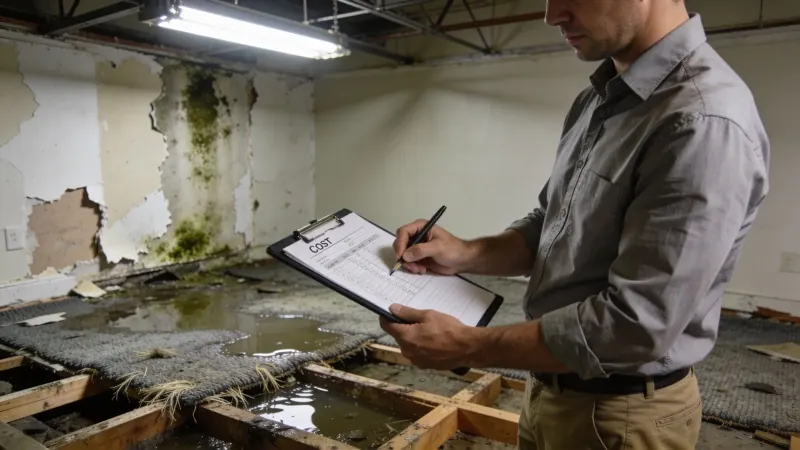
What Water Damage Restoration Actually Costs
You just found water in your home. The plumber stopped the leak or the appliance got shut off, and now you're staring at soaked carpet, wet drywall, and a growing sense of dread about how much this is going to cost.
We've been doing water damage restoration for over 15 years, and the single biggest complaint we hear from homeowners is that nobody gave them a straight answer on pricing. Other companies say "it depends" and leave it at that. That's not helpful when you're standing in a puddle trying to figure out your next move.
So here's the honest breakdown. Water damage restoration cost for a typical residential job ranges from $1,500 to $7,500. Minor damage in a single room sits at the low end. Multi-room damage with drywall removal and structural drying pushes toward the high end. Major events involving contaminated water or multi-story flooding can run $10,000 to $25,000+.
Those numbers cover the full scope: water extraction, structural drying, antimicrobial treatment, damaged material removal, and rebuild. What you'll actually pay depends on five things: the water category, how many square feet got hit, what materials are involved, how long the water sat, and whether your insurance covers it.
Call us at (844) 426-5801 for a damage assessment with a written estimate before any work starts. We work with all major insurance carriers and bill them directly, so most homeowners end up paying only their deductible.
Water Damage Restoration Cost by Damage Category
The Institute of Inspection, Cleaning and Restoration Certification (IICRC) classifies water damage into three categories under the ANSI/IICRC S500 standard. The category of water that entered your home is the single biggest factor in what the restoration will cost, because it determines how much material has to come out versus what can be dried in place.
Category 1: Clean Water
Source: Broken supply lines, faucet failures, toilet tank leaks (no waste), rainwater through a fresh opening, ice maker line breaks.
Cost range: $1,500 - $5,000 for most residential jobs.
What it means for your bill: Category 1 is the least expensive to restore because the water itself isn't contaminated. We can dry building materials in place rather than tearing them out.
A burst cold water supply line under your kitchen sink that soaked 200 square feet of flooring? We extract the water, set up air movers and dehumidifiers, apply antimicrobial treatment as a precaution, and dry everything over 3-5 days. The drywall below 24 inches usually survives if we get there within 24-48 hours.
The catch: Category 1 water doesn't stay Category 1. After 48-72 hours, clean water that's been sitting in carpet, drywall, and wall cavities picks up bacteria, organic material, and contaminants. It reclassifies to Category 2, and the price goes up because now we're pulling out materials instead of drying them.
| Service Component | Cost Range |
|---|---|
| Water extraction | $500 - $1,500 |
| Structural drying (3-5 days) | $1,000 - $3,000 |
| Antimicrobial treatment | $200 - $500 |
| Moisture monitoring | Included |
| Insurance documentation | Included |
Category 2: Gray Water
Source: Washing machine overflow, dishwasher discharge, toilet overflow with urine (no feces), sump pump failure, HVAC condensation overflow.
Cost range: $3,000 - $8,000 for most residential jobs.
What it means for your bill: Category 2 water contains contaminants that can cause illness. The IICRC S500 standard requires more aggressive protocols. Porous materials that absorbed gray water, like carpet padding, need to come out. Drywall below the water line often needs a flood cut (we cut it out 12-24 inches above the high-water mark and replace it). We apply stronger antimicrobial treatments and run HEPA air scrubbers during the project.
In our experience, washing machine overflows are one of the most common Category 2 events we respond to. The supply line cracks or the drain hose pops off while you're at work, and by the time you get home, 300-500 gallons of wash water has saturated the laundry room, the adjacent hallway, and sometimes the room below if it's on a second floor. That type of job typically runs $3,500-$6,500 including drywall replacement.
| Service Component | Cost Range |
|---|---|
| Water extraction | $500 - $2,000 |
| Carpet pad removal and disposal | $300 - $800 |
| Drywall flood cuts and removal | $500 - $2,000 |
| Structural drying (3-5 days) | $1,000 - $3,500 |
| Antimicrobial treatment | $300 - $800 |
| HEPA air scrubbing | $200 - $600 |
| Drywall replacement | $800 - $2,500 |
| Carpet replacement (if needed) | $500 - $2,000 |
Category 3: Black Water
Source: Sewage backup, toilet overflow with feces, rising floodwater from rivers or storms, storm surge, standing water that's been stagnant for over 72 hours.
Cost range: $7,000 - $25,000+ for most residential jobs.
What it means for your bill: Category 3 water is the most expensive to restore and there's no way around it. Every porous material the water touched has to be removed, not dried. That means all carpet, carpet pad, drywall (typically cut to at least 24 inches above the water line, often 48 inches for sewage), insulation, particleboard shelving, and any porous personal items. Our crew works in full PPE, including Tyvek suits and respirators, throughout the project.
Sewage backups are the Category 3 job we see most often. When the main sewer line backs up into a basement, contaminated water spreads across the entire floor. We're looking at full carpet removal, drywall demolition on every wall that water touched, structural cleaning with hospital-grade antimicrobials, extensive drying of the structural framing, HEPA air scrubbing, and then a complete rebuild. A finished basement sewage backup affecting 800-1,200 square feet regularly comes in between $12,000 and $20,000.
| Service Component | Cost Range |
|---|---|
| Category 3 water extraction (PPE required) | $1,000 - $3,000 |
| Full demolition (carpet, pad, drywall, insulation) | $2,000 - $6,000 |
| Structural cleaning and antimicrobial treatment | $1,000 - $3,000 |
| HEPA air scrubbing | $500 - $1,500 |
| Structural drying (5-7 days) | $1,500 - $4,000 |
| Contents removal and disposal | $500 - $2,000 |
| Rebuild (drywall, flooring, paint, trim) | $3,000 - $10,000+ |
| Post-remediation testing | $300 - $600 |
Need a Damage Assessment?
Our IICRC-certified team provides a written estimate before any work begins. We respond within 1 hour.
📞 Call (844) 426-5801Water Damage Repair Cost by Square Footage
Square footage is the second biggest cost driver after water category. More affected area means more equipment, more labor hours, and more materials for demolition and rebuild.
| Affected Area | Category 1 Cost | Category 2 Cost | Category 3 Cost |
|---|---|---|---|
| Small (under 100 sq ft) | $1,500 - $2,500 | $2,500 - $4,000 | $5,000 - $8,000 |
| Medium (100 - 500 sq ft) | $2,500 - $5,000 | $4,000 - $7,500 | $8,000 - $15,000 |
| Large (500 - 1,000 sq ft) | $5,000 - $8,000 | $7,500 - $12,000 | $15,000 - $22,000 |
| Very Large (1,000+ sq ft) | $8,000 - $12,000 | $12,000 - $18,000 | $20,000 - $35,000+ |
The "affected area" isn't just the floor space that got wet. Water travels. It wicks up drywall, seeps under baseboards into adjacent rooms, and saturates subfloor material beyond the visible water line. When we do moisture mapping with thermal imaging cameras and pin-type moisture meters, the actual affected area is almost always 20-40% larger than what the homeowner initially sees.
Equipment needs scale with square footage too. A single room with 150 square feet of water damage might need 3 air movers and 1 LGR dehumidifier. A whole floor at 1,000 square feet could need 10-15 air movers and 3-4 dehumidifiers. Each piece of equipment has a daily rental rate that factors into the total, and structural drying typically runs 3-5 days.
Water Damage Restoration Cost by Material Type
The materials in your home directly affect what it costs to restore or replace them after water damage. Carpet and standard drywall are relatively inexpensive to address. Hardwood floors and custom tile work are a different story.
Flooring Materials
| Floor Type | Restoration Cost (per sq ft) | Replacement Cost (per sq ft) | Notes |
|---|---|---|---|
| Carpet and pad | $2 - $4 (drying) | $3 - $8 (replacement) | Pad almost always replaced; carpet can sometimes be saved if Category 1 and dried within 24 hours |
| Hardwood | $5 - $10 (mat drying) | $8 - $15 (replacement) | Mat drying systems can save hardwood if cupping is minor; buckling usually means replacement |
| Engineered hardwood | $3 - $6 (drying attempt) | $6 - $12 (replacement) | Less tolerant of water than solid hardwood; delamination is common and irreversible |
| Laminate | Not restorable | $3 - $8 (replacement) | Laminate swells when wet and can't be dried back to shape. Always replacement. |
| Vinyl plank (LVP) | $1 - $3 (remove, dry subfloor, reinstall) | $3 - $7 (replacement) | LVP itself is waterproof but traps water underneath, requiring removal to dry the subfloor |
| Ceramic/porcelain tile | $2 - $4 (grout sealing check) | $8 - $15 (replacement) | Tile usually survives; the concern is water that penetrated grout lines and saturated the underlayment |
Wall and Ceiling Materials
| Material | Restoration Approach | Cost per Linear Foot / Sq Ft |
|---|---|---|
| Drywall (standard) | Flood cut at 24-48" above water line, replace | $4 - $8 per linear foot |
| Drywall (ceiling) | Usually requires full panel replacement | $5 - $10 per sq ft |
| Plaster walls | Can sometimes be dried in place; crumbling plaster replaced | $8 - $15 per sq ft |
| Baseboards and trim | Often removed during drying, reinstalled or replaced | $2 - $5 per linear foot |
| Insulation (fiberglass batts) | Removed and replaced if saturated | $1 - $3 per sq ft |
| Insulation (spray foam) | Usually survives; closed-cell is water-resistant | Inspection only |
Cabinetry and Built-Ins
Kitchen and bathroom cabinets add a big variable to water damage repair cost. Standard particleboard cabinets swell and delaminate when they absorb water. Once that happens, they can't be restored and need full replacement. Solid wood cabinets fare better and can often be dried, cleaned, and refinished.
- Particleboard cabinets (replacement): $3,000 - $12,000 depending on kitchen size
- Solid wood cabinets (restoration): $500 - $2,000 for cleaning, drying, and refinishing
- Bathroom vanities: $300 - $2,500 for replacement
What Actually Drives the Price: An Honest Breakdown
After 15 years and thousands of restoration jobs, here are the factors that make the biggest difference in what you'll pay. We're listing them in order of impact.
| Cost Factor | Impact Level | How It Affects Price |
|---|---|---|
| Water Category (1, 2, or 3) | Highest | Determines whether materials get dried or demolished |
| Affected Square Footage | High | More area = more equipment, labor, and materials |
| Duration of Exposure | High | Delays cause reclassification and mold risk |
| Materials Involved | Moderate | Hardwood and custom materials cost more than carpet/drywall |
| Height of Water | Moderate | Higher water means more drywall and insulation removal |
| Accessibility | Moderate | Hard-to-reach areas increase labor hours |
| Geographic Location | Low-Moderate | Major metros run 10-20% above national average |
| Secondary Mold Damage | Variable | Adds $1,500-$15,000+ if present |
1. Water Category (Biggest Factor)
The jump from Category 1 to Category 3 can double or triple your bill. Category 1 water lets us dry things in place. Category 3 means ripping it out and starting over. If your sewage line backs up versus a clean water supply line breaking, you're looking at a completely different scope of work.
2. Affected Square Footage
More area means more equipment, more labor, more time. A burst pipe that hits one bathroom is a different job than a supply line failure on the second floor that runs overnight and floods three rooms plus the ceiling below.
3. Duration of Exposure
This is where a lot of homeowners get burned on cost. Water that gets addressed within the first 12-24 hours costs significantly less to restore than water that's been sitting for 3, 5, or 7 days. After 48 hours, clean water reclassifies to gray water. Mold starts growing in wall cavities. Drywall that could have been dried now needs to be cut out. That's why we guarantee a 1-hour response when you call (844) 426-5801. Getting there fast saves you money in every case.
4. Materials Involved
Carpet and standard drywall are the cheapest materials to deal with. Hardwood floors, custom tile, plaster walls, and solid wood cabinetry all push costs up, whether we're restoring them or replacing them.
5. Height of Water
A water heater that dumps 40 gallons onto a concrete slab in a utility room is very different from 6 inches of standing water across a finished basement. The higher the water level, the more drywall comes out, the more insulation gets replaced, and the more personal property gets affected.
6. Accessibility
Water in a finished basement with drop ceilings and accessible wall cavities is easier to address than water in a crawl space, behind built-in bookshelves, or inside a wall cavity between the tub and an adjacent room. Difficult access means more labor hours and sometimes means more demolition to reach the wet materials.
7. Geographic Location
Restoration costs vary by metro area. Markets like Miami, Houston, and Los Angeles tend to run 10-20% above the national average. Midwestern and Southern markets outside the major metros tend to run 5-10% below. The cost tables in this guide reflect national averages.
8. Secondary Damage: Mold
If water damage sat long enough for mold to start growing, you're adding mold remediation costs on top of the water damage restoration. Mold remediation runs $1,500-$5,000 for a small area and $5,000-$15,000+ for extensive colonization. Every day of delay increases the chance you'll need mold remediation on top of everything else.
Three Real Cost Scenarios
| Scenario | Water Category | Area | Total Cost | Insurance |
|---|---|---|---|---|
| Kitchen sink supply line | Category 1 | 150 sq ft | $3,800 | Covered ($1,000 deductible) |
| Second-floor toilet overflow | Category 2 (reclassified) | 600 sq ft | $11,200 | Covered ($2,500 deductible) |
| Basement sewage backup | Category 3 | 900 sq ft | $18,500 | Partial ($10,000 rider) |
Scenario 1: The Kitchen Sink Supply Line
A homeowner in a two-story home noticed water pooling on the kitchen floor after work. The cold water supply line under the kitchen sink had cracked, leaking for roughly 4-5 hours. The water spread across the kitchen (tile floor, about 120 sq ft), into the adjacent hallway (30 sq ft of hardwood), and saturated the bottom 8 inches of drywall along three kitchen walls.
Water category: Category 1 (clean supply water)
Affected area: Approximately 150 square feet of flooring, 40 linear feet of drywall
Scope of work:
- Emergency water extraction (kitchen and hallway)
- Remove and dispose of carpet pad in hallway
- Set up 4 air movers and 1 LGR dehumidifier
- Antimicrobial treatment on all wet surfaces
- 4 days of structural drying with daily moisture monitoring
- Flood cut drywall at 24 inches on three kitchen walls (40 linear feet)
- Replace drywall, tape, mud, and paint
- Reinstall baseboards
Total cost: $3,800
Insurance covered: Yes. Homeowner paid $1,000 deductible. Insurance covered the remaining $2,800. We billed the carrier directly.
Scenario 2: The Second-Floor Toilet Overflow
A family returned from a weekend trip to find water damage on both their first and second floors. The toilet supply line in the upstairs bathroom failed sometime Friday evening. By Sunday afternoon, water had been running for roughly 40 hours.
Water category: Started as Category 1, reclassified to Category 2 due to time (40+ hours)
Affected area: Approximately 600 square feet across two floors
Total cost: $11,200
Insurance covered: Yes. Homeowner paid $2,500 deductible. Insurance covered $8,700. We handled all documentation and adjuster communication.
The 40-hour delay drove this bill up. If the supply line had been caught the same day, we would have been looking at Category 1 water in a smaller affected area, probably a $4,000-$5,000 job.
Scenario 3: The Basement Sewage Backup
A homeowner called at 6 AM on a Saturday. The main sewer line had backed up overnight, and the finished basement had 3-4 inches of sewage water across the entire floor. The basement was approximately 900 square feet with carpet, drywall, a bathroom, and a small kitchenette.
Water category: Category 3 (sewage; contaminated)
Affected area: 900 square feet of finished basement
Total cost: $18,500
Insurance covered: Partially. Standard homeowners insurance didn't cover the sewage backup, but the homeowner had a sewer/drain backup rider on their policy. The rider covered $10,000. The homeowner paid the remaining $8,500 out of pocket.
Dealing With Water Damage Right Now?
Our IICRC-certified crew arrives within 60 minutes. We bill your insurance directly.
📞 Call (844) 426-5801Does Insurance Cover Water Damage Restoration Cost?
| Type of Water Damage | Standard Homeowners Insurance | Additional Coverage Needed |
|---|---|---|
| Burst pipes / supply line failures | Covered | None |
| Appliance malfunctions (washer, dishwasher) | Covered | None |
| Accidental overflows | Covered | None |
| Sewer / drain backups | Not covered | Sewer backup rider ($40-$75/year) |
| Natural flooding (rivers, storms) | Not covered | NFIP or private flood insurance |
| Gradual leaks (slow, long-term) | Not covered | None available (maintenance issue) |
Most sudden water damage events are covered by standard homeowners insurance. You typically pay only your deductible ($500 to $2,500). Flooding from natural events, sewer backups, and gradual leaks are commonly excluded and require separate coverage. Our water damage insurance claim guide covers what's included, what's excluded, how to file, and how to maximize your settlement.
We bill your insurance company directly and handle all documentation and adjuster communication, so most homeowners don't front any cost beyond their deductible. Call (844) 426-5801 to get started.
When to Call a Professional vs. DIY
When You Can Handle It Yourself
- A small spill (less than 10 gallons) on hard flooring
- A minor leak that's been stopped and wet an area smaller than a bathroom floor
- Category 1 water only (clean water from a known source)
- No carpet or drywall involved
- No wall cavities or subfloor affected
Your DIY cost: $50-$200 for towels, a fan, and maybe a consumer dehumidifier rental.
When You Need a Professional
- Any amount of Category 2 or Category 3 water
- Water that reached carpet, carpet pad, or drywall
- Water that was standing for more than 24 hours
- Water in wall cavities
- Any situation involving more than one room
- Any time water came through a ceiling from the floor above
- Anytime you plan to file an insurance claim
Why the DIY gamble backfires: We get calls every week from homeowners who tried to handle water damage themselves with box fans and towels. Three weeks later, they smell mold. The typical "I tried DIY and now have mold" call costs $6,000-$12,000 to fix. If they'd called on day one, the water damage alone would have been $2,000-$4,000.
Professional equipment dries a home in 3-5 days; consumer equipment can take weeks, giving mold time to colonize. See our water damage cleanup page for the full breakdown.
If you're unsure whether your situation needs professional help, call (844) 426-5801 and describe what you're dealing with. We'll tell you straight if it's something you can handle or if you need a crew.
Water Damage Cleanup Cost by Service Type
Emergency Water Extraction
Cost: $500 - $3,000
Extraction for a single flooded room might run $500-$800, while a fully flooded basement with 6+ inches of standing water across 1,000 square feet is closer to $2,000-$3,000. See our emergency extraction service for details.
Structural Drying
Cost: $1,000 - $4,000
After extraction, all affected building materials need to reach their dry standard. Standard structural drying takes 3-5 days with daily moisture monitoring; concrete slabs and hardwood flooring often take 5-7 days.
Demolition and Material Removal
Cost: $1,000 - $6,000
Any material that's too saturated or contaminated to be restored needs to come out. Flood cuts on drywall, carpet and pad removal, insulation removal, baseboard removal, and sometimes cabinet or flooring removal.
Antimicrobial Treatment
Cost: $200 - $1,500
Applied to all affected surfaces after extraction and during drying to prevent bacterial and mold growth. Category 2 and 3 jobs get aggressive antimicrobial protocols with hospital-grade products.
Rebuild and Restoration
Cost: $1,500 - $15,000+
Once drying is complete, everything removed gets rebuilt. Basic drywall and carpet replacement in two rooms might run $2,000-$3,500. A full basement rebuild with new cabinets, flooring, and bathroom fixtures can run $8,000-$15,000+.
Mold Remediation (If Needed)
Cost: $1,500 - $15,000+
If mold is discovered during restoration, mold remediation adds $1,500 to $5,000 for small areas and $5,000 to $15,000+ for extensive growth. Addressing mold during active restoration is significantly cheaper than treating it as a separate project later.
Flood Damage Repair Cost
Flood damage restoration is fundamentally different from pipe burst or appliance failure water damage, both in scope and in insurance coverage. Flood water is always Category 3. Everything it touches requires demolition, not drying.
| Flood Severity | Cost Range | Description |
|---|---|---|
| Minor (1-2 inches in unfinished basement) | $3,000 - $6,000 | Extraction, cleaning, drying of concrete and framing |
| Moderate (2-6 inches in finished space) | $8,000 - $15,000 | Extraction, full demolition, structural cleaning, drying, rebuild |
| Severe (6+ inches or multiple rooms) | $15,000 - $35,000 | Extensive demolition, possible structural damage, full rebuild |
| Catastrophic (whole home flooding) | $30,000 - $75,000+ | Complete gut renovation, possible foundation issues, HVAC replacement |
Standard homeowners insurance doesn't cover flood damage from natural events. You need separate flood insurance through the NFIP or a private insurer. Our insurance claim guide explains the differences in detail.
The Hidden Costs Nobody Talks About
| Hidden Cost | Typical Range | Insurance Coverage |
|---|---|---|
| Temporary housing (hotel, rental) | $100-$300/night | Usually covered under ALE/loss of use |
| Contents damage (furniture, electronics) | $2,000-$20,000+ | Covered under personal property coverage |
| Increased utility bills | $100-$300 per billing cycle | Often covered as part of restoration claim |
| Time off work | 2-3 days over 1-2 weeks | Not covered |
If the damage is severe enough that you can't live in your home during restoration, your policy's "loss of use" or "additional living expenses" (ALE) provision typically covers temporary housing. Standard HO-3 policies provide ALE equal to 20% of your dwelling coverage.
Industrial dehumidifiers and air movers running 24 hours a day for 3-7 days draw significant electricity. Expect your electric bill to be $100-$300 higher for that billing cycle.
How to Get an Accurate Estimate
What a Proper Estimate Should Include
- Line-item breakdown of every service (extraction, drying, demolition, rebuild)
- Specific quantities (linear feet of drywall, square footage of flooring, number of equipment days)
- Equipment list with daily rates
- Labor costs separated from material costs
- Clear scope of work description
- Timeline estimate
- Insurance billing information
Red Flags in Restoration Estimates
- No written estimate before work starts. Walk away.
- Pricing dramatically lower than other estimates. They're either planning to cut corners or will hit you with change orders.
- Pressure to sign immediately. You have time to review an estimate.
- No IICRC certification. The IICRC S500 standard is the industry benchmark for water damage restoration.
- They won't work with your insurance company. Most reputable restoration companies bill insurance directly.
Frequently Asked Questions
Water damage restoration costs $1,500 to $7,500 for most residential jobs. Minor damage in a single room runs $1,500-$3,500. Multi-room damage with drywall and flooring replacement runs $3,500-$7,500. Major events with contaminated water or multi-story damage can exceed $10,000-$25,000.
The biggest cost factors are the water damage category (clean, gray, or black water), total square footage affected, types of materials damaged, how long the water sat before extraction began, and whether secondary damage like mold has developed.
Structural drying costs roughly $3-$8 per square foot for Category 1 water and $5-$12 per square foot for Category 2 or 3 water. This includes industrial dehumidifiers, air movers, daily moisture monitoring, and antimicrobial treatment. Standard drying runs 3-5 days.
Drywall exposed to Category 1 water and dried within 24-48 hours can sometimes be saved. Drywall that absorbed Category 2 or 3 water almost always needs replacement. Replacement runs $4-$8 per linear foot for wall flood cuts and $5-$10 per square foot for ceiling panels, including tape, mud, and paint.
Sewage cleanup (Category 3 water damage) costs $7,000-$25,000 for most residential jobs. A finished basement sewage backup affecting 800-1,000 square feet typically runs $12,000-$20,000.
Category 1 (clean water) costs $1,500-$5,000. Category 2 (gray water) costs $3,000-$8,000. Category 3 (black water/sewage) costs $7,000-$25,000+. The jump from Category 1 to Category 3 can double or triple your total bill.
Yes, significantly. Water damage addressed within 12-24 hours typically costs 30-50% less than damage that sits for 48-72 hours or longer. Clean water reclassifies to gray water after about 48 hours. Mold growth begins within 24-48 hours, potentially adding $1,500-$15,000 in remediation costs.
Mold remediation adds $1,500-$5,000 for small areas and $5,000-$15,000+ for extensive growth. It's often avoidable by starting professional restoration within the first 24-48 hours.
For very small Category 1 spills on hard floors, yes, and it costs under $200. For anything involving carpet, drywall, wall cavities, or contaminated water, DIY attempts frequently result in hidden moisture and mold growth that costs $6,000-$12,000 to fix later.
Flood damage costs significantly more because flood water is always Category 3. Minor flooding runs $3,000-$6,000. Moderate flooding runs $8,000-$15,000. Severe flooding costs $15,000-$35,000+. Flood damage requires separate flood insurance.
What to Do Right Now
If you're reading this because you have water damage in your home today, here's the short version of what needs to happen.
- Stop the water source if it's still active. Turn off the supply valve or the main water shutoff.
- Turn off electricity to affected areas if water is near outlets or electrical panels.
- Call (844) 426-5801. We answer 24/7. Our IICRC-certified crew arrives within 60 minutes with industrial extraction equipment.
- Document the damage. Take photos and video before anything gets moved or cleaned.
- Call your insurance company to report the claim.
- Don't throw anything away until the adjuster has seen it.
We provide a written damage assessment before any work begins. You'll know the full scope, the estimated cost, and what your insurance is likely to cover before we start.
Our crews are standing by across 20+ metro areas nationwide. Call (844) 426-5801 and let's get your home back to pre-loss condition.