It was 4 degrees outside in Hartford when the call came in. A homeowner had left for a long weekend, set the thermostat to 55, and figured that was enough. It wasn't. A copper supply line in the exterior wall of the upstairs bathroom split overnight. By Sunday evening, the kitchen ceiling on the first floor had collapsed, and water had been running into the wall cavities for close to 40 hours.
That's the Northeast in a nutshell. You get winters that freeze pipes nobody thought were vulnerable. You get nor'easters that dump rain sideways into 90-year-old window frames.
You get snowmelt in March that floods basements built before anyone thought about waterproofing. And you get ice dams that back water up under roof shingles like a slow, silent bathtub filling in your attic.
If you own a home anywhere from Maine to northern Virginia, the water damage risks you face are shaped by climate, construction age, and seasonal weather patterns that don't exist anywhere else in the country. This page covers those region-specific threats — what causes them, what they look like, and what restoration looks like when the damage is driven by conditions unique to the Northeast. For details on the water damage restoration process itself, our service page covers the step-by-step approach we take on every job. Call (844) 426-5801 any time — our crews respond within 60 minutes, even at 4 degrees.
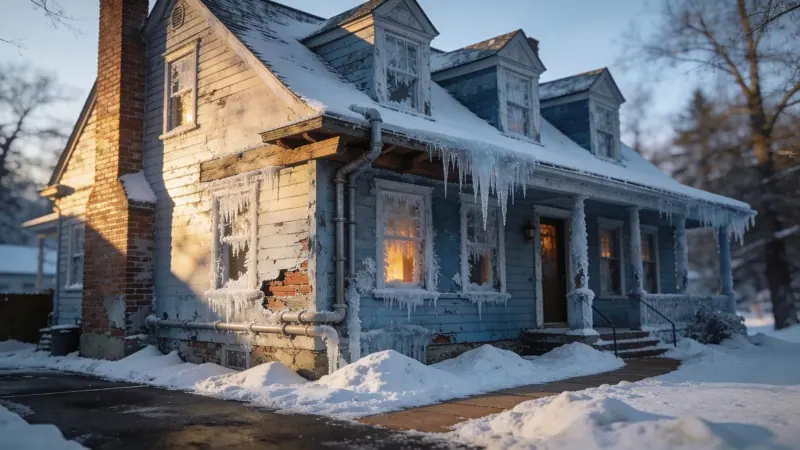
Frozen Pipes: The Northeast's Single Biggest Water Damage Threat
According to the Insurance Information Institute, frozen pipes are one of the most common causes of property damage claims in the United States, and the Northeast accounts for a disproportionate share. The National Weather Service (NWS) reports that prolonged periods of temperatures at or below 20°F put pipes at serious risk, and cities like Boston, Hartford, Buffalo, and Burlington regularly see stretches where temperatures stay in the single digits for days.
Why the Northeast Gets Hit Harder
Temperature alone doesn't explain it. Several factors converge:
Older construction methods. In homes built before the 1960s — which describes a huge portion of Northeast housing stock — plumbing runs were often routed through exterior walls, uninsulated crawl spaces, and unheated attic spaces. Modern building codes pushed pipes toward interior walls, but a 1920s Colonial in Concord doesn't follow 2020 building codes.
Brick and stone masonry. Many Northeast homes have solid masonry walls with no insulation cavity. Those walls conduct cold directly to any pipe running along or through them. In our experience restoring water damage in older Boston triple-deckers and Philadelphia row houses, the pipe that freezes is almost always in the exterior masonry wall — usually a bathroom supply line or a kitchen line that runs up from an unheated basement.
Extended cold snaps. A single night at 15°F might not freeze a pipe. But five consecutive nights in that range — common from December through February across the I-95 corridor — gives cold enough time to penetrate insulation, wall cavities, and even some interior spaces. The January 2025 polar vortex event dropped temperatures across New England below zero for three straight days, and water damage calls spiked accordingly.
Vacant or under-heated properties. Snowbirds who head south, vacation homes in the Catskills or Berkshires, rental units between tenants — these properties lose heat during the worst stretches. Even homes where the thermostat is set to 55°F can freeze pipes in poorly insulated exterior walls because the air around those pipes might be 20 degrees colder than the thermostat reading.
What Frozen Pipe Damage Looks Like in the Northeast
When a pipe freezes and splits in a Northeast home, the damage pattern is often more complex than what we see in newer Southern construction. Here's why:
- Plaster walls absorb and hold water differently than drywall. Plaster on lath — common in pre-1950s homes — wicks water aggressively. Once saturated, it takes significantly longer to dry than standard half-inch drywall. The lath behind it traps moisture, and the plaster itself can crumble when wet, creating a demolition situation where drying isn't enough.
- Multiple floors mean cascading damage. Northeast homes tend to be two and three stories. A frozen pipe on the third floor sends water through every floor below it. We've restored triple-deckers in Boston where a single pipe burst on the top unit caused damage in all three apartments — three ceilings, three sets of wall cavities, three floors of affected materials.
- Balloon-frame construction. Many pre-1940s Northeast homes use balloon framing, where wall studs run continuously from the foundation to the roof. In these homes, water from a burst pipe can travel vertically through the entire wall cavity — from attic to basement — making the damage path much harder to track without thermal imaging.
Regional Story: The Beacon Hill Brownstone
A property manager in Boston's Beacon Hill neighborhood called us on a Wednesday morning in February. One of his tenants reported water staining on the parlor-level ceiling. By the time we arrived, we could hear water running inside the wall between the second and third floors.
The pipe had likely frozen and cracked two days earlier during a cold snap, but because the crack was small, the leak started slow. When temperatures climbed back above freezing and water pressure returned to normal, the crack opened up. Water had been traveling down the balloon-frame wall cavity from the third floor, pooling on the second-floor ceiling joists, and slowly saturating the plaster below.
We extracted standing water from the second floor, opened up the third-floor wall to access the pipe, and used our injectidry system to dry the wall cavities without tearing out all the plaster — which was original to the 1870s building and important to the owner. Moisture monitoring ran for seven days because the old plaster held onto water like a sponge. The entire project took 10 days, about twice what the same burst would take in a drywall home.
That's Northeast restoration work. The building age adds complexity to every step.
Frozen Pipe Emergency?
Our IICRC-certified crews respond within 60 minutes across the Northeast — even during polar vortex events.
📞 Call (844) 426-5801Nor'easters and Coastal Storms: Wind-Driven Water Intrusion
The Northeast gets its own weather category that most of the country doesn't deal with: nor'easters. These extratropical cyclones track up the Atlantic coast and deliver a combination of heavy rain, high wind, and sometimes snow that creates water damage from directions homeowners don't expect.
How Nor'easters Cause Water Damage
A nor'easter isn't just a big rainstorm. The wind direction — from the northeast, hence the name — drives rain horizontally against structures at sustained speeds of 40-60+ mph. That creates problems that a straight-down rainstorm never would:
Wind-driven rain enters through walls. Older Northeast homes rely on building paper and sheathing that can't handle sustained horizontal rain. We've seen water enter through mortar joints in brick facades, through lap siding joints, through window frames, and around chimney flashing — all points where gravity normally keeps water out, but wind-driven rain defeats.
Storm surge and coastal flooding. Nor'easters coinciding with high tide create storm surge along the coast from northern Virginia through Maine. NOAA reports that major nor'easters can produce storm surge of 3-5 feet in coastal communities. The March 2018 back-to-back nor'easters caused extensive flooding in Quincy, Scituate, and Marshfield, Massachusetts. The December 2024 nor'easter pushed tidal flooding into communities along the Connecticut and New Jersey shorelines.
Snowmelt plus rain. The worst damage scenarios come when a nor'easter brings warm rain onto existing snow cover. The rain plus melting snow overwhelms storm drains, foundation drains, and sump pump systems simultaneously. Basements that handle normal groundwater just fine get overwhelmed by the combined volume.
Power outages kill sump pumps. Nor'easters frequently knock out power. According to tracking data from regional utilities, major nor'easters in the last five years have each caused power outages affecting hundreds of thousands of customers across the Northeast. When power goes out, battery backup sump pumps only last 5-8 hours under continuous pumping. After that, the basement floods.
Regional Storm Patterns
Coastal Connecticut, Rhode Island, Massachusetts: Storm surge and tidal flooding during nor'easters. Wind-driven rain through older coastal construction. Salt spray corrosion on exterior systems.
Upstate New York and Vermont: Lake-effect snow events burying homes, followed by rapid warmth that creates massive snowmelt. Ice jam flooding on rivers like the Winooski, Hudson, and Mohawk during spring breakup.
New Jersey and Pennsylvania: Combination of coastal and inland flooding. Rivers like the Delaware, Raritan, and Schuylkill swell during nor'easters and spring rain. The Passaic River basin in northern New Jersey is particularly flood-prone during heavy rain events.
Maine and New Hampshire: Extended freeze-thaw cycles that stress plumbing systems all winter. Nor'easters bring heavy wet snow that causes roof collapses and subsequent water damage. Ice damming is extremely common on older New England saltbox and Cape Cod style roofs.
Northeast Water Damage Risk by State: Regional Comparison
| State | Top Water Damage Threat | Construction Age Factor | Avg. Annual Snowfall | Frozen Pipe Risk | Typical Restoration Timeline |
|---|---|---|---|---|---|
| Massachusetts | Frozen pipes + ice dams | Pre-war balloon framing, plaster walls | 49-60" | Very High | 7-12 days |
| Connecticut | Nor'easter wind-driven rain | Mixed pre-war and post-war stock | 35-45" | High | 5-8 days |
| New York (Upstate) | Lake effect snow + spring flooding | Pre-war stone foundations | 60-120" (lake effect zones) | Very High | 6-10 days |
| New York (Metro) | Aging infrastructure + sewer backup | Pre-war brownstones, row houses | 25-35" | High | 5-9 days |
| New Jersey | Coastal/river flooding + nor'easters | Mixed construction eras | 25-40" | Moderate-High | 5-8 days |
| Pennsylvania | River flooding + aging plumbing | Pre-war row houses (Philadelphia) | 25-50" | High | 5-9 days |
| Maine | Ice dams + frozen pipes | Older Cape Cod and saltbox styles | 60-80" | Very High | 7-10 days |
| New Hampshire | Freeze-thaw cycles + ice dams | Colonial-era to mid-century | 55-70" | Very High | 6-10 days |
| Vermont | Spring ice jam flooding + frozen pipes | Rural older construction | 60-80" | Very High | 6-10 days |
| Rhode Island | Coastal storm surge + nor'easters | Dense pre-war housing stock | 35-45" | High | 5-8 days |
Timelines reflect typical residential restoration in older construction. Projects involving plaster, balloon framing, or stone foundations trend toward the longer end.
Ice Dams: The Slow, Silent Northeast Roof Problem
Ice dams don't make national headlines, but they cause an enormous amount of water damage across the Northeast every winter. The Insurance Information Institute identifies ice dams as a significant source of homeowners insurance claims in cold-weather states.
How Ice Dams Form
An ice dam forms when heat escaping through the roof melts snow on the upper portion of the roof. That meltwater runs down to the eaves — the bottom edge of the roof — where there's no heat loss from the building below. The water refreezes, creating a ridge of ice. As more meltwater runs down and hits that ice ridge, it backs up and pools under the shingles.
Shingles are designed to shed water running downhill. They're not designed to hold back water pooling uphill behind an ice dam. The water works its way under shingles, through the underlayment, and into the roof deck, attic, and eventually into the living space below.
Why the Northeast Is Especially Vulnerable
Older attic insulation. Homes built before the 1980s across New England typically have inadequate attic insulation — R-19 or less, when current code calls for R-49 or higher. That heat loss through the roof is what drives ice dam formation.
Complex rooflines. Northeast architecture — Capes, Colonials, Gambrels, Victorian-era homes — features dormers, valleys, and multiple roof planes that trap snow and create points where ice dams form repeatedly. A simple gable roof rarely dams. A 1910 Victorian with six dormers and three valleys dams every single winter.
Snow load. The Northeast gets enough snow to sustain dams all winter. From November through March, snow sits on roofs for weeks at a time. In northern New England, snow loads on roofs can persist for months. That's months of slow melt, refreeze, and ice dam growth.
What Ice Dam Damage Looks Like
Ice dam water damage is distinctive because it's slow and often hidden. Unlike a burst pipe that dumps gallons per hour, ice dam leaks seep gradually — sometimes for weeks before anyone notices. By the time a homeowner sees a brown stain on the bedroom ceiling, water has been saturating the roof deck, attic insulation, and ceiling joists above for days or weeks.
In our experience restoring ice dam damage across New England and upstate New York, we typically find:
- Saturated attic insulation that has collapsed and lost all R-value
- Mold growth on the underside of the roof deck — often extensive because the leak has been ongoing
- Staining and water damage on ceilings in rooms below the roofline
- Wet wall cavities where eave walls meet the ceiling plane (common in Cape Cod style homes where second-floor rooms sit directly under the roofline)
Regional Story: The Cape Cod in Portland, Maine
A homeowner called us in late February after noticing water dripping from a light fixture in the upstairs bedroom. She thought it was a roof leak from the storm three days earlier. It wasn't — it was an ice dam that had been building since January.
When we inspected the attic (which in a Cape Cod is the narrow knee-wall space along the eaves), we found 18 inches of ice built up along the entire north-facing eave. Meltwater had been seeping under the shingles and running down the roof deck for approximately six weeks. The insulation was saturated and compressed. We found active mold growth on the underside of the roof deck spanning a 12-foot section.
The restoration required removing the damaged insulation, treating the mold on the roof sheathing, drying the ceiling joists and wall cavities, and replacing the ceiling drywall in two rooms. After the water damage was addressed, the homeowner had a roofing contractor install ice and water shield membrane along the eaves and add blown-in insulation to the attic — fixes that should prevent future dams.
Total project: eight days for the water damage restoration and mold treatment. The ice dam itself had been quietly causing damage for over a month before anyone knew. That's the nature of ice dam damage — it's slow, hidden, and by the time you see it, there's more behind the wall than on the surface. For questions about mold specifically, our mold remediation page covers the full treatment process.
Basement Flooding From Snowmelt and Spring Rain
Every March and April across the Northeast, the phone rings with basement flooding calls. Spring thaw is predictable — and so is the flooding it causes.
The Spring Thaw Problem
The Northeast accumulates snow from November through March. When temperatures climb in spring, that snow melts — sometimes gradually, sometimes rapidly during a warm rain event. The ground beneath the snow is often still frozen or saturated from winter moisture, so it can't absorb the meltwater. All that water runs downhill, pools against foundations, and finds every crack, gap, and weakness in the basement wall.
Boston, for example: Average winter snowfall is approximately 49 inches. In high-snowfall years, that number climbs significantly higher. When all of that melts over a few weeks, the volume of water moving through the soil is enormous.
The timing is predictable. In the mid-Atlantic (Pennsylvania, New Jersey, Delaware), the melt usually starts in late February to mid-March. In southern New England, it's March into early April. In northern New England and upstate New York, it can extend into late April. We staff up accordingly because we know the calls are coming.
How Northeast Basements Differ
For general basement flooding causes, prevention, and restoration, see our basement flooding page. What makes Northeast basements distinct:
Stone and rubble foundations. Homes built before the 1920s across the Northeast often have foundations made of stacked fieldstone or rubble — not poured concrete. These walls are inherently porous. Water moves through the mortar joints and stone faces with almost no resistance. You cannot waterproof a rubble foundation the same way you waterproof a poured concrete wall.
Aging drain tile systems. Homes built in the 1950s through 1970s may have original clay drain tile around the foundation footing. After 50-70 years, those tiles crack, collapse, and clog with root intrusion and sediment.
Discharge line freezing. Most Northeast basements rely on sump pumps, and during spring thaw these pumps run continuously for weeks. The unique Northeast risk is discharge line freezing during late-season cold snaps — the pump runs but water has nowhere to go and backs up into the basement.
Prevention Is Regional
For homeowners across the Northeast, spring basement flooding is often preventable with maintenance that accounts for regional conditions:
- Grade soil away from the foundation before the thaw (fall is the best time)
- Clean gutters and extend downspouts 6-10 feet from the foundation
- Test sump pumps in February — before you need them
- Install a battery backup sump pump (critical when spring nor'easters knock out power)
- Know the age and condition of your foundation drain system
For details on basement-specific restoration approaches, see our basement flooding page. If your basement is flooding right now, call (844) 426-5801 — we're available 24/7.
Basement Flooding? Act Now.
Spring thaw and nor'easters don't wait — and neither do we. 60-minute response across the Northeast.
📞 Call (844) 426-5801Aging Infrastructure: Pre-War Homes and Outdated Plumbing
The Northeast has some of the oldest housing stock in the country. According to the U.S. Census Bureau, the Northeast has the highest proportion of homes built before 1950 of any region in the United States. That age shows up in the plumbing.
What We See in Older Northeast Homes
Galvanized steel pipes. Standard in homes built from the 1920s through the 1960s. Galvanized pipes corrode from the inside out, building up mineral deposits that restrict flow and eventually cause pinhole leaks or full failures. A galvanized supply line with 60+ years of corrosion buildup doesn't burst dramatically — it develops slow leaks inside walls that go undetected for weeks. By the time the homeowner sees a stain, the wall cavity is soaked and mold is already growing.
Lead pipes and lead solder joints. Homes built before 1986 may have lead supply lines or copper pipes joined with lead solder. These connections corrode over time and can develop leaks at the joints. We see this frequently in older homes across Connecticut, Massachusetts, and upstate New York.
Cast iron drain lines. Cast iron waste pipes were standard until the 1970s. After 50+ years of use, cast iron rusts, develops holes, and eventually collapses. A failed cast iron drain line under a basement slab can leak sewage-contaminated water for months before it's detected — usually by the smell or by mold growth that appears with no obvious water source.
Knob-and-tube wiring near plumbing. In pre-war homes, we sometimes find plumbing and electrical sharing wall and ceiling cavities. Water damage in these areas creates a serious electrical hazard. We always assess electrical safety before beginning restoration in pre-1940s homes, and we recommend a licensed electrician inspect any area where water has contacted old wiring.
Regional Story: The 1923 Colonial in Westchester County
A family in a 1923 Colonial Revival in Westchester County, New York, noticed their water bill had been creeping up for three months. There was no visible leak. When they finally called a plumber, he found a pinhole leak in a galvanized supply line inside the wall between the kitchen and the dining room.
We got called in after the plumber opened the wall. The galvanized pipe had been weeping water into the wall cavity for an estimated 8-10 weeks. Both sides of the wall were saturated — plaster on lath on both the kitchen and dining room sides. The subfloor beneath was wet. There was established mold growth on the studs and the backside of the plaster, consistent with weeks of continuous moisture.
The restoration required:
- Removing plaster and lath on both sides of the affected wall (approximately 8 linear feet)
- Removing and replacing wet subfloor sections
- Mold remediation on the studs (antimicrobial treatment and HEPA vacuuming)
- Structural drying of the floor joists and remaining framing for five days
- Rebuild of the plaster walls (the homeowner chose to restore with plaster to match the rest of the house)
Total restoration time was 12 days — significantly longer than a similar scope in a modern drywall home, primarily because of the plaster work. The slow leak in the old pipe had turned a minor plumbing issue into a major restoration project. For homeowners wondering about costs for this kind of work, our water damage repair cost guide breaks down pricing by damage type and severity.
Regional Insurance Considerations for Northeast Homeowners
Insurance coverage for water damage in the Northeast involves some region-specific nuances that homeowners should understand. For the full claims process, see our water damage insurance claim guide — but here are the Northeast-specific factors:
Frozen Pipe Coverage
Most standard homeowners policies (HO-3) cover frozen pipe damage if the homeowner maintained adequate heat in the property. Where this gets complicated in the Northeast:
- Vacancy requirements. If you leave a Northeast home unoccupied during winter, many policies require you to either maintain heat at 55°F or above, or drain the plumbing system. If a pipe freezes in a home you left unheated during a January trip, the carrier may deny the claim. Read your policy's vacancy clause carefully.
- "Reasonable care" language. Carriers in the Northeast are experienced with freeze claims. They know that a pipe in an uninsulated exterior wall can freeze even with the thermostat at 60°F. Some will cover the claim; others will argue the homeowner should have taken additional precautions. Documentation of thermostat settings and maintenance helps.
Flood Insurance in the Northeast
Standard homeowners insurance doesn't cover flooding — and the Northeast has significant flood risk from nor'easters, coastal storm surge, and river flooding. Homeowners in FEMA-designated flood zones are required to carry separate flood insurance through the National Flood Insurance Program (NFIP) or a private flood insurer.
Key Northeast-specific flood insurance considerations:
- Coastal flood zones. Much of the shoreline from New Jersey through Maine falls within FEMA Special Flood Hazard Areas. After Hurricane Sandy in 2012, FEMA updated flood maps across the Northeast, reclassifying many properties into higher-risk zones.
- River flood plains. Inland flooding along the Delaware, Connecticut, Merrimack, and Hudson rivers affects thousands of properties that aren't on the coast. Many of these homeowners don't carry flood insurance because they don't think of themselves as in a flood zone.
- Spring thaw isn't covered by homeowners insurance. If snowmelt causes overland flooding that enters your basement through a window well or door, that's a flood — not covered by your HO-3 policy. You need flood insurance. If groundwater pushes up through a floor crack under hydrostatic pressure, coverage depends on your policy language and whether you have a sump pump failure/water backup endorsement.
Wind-Driven Rain Claims
Nor'easter damage from wind-driven rain can fall into a gray area. Your homeowners policy covers wind damage and the resulting water damage from wind — for example, if wind rips off shingles and rain enters through the damaged roof. But if wind-driven rain simply enters through an intact wall because the rain was moving horizontally, some carriers classify that differently. Documentation is critical: we photograph the point of water entry and the storm conditions to support your claim.
Climate Trends Affecting Northeast Water Damage
Weather patterns across the Northeast are shifting, and those shifts directly affect water damage risk:
Warmer winters with more rain. According to NOAA's Northeast climate assessments, the region has seen an increase in heavy precipitation events. Winter storms that once delivered snow are more frequently delivering rain — or a mix of rain on top of snow, which accelerates melt and runoff.
More intense storms. The trend toward heavier individual rainfall events means more water in shorter periods, overwhelming aging storm drain systems and foundation drainage across the region.
Freeze-thaw cycles. As average winter temperatures creep upward, the Northeast experiences more frequent freeze-thaw cycles rather than sustained cold. Repeated freezing and thawing stress plumbing systems, foundation walls, and masonry more than a consistent cold snap. Pipes that survive a steady 10°F week may fail during a rapid swing from 40°F to 5°F and back.
Extended shoulder seasons. Springs are earlier and falls are warmer, but winter storms can still strike late. The March 2025 nor'easter hit the mid-Atlantic with heavy rain when many homeowners had already disconnected sump pump discharge lines and moved outdoor furniture against foundations, creating drainage problems they wouldn't have had in January.
These trends mean Northeast homeowners are dealing with water damage risks that are evolving — not stable. What your parents' home handled fine in the 1980s may not hold up the same way under current conditions.
When to Call for Water Damage Restoration in the Northeast
Because of the region's specific risks, there are situations where Northeast homeowners should call for professional assessment even when the damage doesn't look severe:
- After any frozen pipe event — even if you caught it quickly. Water in balloon-frame walls travels vertically, and the damage below the burst point may be worse than what you see at the pipe.
- After a nor'easter with wind-driven rain — if you notice any damp spots on interior walls, especially on the windward side of the house. Wind-driven rain penetrates in ways that keep leaking for hours after the storm passes.
- In spring when the sump pump runs continuously — if it's cycling more frequently than usual, the groundwater level is high and your foundation is under pressure. One pump failure away from a flooded basement.
- After discovering any leak in a pre-war home — slow leaks in old plumbing cause more hidden damage than fast leaks in modern construction because the building materials hold moisture differently.
- Any time you smell musty air in the basement during spring — that smell is moisture. It may be normal seasonal dampness, or it may be the beginning of a mold problem from water you can't see.
We respond to calls across the Northeast within 60 minutes — Boston, New York metro, Hartford, Philadelphia, and everywhere in between. Call (844) 426-5801 any time, day or night.
Frequently Asked Questions About Water Damage Restoration in the Northeast
Many Northeast homes feature balloon-frame construction, plaster-on-lath walls, and plumbing routed through exterior masonry walls. When a pipe freezes in these structures, water can travel vertically through entire wall cavities, plaster absorbs and holds moisture longer than drywall, and the damage path is harder to trace without thermal imaging. Restoration typically takes longer because of these older building methods.
Most standard HO-3 policies cover water damage resulting from ice dams — the damage to ceilings, walls, and insulation caused by water backing up under shingles. However, insurance typically doesn't cover the cost of removing the ice dam itself or improving the insulation and ventilation that caused the dam. Coverage varies by carrier, so review your policy or call your agent.
Extremely common. The spring thaw season — typically late February through April depending on latitude — is our busiest time for basement flooding calls across the Northeast. Snow accumulation melts into saturated or frozen ground that can't absorb it, overwhelming foundation drains and sump pumps. Homes with older stone foundations, aging drain tile, or no sump pump backup are most vulnerable.
Yes. Plaster-on-lath walls take significantly longer to dry than standard drywall, balloon-frame construction allows water to travel vertically through entire wall cavities, and older pipe materials like galvanized steel develop slow hidden leaks. Restoration in pre-war homes typically requires more drying time, more careful demolition, and more moisture monitoring than modern construction.
Standard homeowners insurance covers sudden internal water damage — burst pipes, appliance failures, roof leaks. Flooding from external sources — nor'easter storm surge, river overflow, spring snowmelt overland flow — requires separate flood insurance through the NFIP or a private carrier. Many Northeast homeowners in flood-prone areas need both policies. Our insurance claim guide covers the full details.
Nor'easters affect inland homes through wind-driven rain that penetrates wall assemblies and window frames, heavy rainfall that overwhelms storm drains and causes basement flooding, power outages that disable sump pumps, and rapid snowmelt when warm rain falls on existing snow cover. Inland flooding from rivers swollen by nor'easter rainfall is also a significant risk in valleys across the region.
If you're leaving for more than a few days during winter, either maintain heat at 55°F minimum and have someone check the property regularly, or drain the plumbing system entirely and shut off the main water supply. Many insurance policies require one of these precautions for freeze claims to be honored. Draining the system is the safest option for extended absences.
If your home was built between the 1920s and 1960s and the plumbing has not been updated, you likely have galvanized steel supply pipes. You can check visible pipes in the basement — galvanized looks like dull gray metal, often with crusty mineral deposits at joints. Low water pressure, rusty-colored water, and pinhole leaks are signs of advanced corrosion. A plumber can assess the full system.
Protect Your Northeast Home — Call Now
The Northeast throws more varied water damage scenarios at homeowners than almost anywhere else in the country. Frozen pipes in January, ice dams in February, snowmelt flooding in March, nor'easters from October through April — the threats rotate with the seasons, and the older your home, the more vulnerable it is.
You can't control the weather. But you can control how fast you respond when water gets inside. Our IICRC-certified crews are positioned across the Northeast — from Boston to Philadelphia, Hartford to Buffalo — and we respond within 60 minutes, 24 hours a day, 365 days a year. We understand the specific challenges of restoring water damage in older Northeast construction, and we've got the equipment and experience to handle plaster walls, balloon framing, stone foundations, and everything else this region's housing stock throws at us.
For general information about our water damage restoration services, visit our main service page. For pricing specifics, see our cost guide. And for help with your insurance claim, our insurance claim guide walks through the process step by step.
If water is in your Northeast home right now, call (844) 426-5801. We'll be there within the hour.