The call came from a homeowner in Scottsdale at 7:45 PM on a July evening. A monsoon cell had parked over the north side of the metro for 40 minutes, dropping rain at a rate the ground simply couldn't absorb. The wash behind her property — bone dry for the previous 11 months — was running 4 feet deep. Water had breached the back wall, entered through the sliding glass door threshold, and flooded the living room, kitchen, and hallway with 3 inches of muddy, debris-laden water.
Forty minutes of rain. Eleven months of drought before it. Three inches of water inside a home that had never flooded before.
That's water damage restoration in the Southwest — a region where people assume water isn't the problem. It is. The Southwest's arid climate creates a paradox: the same dryness that makes water damage seem unlikely is exactly what makes it severe when it happens. Hard-baked soil can't absorb sudden rainfall. Plumbing corrodes faster in mineral-heavy desert water. Evaporative coolers drip moisture into structures year-round. And when monsoon season arrives, flash floods fill desert washes faster than some rivers rise.
This page covers the water damage threats specific to the Southwest — Arizona, New Mexico, Nevada, western Texas, and southern Utah. For the general restoration process or insurance claims guidance, those dedicated pages have the details. Here, we focus on what makes desert water damage different from what the rest of the country experiences. Call (844) 426-5801 for 24/7 emergency response across the Southwest.
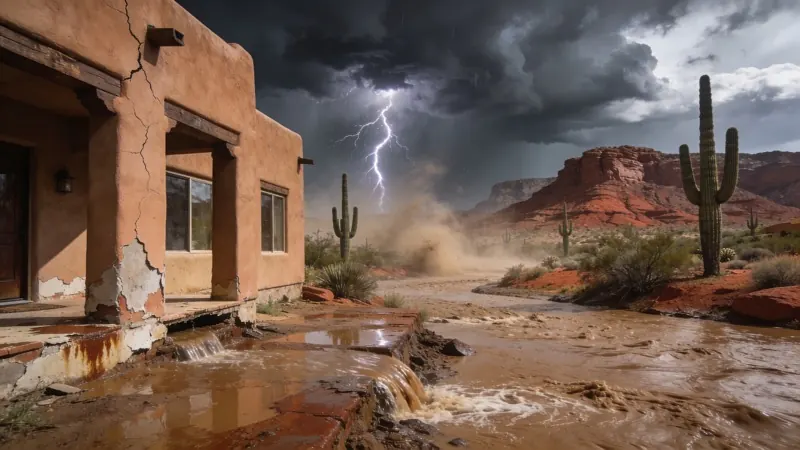
Monsoon Season: The Southwest's Annual Flood Event
The North American Monsoon — officially tracked by the National Weather Service — runs from approximately June 15 through September 30 across the Southwest. It brings a dramatic shift in weather patterns: moisture surges from the Gulf of Mexico and Gulf of California, combined with intense afternoon heating, produce thunderstorms that are brief but extraordinarily intense.
What Makes Monsoon Rain Different
Intensity over duration. A typical Midwest thunderstorm might drop 1-2 inches of rain over an hour. A monsoon cell over Phoenix, Tucson, or Albuquerque can drop 1-2 inches in 15-20 minutes. This rainfall intensity exceeds the capacity of storm drainage systems, parking lots, streets, and landscapes to handle the volume. Water accumulates faster than it can drain.
Localized cells. Monsoon storms are often hyperlocal — a thunderstorm cell may cover only 5-10 square miles. One side of a metro area can receive 2 inches of rain while the other side gets nothing. This means your neighborhood can flash-flood while your friend 10 miles away sees clear skies. The localized nature makes prediction difficult and preparation challenging.
Desert soil doesn't absorb water. The caliche and clay soils common across the Southwest develop a hard, compacted surface layer during months of extreme heat and dryness. When rain finally falls, the soil surface acts more like pavement than soil. Virtually all the rainfall becomes surface runoff, channeling into washes, streets, and — when topography or grading directs it — homes.
How Monsoon Flooding Enters Southwest Homes
Southwest homes are designed for heat, not water. That design philosophy creates entry points that don't exist in wetter climates:
Slab-on-grade construction with minimal foundation height. Most Southwest homes are built on concrete slab foundations with very little elevation above the surrounding grade — sometimes only 2-4 inches. In wetter regions, homes are typically elevated 8-12 inches or more above grade. Those few inches of elevation difference mean Southwest homes flood at lower water depths.
Sliding glass doors and low thresholds. Southwest architecture emphasizes indoor-outdoor living — large sliding glass doors, patio connections, minimal thresholds. Those low thresholds that make it easy to step onto the patio also make it easy for flash flood water to enter when the water level outside reaches 2-3 inches.
Desert landscaping directs water toward structures. Gravel, decomposed granite, and hardscape — the standard Southwest yard — don't absorb water the way grass lawns do. Hardscape can channel water toward the home if the grade isn't carefully maintained. We've seen homes flood not because the storm was unusually severe, but because landscaping changes — a new patio, a raised planter bed, a modified drainage path — redirected water toward the foundation.
Wash proximity. Many Southwest neighborhoods are built near dry washes (arroyos) that carry water only during storms. These washes can go from bone dry to raging torrents in minutes during a monsoon event. Properties adjacent to washes face particular risk. The Maricopa County Flood Control District tracks wash conditions during monsoon season, but the speed at which conditions change catches many homeowners off guard.
Regional Story: The Monsoon in North Phoenix
A homeowner in north Phoenix had lived in a 2004-built stucco home for nine years without a single water issue. The lot was flat, graded away from the house, with a typical desert landscape of decomposed granite and native plants.
In July, a monsoon cell dropped an estimated 1.5 inches of rain in approximately 25 minutes directly over the neighborhood. The wash two blocks east filled and overflowed. Sheet water across the neighborhood flowed toward a low point — which turned out to be the homeowner's backyard, where a recently installed raised patio had altered the drainage pattern.
Water entered through the sliding glass door threshold and through a utility penetration where the AC refrigerant line entered the exterior wall. By the time the storm passed, 2 inches of muddy water covered approximately 800 square feet of tile and carpet.
The water was Category 3 — contaminated with soil, debris, and wash runoff that contained fertilizer, motor oil, and animal waste. Every square inch of carpet and pad in the affected area had to be removed. The drywall was cut to 24 inches above the flood line. Antimicrobial treatment was applied to the slab, studs, and remaining drywall.
Here's the part that surprises people: the drying took only two days. In the Southwest's low humidity — often 10-15% relative humidity in summer — our dehumidifiers and air movers pull moisture out of building materials dramatically faster than in humid climates. The entire restoration, including demolition, drying, and rebuild, took nine days. The same scope in Miami would have taken 14.
That fast drying is the one advantage of desert water damage restoration. The disadvantage is that the flooding itself often comes with zero warning.
Monsoon Damage? Call Now.
Our Southwest crews respond within 60 minutes, 24/7 — even during active storms.
📞 Call (844) 426-5801The Desert Paradox: Dry Climate Creates Pipe Corrosion and Plumbing Failures
Here's what most people don't realize about water damage in the Southwest: the region's plumbing failure rate is significant, driven by water chemistry and soil conditions that are unique to arid environments.
| Water Damage Source | Risk Level | Peak Season | Typical Detection Time | Avg. Restoration Days |
|---|---|---|---|---|
| Monsoon flash flooding | High | Jul–Sep | Immediate | 7–10 |
| Slab leak (copper corrosion) | High | Year-round | Days to weeks | 5–7 |
| Evaporative cooler leak | Moderate | Apr–Oct | Hours to days | 3–5 |
| Polybutylene pipe rupture | Moderate | Year-round | Immediate | 4–7 |
| Expansive soil foundation crack | Moderate | Jul–Sep (monsoon) | Weeks to months | Varies |
How Dry Climate Damages Plumbing
Hard water and mineral buildup. Southwest water supplies — whether municipal or well water — are typically very hard, with high concentrations of calcium, magnesium, and other dissolved minerals. Phoenix metropolitan area water, for example, has hardness levels that are considered hard to very hard by USGS standards. This mineral content builds up inside pipes over years, restricting flow and creating points of corrosion.
Copper pipe corrosion. Copper supply lines — standard in Southwest homes built from the 1970s through the 2000s — are susceptible to a specific type of corrosion called pitting corrosion when exposed to the region's water chemistry. The combination of high mineral content, chloramine disinfection (used by many Southwest municipal water systems), and the water's pH creates conditions where small pits form in the interior of copper pipes. Over 15-25 years, those pits penetrate the pipe wall and create pinhole leaks.
Pinhole leaks in copper pipes are one of the top three water damage calls we respond to across the Phoenix and Tucson metro areas. The leak often occurs inside a wall or under a slab, where it runs undetected for days or weeks before staining, mold, or a spike in the water bill reveals it.
Slab leaks. Many Southwest homes have supply and drain lines running under or within the concrete slab foundation. When a pipe fails under the slab, the water has nowhere to go but up — through the slab, through the tile or carpet, and into the living space. Slab leaks are particularly common in the Southwest because of the combination of soil movement (from expansive clay), copper corrosion from aggressive water chemistry, and the fact that so much of the plumbing is under the slab.
A slab leak restoration involves not just the water damage remediation but also the plumbing repair — which may require tunneling under the slab, jackhammering a section of slab, or rerouting the line through the attic or walls. The water damage scope depends on how long the leak ran before detection. We've responded to slab leaks that were actively leaking for an estimated 2-3 weeks, saturating carpet and subfloor across multiple rooms.
Polybutylene pipe failures. Homes built in the Southwest between approximately 1978 and 1995 may have polybutylene supply lines — a plastic pipe material that degrades from the inside when exposed to chlorinated water. Southwest water systems use chlorine or chloramine disinfection, and over decades, the disinfectant weakens the polybutylene until it fails. These pipes don't develop slow leaks — they tend to rupture catastrophically, dumping water at full supply line pressure.
Regional Story: The Slab Leak in Tucson
A retired couple in a 1987 ranch-style home in Tucson noticed their water bill had increased by about $40 per month over three months. No visible leaks anywhere. A plumber ran a pressure test on the supply lines and confirmed a leak — under the slab, in the hot water supply line running from the water heater to the master bathroom.
We were called in after the plumber exposed the leak by cutting a 3-foot section of slab in the hallway. The hot water supply line — copper, original to the 1987 construction — had three pinhole perforations caused by pitting corrosion. Hot water had been seeping into the soil under the slab and wicking up through the concrete.
The carpet in the hallway and master bedroom was wet. Moisture meter readings on the slab showed elevated moisture across approximately 200 square feet. The carpet and pad had to be removed. We placed floor mat drying systems on the slab to pull moisture out of the concrete — a process that took four days in the Tucson heat (we keep the AC running during restoration to prevent the rapid drying from causing slab cracking).
The plumber rerouted the hot water supply line through the attic rather than repairing under the slab — a common approach in the Southwest where attic temperatures of 140°F+ during summer require insulated PEX lines but the access is easier than repeated slab work.
Total restoration: six days for the water damage. The plumbing reroute took two additional days. The homeowner's insurance covered the water damage and the slab cut, though not the plumbing repair itself — a common coverage distinction we explain in our insurance claim guide.
Expansive Soil and Foundation Movement
The Southwest's soil isn't just hard and dry — in many areas, it's actively working against your foundation.
What Expansive Soil Does to Southwest Homes
Expansive clay (adobe soil). Large areas of Arizona, New Mexico, and west Texas have soils with high clay content that expand significantly when wet and shrink when dry. The expansion pressure can be enormous — enough to crack and displace foundation slabs, basement walls, and stem walls.
The wet-dry cycle. In the Southwest, the soil around a home goes through extreme wet-dry cycles. During the dry months (roughly October through June), the soil shrinks away from the foundation, creating gaps around the perimeter. When monsoon season arrives and the soil gets wet, it expands — but it doesn't expand evenly. Differential expansion puts uneven pressure on the foundation, causing cracks.
Foundation cracks become water entry points. Once the foundation slab or stem wall cracks from soil movement, those cracks become pathways for water entry during subsequent monsoon events or plumbing leaks. We frequently see homes where the initial problem was soil-related foundation movement, and the water damage followed because the movement created entry points.
What This Means for Restoration
When we restore water damage in a Southwest home with expansive soil conditions, the restoration scope sometimes reveals underlying foundation issues:
- Slab cracks that were hidden under flooring until the water damage required floor removal
- Wall cracks that were cosmetically patched but indicate active soil movement
- Uneven floor surfaces that show differential foundation settlement
We document these conditions thoroughly and notify the homeowner. Foundation repair is outside our scope — that's a structural engineering and foundation repair issue. But the water damage and the soil movement are often connected, and addressing the water damage without understanding the soil dynamics leads to repeat problems.
Evaporative Cooler Leaks: A Southwest-Specific Water Source
Evaporative coolers — swamp coolers — are common across the dry Southwest, especially in homes built before the 2000s and in areas where electricity costs make traditional AC expensive to run. These coolers work by passing hot air over water-saturated pads, cooling the air through evaporation. They're effective and energy-efficient in low-humidity climates.
They're also water damage sources that other regions of the country never deal with.
How Swamp Coolers Cause Water Damage
Roof-mounted units. Most residential swamp coolers are mounted on the roof. The water supply line runs from a rooftop connection down through the cooler and into the pan at the bottom. The pan has a drain line and a float valve.
When any of these components fail — a cracked pan, a stuck float valve, a clogged drain — water overflows onto the roof and enters the structure through the roof penetration.
Chronic dripping. Even a properly functioning evaporative cooler produces moisture. The connection between the cooler and the roof duct opening can deteriorate over time, allowing condensation to drip into the ceiling cavity below. This chronic, low-volume moisture creates a localized environment perfect for mold growth — especially problematic in the Southwest where homeowners aren't looking for mold because they associate the dry climate with mold resistance.
Seasonal startup failures. Swamp coolers sit dormant through the mild winter months. When homeowners turn them on in late April or May, components that deteriorated during the off-season fail: supply lines crack from UV exposure, float valves stick from mineral buildup, and pans that developed rust holes over the winter start leaking.
The homeowner turns on the cooler and goes to work. Eight hours later, water has been running through the roof into the attic and ceiling.
Winter freeze damage. In higher-elevation Southwest areas (Albuquerque, Santa Fe, Flagstaff, parts of west Texas), temperatures drop below freezing in winter. If the cooler's water supply isn't drained before the first freeze, the residual water freezes and cracks the float valve, supply line, or pan. The damage goes unnoticed until spring startup.
What Swamp Cooler Damage Looks Like
We've restored dozens of swamp cooler water damage jobs across the Phoenix, Tucson, and Albuquerque metro areas. The damage pattern is consistent:
- Water staining and eventual mold growth on the underside of the roof deck around the cooler duct opening
- Ceiling drywall damage directly below the unit — staining, softening, and eventual collapse if left long enough
- Wet attic insulation that loses R-value and becomes a mold substrate
- In severe cases, water tracking down through wall cavities to the floor level
The restoration is straightforward — but prevention is even simpler: inspect the cooler pan, float valve, supply line, and drain before each cooling season. Replace corroded pans. Clean mineral deposits from the float valve. Check the supply line for UV damage. Five minutes of inspection prevents thousands of dollars in water damage.
Rare But Severe: When the Desert Gets a Real Storm
The Southwest doesn't get hit often. But when it does, the damage is disproportionate — because nothing in the landscape, infrastructure, or construction is designed for sustained heavy water.
Why Rare Events Hit Harder in the Southwest
Stormwater infrastructure is undersized. Southwest cities design their storm drainage systems for the rainfall patterns they typically see — short, intense bursts during monsoon season. When a rare event drops sustained rain over many hours, the drainage systems are overwhelmed to a degree that cities in wetter climates rarely experience. Streets become rivers. Underpasses fill. Washes overtop their banks by feet, not inches.
Homeowners aren't prepared. In a region where it may rain significantly only 20-30 days per year, homeowners don't maintain their properties for water resistance the way they would in Seattle or Miami. Roof maintenance is often neglected because it "never rains." Caulking deteriorates under UV exposure but isn't replaced because water isn't the perceived threat. When a real storm arrives, every deferred maintenance item becomes a water entry point.
The ground can't help. After months of baking in 100°F+ temperatures, the soil surface is essentially waterproof. Normal rain on normal soil — where the soil has some moisture content and biological activity — absorbs into the ground. Rain on sun-baked caliche sheets off like it hit a parking lot. The entire rainfall volume becomes surface runoff, and runoff in the Southwest converges in washes, streets, and low areas with violent speed.
Notable Southwest Weather Events
The September 2014 Phoenix metro flooding: A tropical moisture surge from Hurricane Odile in the eastern Pacific brought sustained heavy rain to the Phoenix metro area. Streets throughout the Valley flooded. Homes that had never taken water flooded from wash overflow and street flooding. The event was described as a 200-year rain event for parts of the metro. Restoration teams from across the region were deployed for weeks.
Monsoon seasons of 2021-2023: Multiple strong monsoon seasons produced repeat flooding in the same communities across southern Arizona. Some homeowners experienced monsoon flooding in consecutive years — a pattern that challenged insurance coverage and exhausted affected families.
El Paso flash flooding events: The Sun City's terrain — built in a mountain pass — channels monsoon runoff through the city. Flash flooding in El Paso's lower-elevation neighborhoods is a recurring problem that puts water into homes with every significant monsoon event.
These events reinforce a critical point: the Southwest isn't immune to water damage. The events are less frequent, but when they occur, the intensity and the lack of preparedness amplify the damage.
Southwest-Specific Insurance Considerations
For the full insurance claims process, visit our insurance claim guide. Here are the Southwest-specific factors:
Flood Insurance Gaps
Most Southwest homeowners don't carry flood insurance. FEMA flood zone maps in the Southwest focus primarily on wash corridors and river flood plains. But monsoon flash flooding doesn't follow traditional flood zone boundaries — it follows topography, grading, and street drainage patterns that FEMA maps don't capture.
The result: homeowners whose properties flood from monsoon runoff discover that their standard homeowners policy doesn't cover "flooding" (defined as rising water from an external source), and they don't have flood insurance because they're not in a FEMA-designated flood zone. This coverage gap is one of the most painful insurance realities in the Southwest.
NFIP flood policies are available to any homeowner in a participating community, regardless of flood zone designation. Given the monsoon risk, Southwest homeowners — especially those near washes or in low-lying areas — should seriously consider flood coverage even if it's not required.
Slab Leak Coverage
Most homeowners policies cover the resulting water damage from a slab leak — the wet carpet, the damaged drywall, the mold treatment. Many policies also cover the cost of accessing the leak (cutting the slab). What they typically don't cover is the plumbing repair itself — the cost of the new pipe, reroute, or patch. This distinction catches Southwest homeowners off guard because slab leaks are so common in the region.
Foundation Damage Exclusions
Damage to the foundation itself — cracking from expansive soil movement — is typically excluded from standard homeowners policies. The water damage that results from water entering through those foundation cracks may be covered if the water source is sudden (a monsoon event), but the foundation repair is the homeowner's responsibility.
Evaporative Cooler Claims
Water damage from a malfunctioning evaporative cooler is generally covered under homeowners insurance as an appliance failure — similar to a washing machine overflow or water heater burst. The key is that the failure must be sudden and accidental, not the result of deferred maintenance. Document the cooler's condition and maintenance history when filing a claim.
Climate Trends in the Southwest
NOAA data and climate projections indicate several trends affecting Southwest water damage risk:
Intensifying monsoon events. While total annual rainfall in the Southwest may not change dramatically, the distribution is shifting — fewer but more intense rain events. The same annual rainfall coming in fewer, heavier bursts means more flash flooding and more water damage per event.
Extended heat and drought. Longer, hotter dry seasons bake soil harder, reducing absorption capacity when rain does arrive. The more extreme the drought before the monsoon, the more severe the runoff when rain finally falls.
Urbanization and impervious surfaces. Southwest metro areas — Phoenix, Las Vegas, Tucson, Albuquerque — continue to grow. New development replaces desert landscape with rooftops, parking lots, and streets. Every acre of new impervious surface increases runoff volume during storms, directing more water toward existing neighborhoods downstream.
Water infrastructure aging. Many Southwest communities are dealing with aging water infrastructure — supply mains and sewer lines that were installed during the region's rapid growth in the 1960s through 1980s. As these systems age, main breaks become more common. A municipal water main break near your property can flood your home as effectively as any storm.
When to Call for Water Damage Restoration in the Southwest
Southwest homeowners should act on these region-specific situations:
- After any monsoon event that produces visible runoff around your home — even if water didn't enter the living space, check the garage, utility room, and any area with a low threshold or slab-level entry point.
- Unexplained increase in your water bill — In the Southwest, this is often the first sign of a slab leak or pinhole leak in a supply line. Don't wait months — a $30 increase in water usage could indicate a hidden leak that's saturating materials inside your walls or under your slab.
- Water staining on the ceiling below a roof-mounted evaporative cooler — This means the cooler is leaking, and the water is already in the ceiling cavity. The stain you see is the visible portion of a larger wet area above.
- Cracks in your foundation slab or stem walls — Particularly after monsoon season when expansive soil has been through a wet-dry cycle. Cracks that weren't there last year indicate active soil movement and future water entry risk.
- Any musty smell in a Southwest home — Because the climate is so dry, a musty smell is abnormal and almost always indicates a moisture source that's feeding mold growth. Don't assume it will dry out on its own.
Our crews across the Southwest respond within 60 minutes, 24/7. Call (844) 426-5801 — monsoon or midnight, we're on the way.
24/7 Southwest Emergency Response
IICRC-certified crews across Arizona, New Mexico, Nevada, and west Texas.
📞 Call (844) 426-5801Frequently Asked Questions About Water Damage Restoration in the Southwest
Months of extreme heat bake Southwest soils to a near-impervious surface. When monsoon rain falls — often at very high intensity — the ground can't absorb it. Nearly all rainfall becomes surface runoff, concentrating in washes, streets, and low areas. A monsoon cell that drops 1.5 inches of rain in 20 minutes produces more runoff than a moderate rainstorm in a wetter climate because the ground absorbs almost nothing.
A slab leak is a plumbing failure in a pipe that runs under or within the concrete slab foundation. Southwest homes are predominantly slab-on-grade construction with supply and drain lines routed under the slab. The combination of pitting corrosion from hard, mineral-heavy water, soil movement from expansive clay, and the age of copper pipes in homes built in the 1970s-1990s makes slab leaks one of the most common water damage causes in the region.
Yes, significantly. The Southwest's low ambient humidity — often 10-20% — means structural drying equipment works much more efficiently than in humid climates. A drying job that takes five days in the Southeast may take two to three days in the Southwest. This is one genuine advantage of desert water damage restoration: the climate accelerates the drying process, reducing the window for mold growth.
Yes. Mold grows wherever there's sustained moisture, regardless of the outdoor climate. Inside a Southwest home with a hidden plumbing leak or swamp cooler drip, the localized conditions — wet building materials, darkness inside wall cavities, temperatures between 60-80°F — are perfect for mold. The dry outdoor air doesn't reach inside a wet wall cavity. We find mold in Southwest homes more often than most homeowners expect. See our mold remediation page for details.
It depends on the water source. If monsoon rain enters through a wind-damaged roof, that's typically covered. If rising water from a swollen wash or street flooding enters through your door or foundation, that's classified as flooding and requires separate flood insurance through the NFIP or a private carrier. Most Southwest homeowners don't carry flood insurance, creating a significant coverage gap during severe monsoon events.
Expansive clay soil — common across Arizona, New Mexico, and west Texas — swells when wet and shrinks when dry. This cycle creates uneven pressure on foundation slabs and stem walls, causing cracks over time. Those cracks become water entry points during monsoon events or plumbing leaks. Expansive soil also damages underground plumbing by shifting the soil around pipes, which can cause joints to separate or pipes to crack.
Shut off the water supply to the cooler and turn off the unit. Check the ceiling below for water staining — if you see staining, water has already entered the structure. Call (844) 426-5801 for a moisture assessment. Cooler leaks that run into the ceiling cavity can saturate insulation and roof deck sheathing, creating mold conditions that aren't visible from inside the home. The sooner you address it, the smaller the restoration scope.
If your Southwest home was built between approximately 1978 and 1995, check for gray, blue, or black flexible plastic pipes at the water heater connections, under sinks, or at the main water shutoff. Polybutylene pipes have markings that include PB2110. Unlike pinhole leaks in copper, polybutylene failures tend to be catastrophic — a full rupture at supply line pressure. If you have polybutylene, proactive replacement before failure is the recommended approach.
Most Southwest homes are built on slab-on-grade foundations because the region's shallow frost line doesn't require deep footings, the hard caliche soil layer makes excavation difficult and expensive, and the low water table makes below-grade spaces less practical. The absence of basements eliminates one water damage vulnerability but creates another — slab leaks — since plumbing runs under the slab rather than through an accessible basement.
Protect Your Southwest Home — Call Now
The desert doesn't flood often. But when it does, the combination of hard-packed soil, minimal building elevation, infrastructure not built for heavy water, and homeowners who aren't expecting it creates damage that's outsized relative to the actual rainfall. Add the region's plumbing corrosion issues, evaporative cooler risks, and expansive soil movement, and the Southwest has a water damage profile that's more complex than most people realize.
Our IICRC-certified crews across the Southwest respond within 60 minutes, 24/7/365. We understand desert construction — slab-on-grade foundations, stucco wall systems, flat roofs, and the rapid drying conditions that are the one advantage of working in this climate. For details on our restoration process, visit our service page. For cost information, see our water damage repair cost guide.
Monsoon flooding, slab leak, swamp cooler overflow — whatever put water in your Southwest home, call (844) 426-5801 now. We're on the way.