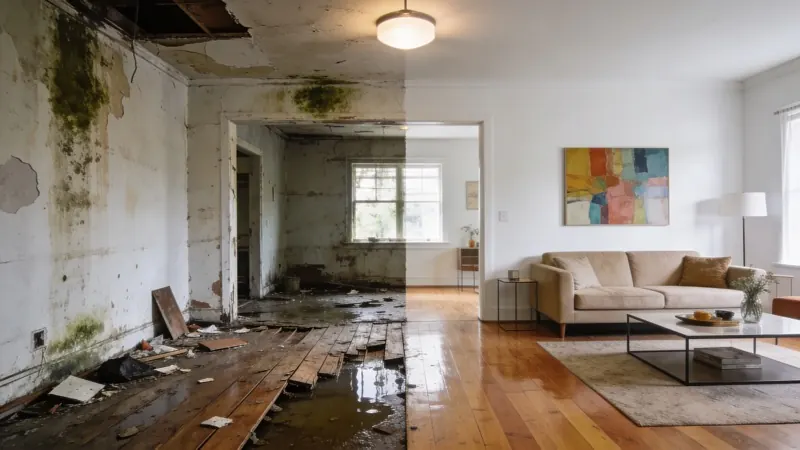
Restoration Timeline Overview
You just found water in your home. Maybe a pipe burst behind the wall while you were at work. Maybe the washing machine supply line gave out overnight. Maybe you came home from vacation to carpet that squishes when you step on it and a smell you can't place.
Whatever the cause, the question running through your head right now is the same one we hear from every homeowner we respond to: how long is this going to take?
After 15 years and thousands of water damage restoration jobs, we can give you honest timelines for every phase. The water damage restoration timeline depends on the severity of the event, the water category, and how fast the response starts. A minor appliance leak caught within an hour has a very different timeline than a supply line failure that ran for 12 hours before anyone noticed.
This guide walks you through every phase of the restoration timeline, from the minute you discover water damage through the final day of reconstruction. You'll know what happens at each stage, what equipment is running, what our crew is doing, and what you should expect as a homeowner living through the process.
| Phase | Timeframe | What Happens |
|---|---|---|
| Discovery and first moves | Minutes 0-15 | Stop water source, cut electricity, call for help |
| Dispatch and arrival | Hour 0-1 | Crew dispatched, on-site within 60 minutes |
| Assessment and extraction | Hours 1-4 | Moisture mapping, documentation, water removal |
| Drying equipment setup | Hours 4-8 | Air movers, dehumidifiers, and specialty systems placed |
| First monitoring visit | Day 1 | Moisture readings compared to baseline |
| Critical mold window | Day 2 | 48-hour mold threshold; readings should show progress |
| Continued drying | Days 3-5 | Materials approach dry standard; equipment removed in stages |
| Repairs and reconstruction | Days 5-14+ | Drywall, flooring, paint, trim, and finish work |
If you're dealing with water damage right now, call (844) 426-5801. Our crews are on standby 24/7/365, and we guarantee a technician at your door within 60 minutes. The sooner extraction starts, the shorter your overall restoration timeline will be. That's not a sales pitch. It's physics.
Minute 0-15: The Discovery and Your First Moves
The restoration timeline starts the moment you discover the water, not when a crew arrives. What you do in these first 15 minutes directly affects how long the entire process takes and how much damage accumulates.
Stop the water source
Before you call anyone, stop the water if you can. A burst pipe with the water still running is adding gallons per minute to the problem. For a plumbing failure, go to your main water shutoff valve and turn it clockwise until it stops.
For most homes, this is in the basement, the garage, or near the street where the water line enters the property. If you have a washing machine or dishwasher leak, turn the individual supply valves behind the appliance clockwise to close them.
If you can't find the shutoff or can't reach it safely, skip this step and call us. Our crew can shut the water off when we arrive.
Address electrical safety
If there's standing water near outlets, light switches, or appliances, go to your breaker box and turn off the circuits for the affected area. Don't walk through standing water to reach the breaker panel. If the panel is in a flooded area, leave it alone and call us or your utility company.
We've responded to homes where homeowners were wading through water with live outlets submerged. In one case in Houston, the homeowner didn't realize the power strip behind the entertainment center was sitting in three inches of water. That's a life-threatening situation. Cut the power first.
Make the call
Call (844) 426-5801. When you call, our dispatch team will ask you a few questions: what happened, how much water you can see, whether the source is stopped, whether electricity is off in the affected area, and your address. This takes about two minutes. Based on your answers, we dispatch the appropriate crew with the right equipment for your situation.
While waiting for the crew, move furniture and valuables off wet carpet or flooring if you can do so safely. Pull up area rugs. Open cabinet doors under sinks to expose wet areas. Don't attempt to use a household vacuum to extract water. Standard vacuums aren't rated for water and can electrocute you.
Hour 0-1: Dispatch and Arrival
After your call, our crew is rolling within minutes. We guarantee on-site arrival within 60 minutes in all our service areas across the US.
What's happening on our end
Our dispatch assigns the job to the closest available crew. The truck they are driving isn't a work van with a shop vac in the back. It's a fully equipped restoration vehicle carrying a truck-mounted extraction unit, portable extractors, moisture meters, a thermal imaging camera, air movers, dehumidifiers, antimicrobial solution, and documentation equipment. These trucks stay loaded and staged at all times specifically so there's zero prep time between your call and our departure.
The lead technician reviews the job details from dispatch en route. They already have an initial game plan for your property before they knock on your door.
Arrival and safety assessment
When the crew arrives, the first thing they do is a safety walk-through. This isn't a formality. They are checking for electrical hazards, structural instability (sagging ceilings, buckling floors), and contamination. If the water source is a sewage backup or flood water, the crew shifts to Category 3 protocols, which include PPE (personal protective equipment) with respirators and Tyvek suits.
The safety assessment takes about 10-15 minutes. If they find a sagging ceiling full of water, they will perform a controlled drain before it collapses on its own. If the electricity is still on in the affected area, they will coordinate with you to shut it off at the panel.
Water Damage Right Now?
Our IICRC-certified crew arrives within 60 minutes with full extraction equipment.
📞 Call (844) 426-5801Hours 1-4: Assessment, Documentation, and Water Extraction
This is the most active phase of the entire restoration timeline. More happens in these first four hours than in any other single block of time during the project. The speed and thoroughness of this phase determines how long the drying phase will take and whether secondary damage like mold becomes a factor.
Moisture mapping and damage assessment
Before the extraction equipment starts, the technician maps the damage. This involves two tools that separate professional water damage restoration from anything a homeowner can do with a rental unit.
The first is a thermal imaging camera. This device shows temperature differences in walls, floors, and ceilings. Wet areas are cooler than dry areas because of evaporative cooling, the same reason you feel cold when you step out of a swimming pool.
The thermal camera lets our technician see water behind drywall, under tile, and inside ceiling cavities without cutting anything open. We can identify the full extent of water migration in about 20 minutes.
The second tool is a pin-type moisture meter. This gives us actual moisture content readings in materials. Dry drywall reads below 1% moisture content. Dry wood framing reads around 8-12% depending on the region and time of year.
Any reading above those baselines tells us the material has absorbed water and needs to be dried. We take readings at multiple points and document them on a floor plan.
This moisture map becomes the blueprint for the entire restoration. It shows exactly what's wet, how wet it is, and where the water traveled. It's also critical documentation for your insurance claim. For a thorough overview of the insurance process, see our water damage insurance claim guide.
The mini-story of the "dry" living room
Last spring, we responded to a supply line failure in a two-story home outside Dallas. The homeowner called us about the upstairs bathroom, where the toilet supply line had cracked. She said the downstairs looked fine.
When we ran the thermal imaging camera across the first-floor living room ceiling, the entire thing lit up blue. Cooler. Wetter. The water had traveled along the second-floor subfloor joists and soaked the first-floor ceiling drywall across a 300 square foot area.
The living room ceiling looked normal to the eye, but it was holding probably 50-60 gallons of water. If we hadn't mapped it, that ceiling would have eventually collapsed. If the homeowner had just cleaned up the upstairs bathroom and called it done, she would have had a catastrophic ceiling failure and a mold problem within two weeks.
That's why mapping comes before extraction. You have to know where the water went before you can remove it.
Water extraction begins
With the map complete, extraction starts. For standing water, the truck-mounted extraction unit is the primary tool. These units generate powerful vacuum suction through a hose connected to a wand that the technician moves across the flooded area. A truck-mounted unit can extract several hundred gallons per hour, depending on the surface type and water depth.
For carpet and pad, we use weighted extraction tools that compress the carpet and squeeze water out of the pad underneath. After the bulk water is removed with the truck-mounted unit, the portable extractor makes multiple passes over carpet to pull as much water out of the fibers and pad as possible. This step alone can cut drying time by a full day.
For hard surfaces like tile, hardwood, or vinyl, the approach depends on the flooring type. On hardwood, we're careful not to over-extract, because aggressive suction can pull boards up. On tile, the concern is less the tile itself and more the water that has seeped into the grout lines and the subfloor underneath.
Extraction on a standard residential job affecting three to four rooms typically takes two to four hours. A large-scale event, a whole-floor flood from a supply line failure, a sewer backup through a first-floor drain, can take four to six hours or more. For Category 3 (contaminated) water events, extraction is combined with immediate removal of all contaminated porous materials. For more on what those contamination categories mean, see our water damage categories guide.
What gets removed versus what gets saved
During extraction, the crew also begins making decisions about what stays and what goes. These decisions are based on IICRC S500 standards and the water category.
For Category 1 water (clean water from a supply line or faucet), most materials can be saved through drying. Drywall that has been wet for less than 48 hours and has not started to crumble can usually be dried in place. Carpet can be dried if the water was clean and extraction happened fast.
For Category 2 (gray water from a washing machine, dishwasher, or toilet without solid waste) and Category 3 (contaminated water from sewage, flood water, or toilet overflow with waste), the rules change. Carpet pad is always removed in Category 2 and 3 situations. Drywall soaked by Category 3 water gets cut out, typically 12-24 inches above the visible water line. Insulation in wall cavities gets removed. Anything porous that contacted contaminated water gets thrown away, not dried.
This demolition work adds time to the initial response but shortens the overall drying timeline because you're removing material that would take days to dry and replacing it later with new material that doesn't need drying at all.
Hours 4-8: Drying Equipment Setup
Once extraction is complete and any necessary demolition is done, the crew transitions to the drying phase. This is where the bulk of the equipment comes in, and where structural drying becomes the focus.
Equipment placement
The lead technician determines equipment placement based on the moisture map, the affected materials, the layout of the home, and the IICRC drying class of the damage.
Here's what gets placed and why:
- Air movers (high-velocity fans): These are placed at 45-degree angles along wet walls and across wet floors. They create concentrated airflow across wet surfaces, which accelerates evaporation. For a typical three-room residential job, we place four to eight air movers. Each one moves approximately 2,500-3,000 cubic feet of air per minute. These aren't box fans from the hardware store. A single professional air mover creates more concentrated airflow than four household fans combined.
- LGR dehumidifiers: LGR stands for Low Grain Refrigerant. These are industrial dehumidifiers designed specifically for water damage restoration. A standard residential LGR unit pulls 15-20 gallons of water per day out of the air. For a three-room job, we typically place one to two LGR units. For a whole-floor event, three or more. The dehumidifier works in tandem with the air movers: the air movers push moist air off wet surfaces, the dehumidifier strips the moisture out of that air, and the cycle repeats continuously.
- Injectidry systems (when needed): When walls have water trapped in the cavity but the drywall is salvageable, we use an injectidry system. This creates targeted negative pressure inside the wall cavity, pulling moisture through small holes drilled into the drywall. It dries the cavity without removing the drywall. We use this on walls where the drywall has been wet for less than 48 hours, is structurally sound, and the water was Category 1.
- Floor mat drying systems (when needed): For hardwood floors that are wet but not yet cupped or buckled beyond recovery, we place specialty drying mats on the surface. These mats use vacuum pressure to pull moisture up through the wood. This approach saves hardwood floors that would otherwise need to be torn up and replaced.
The initial environment setup
Beyond placing equipment, the crew configures the drying environment. Windows get closed. Interior doors in affected areas get propped open so air circulates between rooms.
If it's winter, the thermostat gets set to 70-75 degrees. In summer, we may leave the AC running but adjust dehumidifier placement to compensate for the cooling effect. The goal is a controlled environment where temperature, humidity, and airflow are all optimized for drying.
The crew takes a full set of baseline moisture readings after equipment is placed. These readings document the starting moisture levels across every affected material and become the benchmark against which we measure drying progress every day.
By the end of hour eight, the extraction is done, any necessary demo is done, equipment is placed and running, the environment is configured, and baseline readings are documented. The active drying phase has officially begun. The crew leaves the equipment running and schedules a return visit for the following day.
What the homeowner experiences
This is the part nobody warns you about: the equipment is loud and it runs 24 hours a day. Air movers produce a constant whooshing sound. Dehumidifiers hum and cycle. If you have six air movers and two dehumidifiers running, your home sounds like a wind tunnel. Sleep is difficult for the first couple of nights if the affected area is near bedrooms.
You'll also notice your electric bill spike. Running industrial drying equipment around the clock for three to five days adds to your electricity usage. The good news is that most insurance policies cover this increased utility cost as part of the restoration claim. Ask your adjuster about "loss of use" or "additional living expenses" coverage.
Your home will feel different. The dehumidifiers pull so much moisture from the air that the indoor humidity drops well below normal. Your skin might feel dry. You might get a scratchy throat.
This is temporary and it's working exactly as intended. Low humidity means the wet materials in your home are releasing moisture into the air, which is exactly what needs to happen.
Day 1 Check: The First Monitoring Visit
Approximately 24 hours after drying equipment is placed, a technician returns for the first monitoring visit. This is one of the most important check points in the water damage restoration timeline because the first 24 hours of drying data tells us whether the equipment setup is working or needs adjustment.
What the technician checks
The technician takes moisture readings at every point documented during the baseline reading. They are comparing today's numbers to yesterday's numbers. Here's what those readings tell us:
- Moisture levels dropping steadily: This means the drying plan is working. Equipment stays where it is. No changes needed.
- Moisture levels dropping slowly: This could mean we need more air movers, a different dehumidifier placement, or a temperature adjustment. The technician reconfigures equipment on the spot.
- Moisture levels stagnant or increasing: Something is wrong. Maybe there's an ongoing water source we missed. Maybe the dehumidifier drain line clogged and it shut off overnight. Maybe the homeowner opened windows, letting humid outdoor air in and disrupting the drying environment. The technician diagnoses the issue and corrects it immediately.
The technician also checks equipment operation. Dehumidifier collection tanks or drain lines get checked. Air movers get repositioned if needed. The temperature and relative humidity of the drying environment get logged.
This entire visit takes 30-60 minutes. The technician documents all readings, takes updated photos, and logs everything in the project file. This daily documentation builds the drying record that your insurance company will review.
What you should expect at this point
Twenty-four hours in, your home is still noisy and uncomfortable. The visible surfaces may already feel dry to the touch, especially carpet and the outer face of drywall. Don't be fooled. The materials behind those surfaces, the subfloor under the carpet, the studs behind the drywall, the concrete under the tile, are still wet. Surface drying happens fast. Deep drying takes days.
Resist the temptation to turn off equipment or move air movers because they are loud. Every hour of drying counts. Turning off a dehumidifier overnight because the noise bothers you can add a full day to the drying timeline.
Day 2: The Critical Mold Window
Day 2 is the inflection point in the water damage restoration timeline. This is when the 48-hour mold growth window becomes real, and why the speed of the initial response matters so much.
Why 48 hours matters
Mold spores are present in every home. They are in the air, on surfaces, everywhere. Under normal conditions, they are harmless and simply part of the indoor environment. But give mold spores three things, moisture, an organic food source (drywall paper, wood, carpet backing), and time, and they germinate.
Under favorable conditions (temperatures above 60 degrees, relative humidity above 60%, and an organic surface), mold can begin colonizing within 24 to 48 hours of a material getting wet. At the 48-hour mark, microscopic growth is starting inside wall cavities and on the backside of wet drywall. You won't see it yet. You might start to smell it, a musty, earthy odor that wasn't there before.
This is the primary reason we push so hard on fast response and aggressive drying. If we started extraction within a few hours of the water event and had drying equipment running by hour eight, the affected materials are already well into their drying curve by hour 48. Moisture levels should be dropping. The environment should be too dry for mold to establish.
If the response was delayed, if the homeowner waited two days before calling or tried to dry things with household fans, the situation is different. At that point, the technician on the Day 2 visit is specifically checking for early signs of mold growth. If detected, the timeline extends because mold remediation gets added to the scope.
The mini-story of the delayed call
We got a call from a homeowner in Phoenix who had a refrigerator water line leak. The line had been dripping behind the fridge for about a week before she noticed discoloration on the kitchen floor. She pulled the fridge out, saw the wet area, put some towels down, and figured it would dry on its own. She called us four days later when she noticed a smell.
By the time we arrived, moisture had traveled from the kitchen into the adjacent dining room through the subfloor. The drywall behind the refrigerator was saturated 18 inches up the wall. And when we opened the wall cavity, there was visible mold growth on the studs and the backside of the drywall.
What could have been a straightforward extraction and three-day drying job if she had called on day one became a 10-day project involving mold remediation, drywall removal across two rooms, subfloor treatment, and reconstruction.
The lesson: the water damage restoration timeline gets longer with every day you wait. Speed isn't about convenience. It's about preventing secondary damage that turns a one-week project into a month-long ordeal.
The Day 2 monitoring visit
The technician takes the second set of moisture readings and compares them to both the baseline and the Day 1 readings. By Day 2, you should see meaningful progress. Drywall moisture content might have dropped from 40-60% down to 20-30%. Wood framing might have gone from 30% down to 20%.
The technician also checks the dehumidifier performance. The amount of water the dehumidifier collects should be decreasing by Day 2. On Day 1, an LGR unit on a moderate job might collect 15-18 gallons. By Day 2, that number should drop to 10-12 gallons. This declining collection rate means the air is getting drier, which means the materials are giving up their moisture.
Equipment may get repositioned based on the readings. Air movers that were focused on one wall might get moved to another area that's drying slower. An additional dehumidifier might be brought in if readings aren't dropping fast enough. The drying plan is a living document that gets adjusted every day.
Days 3-5: Continued Drying and the Home Stretch
For most residential water damage events, Days 3 through 5 are when the drying phase wraps up. This is when the numbers on the moisture meter start approaching the targets, equipment starts getting removed, and your home starts sounding normal again.
What "dry" actually means
"It feels dry" isn't a standard we accept. Dry has specific, measurable thresholds based on IICRC S500 guidelines:
| Material | Dry Standard | Measurement Method |
|---|---|---|
| Drywall | Below 1% moisture content | Pin-type meter, or matching unaffected drywall in same home |
| Wood framing | Below 16% moisture content | Within 2% of unaffected wood framing in same structure |
| Concrete | Below 75% relative humidity | In-situ probe testing |
| Hardwood flooring | Within 2% of reference flooring (typically 6-9%) | Species and region dependent |
| Subfloor (OSB/plywood) | Below 16% moisture content | Pin-type meter |
These numbers aren't arbitrary. They represent the equilibrium moisture content (EMC) at which the material is in balance with the normal indoor environment and below the threshold where mold can grow or materials can warp.
Typical drying timelines by material
Not everything in your home dries at the same rate. Here's what we typically see in our restoration work:
| Material | Drying Time | Notes |
|---|---|---|
| Carpet and pad | 1-2 days (pad removed) / 2-3 days (pad in place) | Aggressive extraction shortens timeline significantly |
| Drywall (standard 1/2") | 2-4 days | Thicker drywall or plaster walls: 4-6 days |
| Wood framing (studs) | 3-5 days | Older homes with denser wood species may take longer |
| OSB subfloor | 3-5 days | Swells when wet; dries slowly due to layered construction |
| Plywood subfloor | 2-4 days | Dries faster than OSB due to cross-grain construction |
| Concrete slab | 5-7 days minimum | Extremely porous; under-slab moisture can wick up for weeks |
| Hardwood flooring | 3-7 days | Varies by species, thickness, and finish; oak takes longer than maple |
The material that dries slowest dictates when equipment comes out. If the drywall is dry at Day 3 but the OSB subfloor under the tile is still reading 22%, the dehumidifiers and air movers stay until that subfloor hits its target. Pulling equipment early is one of the most common mistakes we see from less experienced restoration companies. It saves a day of equipment cost but risks mold growth and structural damage from residual moisture.
Equipment removal
As areas reach their dry standard, equipment gets removed in stages. Air movers in the driest areas come out first. Dehumidifiers stay until the last material in the last room reaches its threshold. On a typical residential job, the first air movers come out around Day 3, the last dehumidifiers come out around Day 4 or 5.
When the last piece of equipment comes out, the technician does a final set of readings and photographs. This documentation package, the baseline readings, the daily progress readings, and the final dry readings, is the complete drying record. It goes to your insurance company as proof that the drying was done correctly and completely.
Need Professional Drying Equipment?
Our IICRC-certified technicians use commercial-grade LGR dehumidifiers and air movers for faster results.
📞 Call (844) 426-5801Days 5-14: Repairs and Reconstruction
Once drying is verified complete, the restoration moves from the mitigation phase to the reconstruction phase. Mitigation is stopping the damage and drying the structure. Reconstruction is putting everything back together.
The timeline for reconstruction depends entirely on how much material was removed during the mitigation phase.
Minor damage reconstruction (Days 5-7)
For a Category 1 water event where the drywall was saved, the carpet was dried in place, and no demolition was needed, reconstruction might be minimal. Maybe the baseboards need to be reattached. Maybe a section of paint is bubbling and needs to be scraped, primed, and repainted.
Maybe the carpet needs to be re-stretched because it loosened during extraction. This type of work typically takes one to two days.
Moderate damage reconstruction (Days 7-10)
When flood cuts were made (drywall removed 2 feet up from the floor), the reconstruction involves hanging new drywall, taping, mudding, sanding, texturing, priming, and painting. Carpet pad gets replaced. Baseboards get reinstalled.
If vinyl flooring was pulled up, new vinyl gets laid. For a three-room job with flood cuts, figure five to seven business days for reconstruction, partly because drywall mud needs to dry between coats and texture needs to cure before painting.
Major damage reconstruction (Days 10-14+)
A major event with extensive demolition, think full drywall removal in multiple rooms, subfloor replacement, cabinet replacement, or hardwood floor replacement, takes the longest. This is general contracting work: framing, drywall, tape, texture, paint, trim, flooring, cabinets, and finish work. For a whole-floor restoration with significant structural rebuild, the timeline can stretch to two to four weeks.
The reconstruction timeline also depends on material availability. Custom cabinets, specific hardwood species, or specialty tile may need to be ordered and can add days or weeks to the schedule. Your restoration crew should communicate lead times on special-order materials as early as possible so there are no surprises.
For a detailed breakdown of what these repairs typically run, see our water damage restoration cost guide.
How Long Does Water Damage Restoration Take? Realistic Timelines by Severity
The question "how long does water damage restoration take" doesn't have a single answer. Here's a breakdown based on what we see in the field across different severity levels.
| Severity | Extraction | Drying | Reconstruction | Total Timeline |
|---|---|---|---|---|
| Small/minor (1 room, caught quickly) | 1-2 hours | 2-3 days | 1-2 days | 4-7 days |
| Moderate (2-4 rooms, several hours exposure) | 2-4 hours | 3-5 days | 3-7 days | 7-14 days |
| Major (entire floor, Category 3, or supply line failure) | 1-2 days | 5-7 days | 7-21 days | 14-30+ days |
Small/minor water damage (one room, caught quickly)
Total timeline: 4-7 days
- Extraction: 1-2 hours
- Drying: 2-3 days
- Reconstruction: Minimal, 1-2 days if any drywall needs replacing
Example: A dishwasher supply line leaks while you're home. You catch it within an hour. Water affected the kitchen floor and the toe kicks of the cabinets. We extract, place two air movers and one dehumidifier, dry for three days, replace the toe kick panels, done.
Moderate water damage (two to four rooms, several hours of exposure)
Total timeline: 7-14 days
- Extraction: 2-4 hours
- Demo (if needed): 2-4 hours
- Drying: 3-5 days
- Reconstruction: 3-7 days
Example: A pipe burst behind the upstairs bathroom wall while you were at work. Water ran for six hours and affected three rooms, including the downstairs ceiling. We extract, cut flood lines in the drywall, dry for four days, then rebuild the drywall, repaint, and replace the carpet pad.
Major water damage (entire floor, supply line failure, or Category 3 event)
Total timeline: 14-30+ days
- Extraction and demo: 1-2 days
- Drying: 5-7 days
- Reconstruction: 7-21 days depending on scope
Example: A second-floor toilet supply line failed while you were on vacation for a week. The entire second floor is saturated. Water came through the first-floor ceilings. Mold growth has started.
We extract, perform extensive demolition on both floors, set up heavy drying equipment for a week, do mold remediation in the wall cavities, then rebuild with new drywall, paint, flooring, and trim throughout.
The mini-story of the vacation disaster
One of the longer projects we handled was a two-story home where the upstairs washing machine supply hose burst the day after the family left for a two-week cruise. The neighbor noticed water coming out from under the garage door on day 12.
By the time we got there, the entire second floor subfloor had buckled. First-floor ceilings had collapsed in three rooms. Mold was visible on nearly every wall cavity we opened. The water had been running so long that it saturated the concrete slab and the garage below.
That project took 47 days from start to finish. Seven days of extraction and demolition. Ten days of drying (the concrete slab took the longest). Five days of mold remediation. And 25 days of reconstruction, including new drywall, new flooring, new paint, two new ceiling assemblies, and cabinet refacing in the kitchen.
Every day that water ran added to the timeline and the scope. That's an extreme case, but it illustrates why the duration of exposure is the single biggest factor in how long your water damage restoration timeline will be.
Factors That Shorten or Extend the Water Damage Drying Time
If you want to understand why some water damage restorations take four days and others take four weeks, these are the variables that matter most.
Factors that shorten the timeline
- Fast response time: Getting extraction started within the first few hours minimizes water absorption into materials. Less absorption means less drying time.
- Water category: Category 1 (clean) water allows more materials to be saved through drying instead of removed and replaced. Less demolition means less reconstruction time.
- Small affected area: Fewer rooms means fewer air movers, dehumidifiers, and monitoring points. The job is simply smaller.
- Accessible materials: Open floor plans dry faster than homes with lots of small rooms, closets, and built-in cabinetry that trap moisture.
- Warm environment: Warmer temperatures accelerate evaporation. A water damage event in July dries faster than one in January, all else being equal.
- Cooperation with the drying process: Homeowners who keep windows closed, leave equipment running, and keep the thermostat at the recommended setting help the drying go faster.
Factors that extend the timeline
- Delayed response: Every hour of standing water increases absorption into building materials. A 12-hour delay before extraction can add one to two days to the drying phase.
- Category 2 or 3 water: Contaminated water requires demolition of porous materials, which adds demo time and extends reconstruction significantly.
- Large affected area: Whole-floor events or multi-story damage require more equipment, more monitoring, and more reconstruction.
- Dense materials: Concrete slabs, plaster walls (common in pre-1960 homes), and hardwood flooring all dry slower than standard drywall and carpet.
- Mold discovery: If mold has started growing, the timeline extends by three to seven days for containment, remediation, and clearance testing.
- Hidden cavities: Water trapped in ceiling assemblies, wall cavities behind tile backer board, or under built-in cabinetry takes longer to identify and dry.
- Material lead times: Custom or specialty materials needed for reconstruction (specific hardwood species, custom cabinets, matching tile) can add days or weeks.
What Equipment Runs During Each Phase (and Why)
Homeowners often ask what all the equipment does and why there's so much of it. Here's a phase-by-phase breakdown of what is running in your home and why.
During extraction (Hours 1-4)
- Truck-mounted extraction unit: Removes standing water via high-powered vacuum suction
- Portable extractors: Targeted extraction on carpet, pad, and hard-to-reach areas
- Submersible pump (for deep water): Used when standing water exceeds several inches, pumps water directly to exterior drain
During active drying (Days 1-5)
- Air movers (4-8+ per job): Running 24 hours a day, creating airflow across all wet surfaces. These are the loudest equipment in your home.
- LGR dehumidifiers (1-3+ per job): Running 24 hours a day, pulling moisture from the air. Collection tanks need to be emptied or drain lines need to be clear.
- Injectidry wall drying panels (if applicable): Attached to walls with wet cavities, running 24 hours a day.
- Hardwood floor drying mats (if applicable): Placed on wet hardwood, running 24 hours a day.
During reconstruction (Days 5-14+)
- Standard construction tools: Saws, drills, drywall tools, paint sprayers
- No drying equipment: By this phase, all drying is verified complete. If the structure isn't dry, reconstruction doesn't start.
One important note: reconstruction should never start until drying is verified with moisture readings. We've been called in to fix jobs from other companies that started hanging new drywall over studs that were still reading 25% moisture content. That new drywall grows mold from the backside within weeks. Always verify dry before you rebuild.
Living in Your Home During the Water Damage Repair Timeline
Most homeowners stay in their home during the restoration process, especially for minor and moderate damage. But living around an active drying operation isn't comfortable, and you should know what to expect.
Noise
Air movers and dehumidifiers run continuously. The noise level in the affected rooms is comparable to a loud restaurant. Closing bedroom doors helps, but if the damage is in or near bedrooms, the first two to three nights are going to be rough.
Earplugs or a white noise machine in the bedroom can help. Some homeowners relocate to a hotel for the first few nights of drying. If your insurance policy includes "loss of use" or "additional living expenses" coverage, that's what it's for.
Accessibility
The affected rooms will be mostly unusable during the drying phase. Air movers and dehumidifiers take up floor space. You'll need to navigate around equipment and hoses. If the kitchen is affected, plan on eating out or using a microwave in another room.
Pets and children
Keep pets and small children away from the drying equipment. Air mover cords are tripping hazards. Dehumidifiers collect water that should not be consumed. The antimicrobial agents applied to surfaces during extraction are low-toxicity once dried but should not be touched or ingested while wet.
When you should leave
In some cases, staying in the home isn't advisable. Category 3 (sewage or flood) water events in large areas of the home make the entire structure uncomfortable and potentially unhealthy during the mitigation phase. Extensive mold discovery requires containment barriers and HEPA air scrubbers that affect air quality throughout the home. If more than half the home is affected, the disruption of equipment, restricted areas, and noise often makes temporary relocation the better option.
Frequently Asked Questions About the Restoration Timeline
Most residential water damage restoration projects take 7 to 14 days from initial response through completed repairs. Minor damage with minimal reconstruction can wrap up in 4 to 7 days. Major damage with extensive demolition and rebuild can take 3 to 6 weeks. The drying phase alone typically takes 3 to 5 days for standard materials and 5 to 7 days for concrete or hardwood.
Structural drying with professional equipment typically takes 3 to 5 days for most residential water damage events. Concrete slabs, hardwood floors, and plaster walls can take 5 to 7 days or longer. Without professional equipment, drying can take weeks and often results in mold growth before materials reach safe moisture levels. Our technicians monitor moisture daily to determine exactly when drying is complete.
You can help by keeping windows and exterior doors closed during the drying process, leaving all drying equipment running 24 hours a day, setting your thermostat to 70-75 degrees, keeping interior doors in affected areas open, and staying out of the affected rooms as much as possible. Don't add your own fans to the setup without asking your technician first, as improperly placed fans can disrupt the drying pattern.
Mold can begin germinating within 24 to 48 hours of materials getting wet, given temperatures above 60 degrees and relative humidity above 60%. Visible mold growth typically appears within 3 to 7 days in untreated wet areas. Professional drying that starts within the first 24 hours significantly reduces the risk of mold growth. If mold has already started, our mold remediation team handles testing, containment, and removal.
Drying is a continuous physical process. Moisture moves from wet materials into the air through evaporation, which happens around the clock. Turning off equipment at night slows evaporation, raises humidity in the affected area, and can add one or more days to the drying timeline. The equipment is designed to run continuously and is most effective when it operates without interruption.
Most homeowners stay in their home during restoration, especially for minor to moderate damage. However, Category 3 (contaminated) water events, extensive mold discovery, or damage affecting more than half the home may warrant temporary relocation. Check your homeowners insurance policy for "additional living expenses" or "loss of use" coverage, which can cover hotel costs during restoration.
Drying is complete when moisture readings on all affected materials reach their dry standard as defined by IICRC S500 guidelines. This means specific moisture content percentages for each material type, not just "it feels dry." Your technician documents these final readings, and they are included in your restoration file. Never let anyone start rebuilding on top of materials that have not been verified dry with a calibrated moisture meter.
After one week of untreated water damage, mold growth is likely established in affected wall cavities, on subfloor materials, and on the backside of wet drywall. Materials that could have been saved through drying in the first 48 hours may now need to be removed. The restoration scope and timeline increase significantly with each day of delayed treatment, often doubling or tripling the total project duration and cost.
The Bottom Line: Your Water Damage Restoration Timeline
Here's what 15 years of water damage restoration work has taught us about timelines: the single biggest factor in how long your project takes is how fast the response starts.
A fast response, extraction within hours, drying equipment running the same day, means a shorter drying phase, less demolition, less mold risk, and less reconstruction. A delayed response means the opposite on every front.
For most residential water damage events with a prompt response:
- Extraction and setup: Same day (Hours 0-8)
- Active drying: 3-5 days
- Reconstruction: 2-14 days depending on scope
- Total timeline: 1-3 weeks for most projects
Every job is different. A small kitchen leak and a whole-floor supply line failure are both "water damage," but they are on completely different timelines. The numbers in this guide are based on what we actually see across thousands of projects, not theoretical estimates.
If you have water damage in your home right now, call (844) 426-5801. We're available 24/7/365 and guarantee a technician on-site within 60 minutes. We'll assess the damage, start extraction immediately, and give you an honest timeline for your specific situation. Our IICRC-certified crews handle everything from emergency water extraction through structural drying, mold prevention, and complete reconstruction, all under one roof so you don't have to coordinate multiple contractors.
The clock is running on your water damage right now. Every hour matters. Call (844) 426-5801 and let us get to work.
Additional Resources
- IICRC S500 Standard and Reference Guide for Professional Water Damage Restoration -- the industry standard our technicians follow on every project
- FEMA Flood Damage Recovery Resources -- federal guidance for homeowners dealing with flood-related water damage
- EPA Mold Remediation Guidelines -- EPA recommendations for mold prevention and cleanup after water damage