The hillside had burned the previous October. By January, when the atmospheric river arrived and dropped 4 inches of rain on the burn scar in 12 hours, there was nothing left on that slope to hold the soil. The mudslide came downhill at 3 AM, carrying ash, rocks, and charred vegetation into a neighborhood at the base of the canyon.
One of the homes we were called to had 18 inches of mud and water on the ground floor. The structure itself was sound — the mud flow had slowed by the time it reached the house — but every surface below 18 inches was contaminated with debris, ash residue, and Category 3 water.
That's the West Coast sequence. Fire, then rain, then flood, then restoration. It's not the only water damage pattern out here — atmospheric rivers dump rain on flat cities too, earthquakes shear pipes with no warning, coastal moisture corrodes everything it touches, and El Nino years pile one storm on top of the next for months. But the fire-to-flood cycle is the one that captures what's different about water damage restoration on the West Coast: the threats are interconnected, and one disaster creates the conditions for the next.
This page covers the region-specific water damage risks along the West Coast — California, Oregon, Washington, and coastal areas from San Diego to Seattle. For general information about the restoration process or insurance claims, visit those dedicated pages. Here, we focus on the West Coast's unique combination of weather, geology, and construction patterns that shape how water damage happens and how we restore it. Call (844) 426-5801 for 24/7 emergency response anywhere on the West Coast.
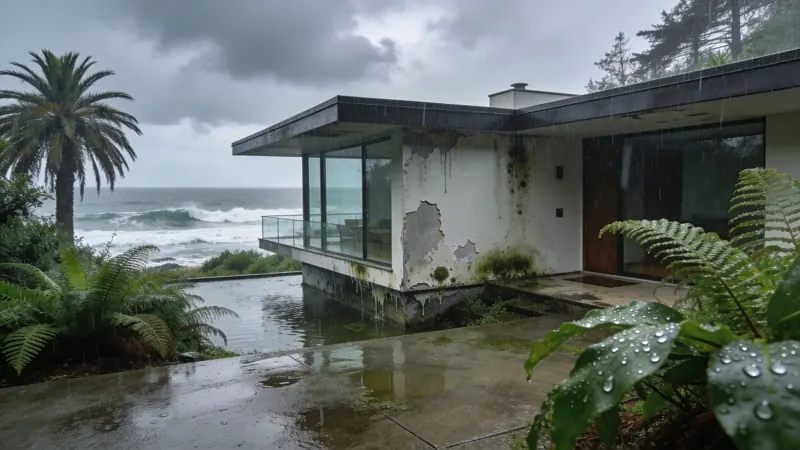
West Coast Water Damage Threats at a Glance
| Threat | Peak Season | Primary Region | Damage Type | Typical Restoration Timeline |
|---|---|---|---|---|
| Atmospheric rivers | Oct - Mar | Entire West Coast | Flooding, roof intrusion, landslides | 5 - 14 days |
| Post-wildfire debris flows | First winter after fire | Southern CA, coastal mountains | Category 3 contamination, mud, structural | 2 - 4 weeks |
| Earthquake pipe damage | Year-round | Southern CA, Bay Area, PNW | Supply line shearing, water heater displacement | 3 - 10 days |
| Coastal moisture intrusion | Year-round (fog season peaks) | Within 2 miles of coast | Mold, corrosion, condensation damage | 5 - 10 days |
| El Nino storm sequences | Nov - Mar (El Nino years) | California (shifts north during La Nina) | Compounded flooding, saturated soil | 7 - 21 days |
Atmospheric Rivers: The West Coast's Heavy Hitter
The term "atmospheric river" has entered the mainstream vocabulary, but many homeowners still don't understand what these weather systems mean for their property. An atmospheric river (AR) is a long, narrow band of concentrated moisture that flows from the tropical Pacific into the West Coast. According to NOAA, atmospheric rivers are responsible for a large portion of the West Coast's annual precipitation and nearly all of its major flooding events.
What Makes Atmospheric Rivers Dangerous
Volume and duration. Unlike a passing thunderstorm that drops rain for an hour and moves on, atmospheric rivers can deliver sustained heavy rain for 24-72 hours or more. The AR events that hit California in January 2023 brought consecutive storms that lasted weeks. Individual AR events can drop 5-15 inches of rain on coastal mountains. That volume, sustained over days, overwhelms every drainage system — natural and engineered.
Orographic enhancement. When atmospheric river moisture hits the Coast Ranges, Sierra Nevada, and Cascade mountains, the air is forced upward and the moisture condenses, intensifying rainfall on the mountain-facing slopes. Foothill and mountain communities receive dramatically more rain than the flatlands — which means hillside homes, canyon neighborhoods, and mountain communities bear the brunt.
Snowmelt compounding. In warmer atmospheric river events — known as "warm ARs" — the freezing level rises dramatically. Rain falls at elevations that normally get snow, and existing snowpack at intermediate elevations begins to melt. The combination of heavy rain plus rapid snowmelt produces river flows that far exceed what rainfall alone would cause. This mechanism drove some of the worst flooding during the 2023 California atmospheric river sequence.
Sequential events. West Coast atmospheric rivers often arrive in series — one storm follows another with little recovery time between. The first storm saturates the soil and fills waterways. The second and third storms hit ground that's already saturated, producing immediate runoff and flooding. This sequential pattern is what makes El Nino winters so damaging.
How Atmospheric Rivers Damage West Coast Homes
Hillside and canyon flooding. The West Coast's topography funnels water into canyons, creek channels, and hillside drainages. Homes built in or near these drainages — common throughout coastal California, the Portland hills, and the Seattle-Tacoma region — receive concentrated water flow during AR events. Retaining walls fail, yards flood, and water enters homes through foundation walls, garages, and lower-level entry points.
Urban flooding in flat areas. Even flat coastal cities like parts of Los Angeles, San Jose, Sacramento, and Portland flood during strong atmospheric rivers. Aging stormwater infrastructure, insufficient drainage capacity, and the sheer volume of water overwhelm city drainage systems. Streets flood, water backs up through storm drains, and low-lying properties take water from the street.
Roof and wall water intrusion. Extended heavy rain — 24-48 hours of continuous rain — tests building envelopes in ways that typical West Coast drizzle never does. In our experience, AR events reveal every weakness in a roof, window, or wall system. Flashing failures, deteriorated caulk joints, and compromised window seals that perform fine during normal rain allow water intrusion during the sustained horizontal rain of a strong atmospheric river.
Landslides and debris flows. Saturated hillsides lose structural integrity. Shallow landslides on steep slopes send soil, rock, and vegetation into neighborhoods below. Unlike the post-wildfire debris flows described later in this page, rain-induced landslides can occur on unburned, vegetated slopes when the rainfall is heavy enough and the soil is saturated deeply enough. The Pacific Northwest experiences these regularly during fall and winter AR events.
Regional Story: The AR Event in San Jose
In January of a strong atmospheric river season, a homeowner in a San Jose neighborhood built in the 1960s called us during the third consecutive day of rain. Water was entering the home through the garage — where the driveway met the garage floor, a small lip was supposed to divert water, but the volume overwhelmed it. Two inches of water covered approximately 300 square feet of the garage and was seeping under the interior door into the hallway and bedrooms.
Simultaneously, water was entering through a sliding glass door on the back of the house, where the patio had settled over the decades and now sloped slightly toward the door rather than away from it. Years of typical West Coast rain — moderate, intermittent — had never exposed this grading issue. Three days of continuous rain did.
The restoration was a two-phase operation: immediate water extraction and contaminated material removal (the garage water was street runoff — Category 3), followed by structural drying. Because the atmospheric river was still active, we couldn't address the exterior water entry points until the rain stopped. We set up containment to manage the ongoing intrusion while simultaneously drying the already-affected areas — a common operational challenge during AR events.
Total restoration after the storm passed: 11 days. The homeowner subsequently regraded the patio, installed a garage door threshold seal, and added a French drain along the back of the house — modifications that protected the home during the next atmospheric river event two weeks later.
Atmospheric River Damage? Call Now.
Our West Coast crews respond within 60 minutes, 24/7 — even during active storms.
📞 Call (844) 426-5801Post-Wildfire Mudslides and Debris Flows
The West Coast's fire-to-flood cycle is one of the most destructive natural hazard sequences in the country. After a wildfire strips vegetation from a hillside, the burn scar becomes a funnel for the next rainstorm — and the debris flows that result are far more damaging than the rain alone.
How the Fire-to-Flood Cycle Works
Wildfire creates hydrophobic soil. When a fire burns at high intensity, the heat creates a waxy, water-repellent layer in the soil called a hydrophobic layer. This layer sits just below the surface and prevents rainfall from soaking into the ground. Rain hits the burn scar and sheets off the slope almost instantly.
Vegetation loss removes anchoring. The root systems of trees, shrubs, and grasses hold soil in place and slow water movement. After a fire, those root systems are dead or damaged. Without vegetation, there's nothing to anchor the soil or slow the runoff. It takes 2-5 years for vegetation to regrow sufficiently to stabilize a burn scar.
First significant rain triggers debris flows. The first heavy rain after a wildfire — often the first atmospheric river of the following winter — produces debris flows that are part water, part mud, and part solid debris (rocks, burned trees, ash). These flows move down canyons and creek channels at speeds that can exceed 20 mph, carrying boulders and logs. They're far more destructive than clear-water flooding because the debris adds mass and impact force.
The risk persists for years. While the first winter after a fire is the highest-risk period, the enhanced flood and debris flow risk persists for 2-5 years until vegetation recovers and the hydrophobic soil layer breaks down. Multiple seasons of FEMA debris flow warnings may follow a single fire.
What Debris Flow Damage Looks Like
Debris flow water damage is among the most complex restoration work we perform:
Contamination level. Debris flow water is Category 3 — contaminated with soil, ash, chemicals from burned structures, and often sewage from damaged sewer lines uphill. The ash residue is particularly problematic because it may contain heavy metals and toxic compounds from burned household materials, vehicles, and infrastructure.
Physical damage plus water damage. Unlike clean water flooding where the water enters gently, debris flows carry physical force. They can break windows, push through doors, displace walls, and deposit inches to feet of mud and debris inside structures. The physical cleanup — removing mud and debris — must happen before the water damage restoration can begin.
Mold timeline is compressed. The organic matter in debris flow mud — ash, soil, plant material — provides an aggressive mold substrate. Combined with the moisture, mold growth can begin within 24 hours of a debris flow event. Speed of response is even more critical than in clean-water flooding.
Regional Story: Post-Fire Debris Flow in the Hills
We responded to a debris flow event in a Southern California foothill community four months after a wildfire had burned the hillside above the neighborhood. The atmospheric river that triggered the flow dropped 3 inches of rain in 6 hours on the burn scar.
The homeowner we worked with had 14 inches of mud and water on the ground floor. The garage door had been pushed in by the flow, and the front entry door had failed. Every surface below the mud line was coated in a thick layer of wet, ash-laden sediment.
The restoration required:
- Structural assessment by a licensed engineer to confirm the building was safe to enter and work in
- Mechanical removal of mud and debris using a combination of small equipment and manual labor — approximately 15 cubic yards of material removed from the ground floor
- Removal of all flooring, drywall to 24 inches above the mud line (36 inches in areas with splash), insulation, cabinetry, and all porous contents contacted by the debris flow
- HEPA air scrubbing throughout the project due to potential contaminants in the ash
- Antimicrobial treatment of all structural surfaces
- Structural drying of the slab, studs, and remaining structural components — six days
- Full rebuild of removed materials
Total project duration: 23 days for the restoration alone. The rebuild took an additional four weeks. This was one home in a neighborhood where dozens were affected simultaneously — the demand for restoration resources after a debris flow event in a populated area is enormous.
Earthquake-Related Water Damage
The West Coast sits on the Pacific Ring of Fire, and seismic activity creates water damage pathways that no other region of the country faces.
How Earthquakes Cause Water Damage
Supply line shearing. Seismic movement — even moderate earthquakes in the 4.0-5.5 magnitude range — can shear rigid plumbing connections. Water heater supply lines, main water connections, and copper pipe joints are particularly vulnerable because they're rigid connections in a structure that's moving. A sheared supply line at full municipal pressure can dump 5-8 gallons per minute into a home — 300-480 gallons per hour.
Water heater displacement. Unsecured water heaters topple during earthquakes, snapping gas lines and water supply connections. California building code has required water heater strapping since 1982, but many older installations and DIY replacements lack proper strapping. A toppled 50-gallon water heater releases its stored water plus whatever comes through the broken supply line until someone shuts off the main.
Foundation cracks and shifts. Moderate to strong earthquakes can crack foundation slabs and shift foundations off their footings. These structural movements create gaps that allow groundwater intrusion, especially during subsequent rainy seasons. Homes with cripple wall foundations (short wood-frame walls between the foundation and the first floor) — common in California homes built before 1940 — are particularly vulnerable to seismic shifting.
Municipal water main breaks. A significant earthquake damages water mains throughout the affected area. Main breaks flood streets and can direct water toward nearby homes. During the recovery period, when mains are being repaired and pressure is being restored, previously weakened joints in residential plumbing may fail under the restored pressure.
Seismic Risk by Region
Southern California (Los Angeles, San Diego, Inland Empire): The San Andreas Fault system and numerous subsidiary faults create persistent seismic risk. The populated areas of the LA Basin sit on or near dozens of active faults. Moderate earthquakes (3.0-5.0) occur regularly and can cause plumbing damage in older construction.
San Francisco Bay Area: The Hayward Fault, San Andreas Fault, and Calaveras Fault all run through the Bay Area. The combination of seismic activity and older housing stock — much of San Francisco's residential construction predates 1940 — creates elevated water damage risk from earthquake events.
Pacific Northwest (Portland, Seattle, Tacoma): The Cascadia Subduction Zone poses the risk of a massive earthquake (magnitude 8.0-9.0) that would cause catastrophic damage. Smaller earthquakes from crustal and deep intraslab faults occur periodically. The region's older plumbing infrastructure — particularly in Seattle and Portland's pre-1950 neighborhoods — is vulnerable to seismic damage.
Earthquake Preparation for Water Damage Prevention
- Strap your water heater. California code requires it, but verify it's actually done. Use a proper seismic strap kit secured to the studs — not wire or improvised strapping.
- Know your main water shutoff. After an earthquake, shutting off the main prevents a small plumbing failure from becoming a major flood.
- Install flexible supply connections. Replace rigid copper connections at water heaters, washing machines, and dishwashers with braided stainless steel flex lines. These connections accommodate the movement that earthquakes produce.
- Consider an automatic seismic shutoff valve. These valves install on the main water line and automatically shut off water flow when they detect significant seismic shaking. They prevent flooding when you're not home to manually shut off the main.
Coastal Moisture and Marine Environment Effects
The West Coast's 1,300+ miles of coastline create a marine environment that affects homes within several miles of the shore in ways that inland homeowners don't experience.
How Coastal Moisture Creates Water Damage
Marine layer and fog. The West Coast marine layer — the fog and low clouds that characterize coastal areas from San Diego through the Pacific Northwest — deposits moisture on building surfaces daily during certain seasons. In the San Francisco Bay Area, the summer fog season coats homes in moisture that penetrates through any gap in the building envelope. This chronic low-level moisture feeds mold growth in attic spaces, wall cavities, and anywhere the moisture can accumulate without drying.
Salt air corrosion. Homes within a mile or two of the coast are exposed to salt-laden air that corrodes metal components faster than inland environments. Plumbing connections, HVAC components, fasteners, and flashing all deteriorate faster in the coastal zone. We see a higher rate of plumbing failures in coastal West Coast homes compared to inland homes of the same age and construction.
Coastal erosion and wave damage. Beachfront and bluff-top properties face direct wave action during high-surf events and king tides. King tides — the highest tides of the year, occurring during specific lunar and solar alignments — push seawater into coastal properties, under boardwalks, and through seawalls. Combined with atmospheric river storm surge, king tides create coastal flooding events that damage ground-floor properties along the entire West Coast.
Condensation in coastal construction. The temperature differential between cool marine air and sun-heated building surfaces creates condensation in wall cavities and attic spaces. In coastal California, Oregon, and Washington homes, we frequently find moisture accumulation and mold growth in exterior wall cavities — particularly on the side of the home facing the ocean. The warm interior air holds moisture that condenses when it contacts the cooler exterior sheathing.
Pacific Northwest-Specific: Year-Round Rain and Moisture
The Pacific Northwest — Portland, Seattle, Tacoma, and surrounding areas — deals with a moisture environment that's distinct from the rest of the West Coast:
Extended rain season. Portland averages approximately 152 days per year with measurable precipitation. Seattle sees about 150. The rainy season runs roughly from October through June — nine months of regular moisture. This extended exposure tests building envelopes continuously. Deferred maintenance — a small flashing gap, deteriorated caulk around a window, a hairline crack in stucco — becomes a water entry point over weeks of continuous rain.
Moss and organic growth. The PNW's cool, wet conditions support moss, lichen, and algae growth on roofs, siding, and decks. Moss holds moisture against roofing materials, accelerating deterioration. We see a disproportionate number of roof leak calls from the Pacific Northwest during fall and winter — often traced to areas where moss growth had trapped moisture against aging shingles for years.
Crawl spaces in PNW homes. Many Pacific Northwest homes are built on crawl space foundations, similar to the Southeast. The year-round moisture creates crawl space conditions where humidity sits at 70-90% during the rainy season. Without a vapor barrier and dehumidification, PNW crawl spaces develop mold on floor joists and subfloor — a restoration scenario our mold remediation team handles regularly.
El Nino and La Nina: The Climate Pattern That Shapes West Coast Seasons
El Nino and La Nina — the periodic warming and cooling of equatorial Pacific waters — have outsized effects on West Coast water damage patterns.
El Nino Years
During El Nino events, the subtropical jet stream shifts southward, directing moisture and storm systems into California and the broader West Coast. El Nino winters are typically wetter than average, with more atmospheric river events, heavier rainfall totals, and extended storm sequences.
The 2023-2024 El Nino contributed to the atmospheric river season that battered California, and strong El Nino events historically correlate with some of the West Coast's most damaging flood seasons. For homeowners along the West Coast, an El Nino forecast should trigger preparation: roof inspection, gutter cleaning, drainage verification, and review of insurance coverage.
La Nina Years
La Nina shifts the jet stream northward, bringing wetter-than-average conditions to the Pacific Northwest while Southern California tends to be drier. La Nina winters drive more atmospheric river activity into Oregon and Washington, increasing flooding, landslide, and water damage risk in those states.
The takeaway for West Coast homeowners: both El Nino and La Nina create elevated water damage risk — they just shift where the risk concentrates. Monitoring NOAA's seasonal forecasts helps you understand what your specific location faces each winter.
West Coast Insurance Considerations
For the complete claims process, see our insurance claim guide. Here are West Coast-specific factors:
California-Specific Insurance Issues
Earthquake coverage. Standard homeowners insurance in California doesn't cover earthquake damage. You need a separate earthquake policy — typically through the California Earthquake Authority (CEA) or a private carrier. If an earthquake breaks a supply line and floods your home, the water damage may fall under your earthquake policy rather than your homeowners policy, depending on the proximate cause. This coverage determination can be contentious.
Wildfire and insurance availability. In fire-prone areas of California, many insurance carriers have pulled out or non-renewed policies. Homeowners in the wildland-urban interface may have difficulty obtaining or affording coverage. If a wildfire burns your area and subsequent rain causes debris flow damage, the coverage depends on whether you have active homeowners and flood policies at the time.
Mudslide and debris flow coverage. Earth movement — including mudslides and debris flows — is typically excluded from standard homeowners policies. Flood insurance covers mudflow (defined differently than mudslide). The distinction between "mudslide" and "mudflow" in insurance language can determine coverage. After a debris flow event, having both homeowners insurance and flood insurance gives you the broadest coverage.
Pacific Northwest Insurance Considerations
Flood insurance in river valleys. The Willamette Valley (Portland area), Puget Sound lowlands (Seattle-Tacoma), and numerous river valleys throughout Oregon and Washington fall within FEMA flood zones. Homeowners with federally backed mortgages in these zones must carry flood insurance. Atmospheric river flooding has reinforced the importance of this coverage.
Earthquake insurance in the PNW. The Cascadia Subduction Zone threat makes earthquake insurance a critical consideration for Pacific Northwest homeowners. Like California, earthquake damage isn't covered by standard homeowners policies. CEA-style programs are available through individual carriers.
Landslide Coverage Gaps
Earth movement from landslides, mudslides, and ground settlement is broadly excluded from standard homeowners policies across the West Coast. This creates a significant coverage gap in a region where these events are relatively common. Some specialty carriers offer landslide coverage, but it's expensive and often carries high deductibles. The difference between coverage and no coverage after a landslide event can be hundreds of thousands of dollars.
Climate Trends on the West Coast
Climate patterns affecting West Coast water damage risk continue to evolve:
More extreme atmospheric rivers. Research published in climate science journals indicates that atmospheric rivers hitting the West Coast are becoming more intense — carrying more moisture and producing heavier rainfall. The categorization of atmospheric rivers on the 1-5 scale (similar to hurricane categories) shows an increase in the frequency of strong (category 3-5) events.
Longer, more intense fire seasons. Extended drought and higher temperatures have expanded the wildfire season across the West Coast. Fires that once burned in September and October now burn from June through December. More burned acreage means more burn scars vulnerable to post-fire debris flows, which means more homes at risk during the subsequent rainy season.
Sea level rise and king tides. According to NOAA tide gauge data, sea levels along the West Coast are rising. This increases the reach of king tides and storm surge, putting more coastal properties at risk of salt water intrusion during high-water events. Coastal communities from San Diego to Seattle are experiencing more frequent tidal flooding.
Atmospheric river "whiplash." Climate research has identified a pattern called precipitation whiplash — rapid swings between extreme drought and extreme wet conditions. The West Coast is experiencing wider swings between dry and wet years. These swings create conditions where drought-stressed infrastructure and parched landscapes are suddenly hit with intense moisture, maximizing damage.
When to Call for Water Damage Restoration on the West Coast
West Coast homeowners should act immediately on these region-specific situations:
- During or after any atmospheric river event — if you see water intrusion at any point in the house, call immediately. AR events often last multiple days, and early intervention limits the scope.
- If your home is near a recent burn scar and rain is forecast — don't wait for the debris flow to hit. Prepare sandbag barriers and have our number ready. If flow reaches your property, call (844) 426-5801 immediately.
- After any earthquake you feel — walk the property and check all visible plumbing connections, water heater, and the area around your main water shutoff. Listen for running water when all fixtures are off. Even a moderate quake can crack a joint.
- If you notice persistent moisture or musty smell in a coastal home — marine moisture intrusion is chronic and progressive. Early intervention prevents mold colonization that becomes a major remediation project.
- Standing water in a crawl space during the rainy season (PNW especially) — this isn't "just winter" — it's damaging your floor system. The sooner it's addressed, the less extensive the restoration.
Our crews are positioned along the entire West Coast — Los Angeles, San Francisco, Portland, Seattle, and San Diego. We respond within 60 minutes, 24/7. Call (844) 426-5801.
24/7 West Coast Emergency Response
IICRC-certified crews across California, Oregon, and Washington.
📞 Call (844) 426-5801Frequently Asked Questions About Water Damage Restoration on the West Coast
An atmospheric river is a long, narrow band of concentrated moisture that flows from the tropical Pacific into the West Coast. Unlike typical rain events, atmospheric rivers deliver heavy, sustained rainfall over 24-72 hours or more, dropping total precipitation that overwhelms drainage systems and saturates hillsides. They are responsible for the majority of the West Coast's major flooding events and are the primary driver of water damage across the region during the rainy season.
Wildfires create a water-repellent layer in the soil called a hydrophobic layer and remove vegetation that normally anchors soil and slows runoff. When rain falls on a burn scar, nearly all of it becomes surface runoff — often carrying mud, ash, rocks, and debris downhill as a debris flow. The risk is highest during the first winter after a fire and persists for 2-5 years until vegetation regrows. This fire-to-flood cycle is unique to the West Coast.
Standard homeowners insurance doesn't cover earthquake damage, including water damage caused by earthquakes. You need a separate earthquake policy through the California Earthquake Authority or a private carrier. If an earthquake breaks a pipe and floods your home, the water damage typically falls under your earthquake policy, not your homeowners policy. Given the seismic risk along the entire West Coast, earthquake insurance is strongly recommended.
El Nino shifts the subtropical jet stream southward, directing more moisture and storm systems toward California and the broader West Coast. El Nino winters typically bring more atmospheric river events, heavier total rainfall, and extended sequences of back-to-back storms. These conditions increase flooding, landslide, and water damage risk significantly. When NOAA forecasts an El Nino winter, West Coast homeowners should prepare with roof repairs, gutter maintenance, and insurance review.
Debris flow restoration involves physical removal of mud and solid debris before water damage restoration can begin. The water is Category 3 contaminated, carrying ash that may contain heavy metals and toxins from burned materials. All porous materials must be removed. HEPA air scrubbing is required throughout the project. Structural engineering assessment may be needed. The combined scope typically takes 2-4 weeks, significantly longer than clean-water flood damage restoration.
Coastal homes face marine layer fog that deposits moisture on building surfaces daily, salt air that accelerates corrosion of plumbing and metal components, and temperature differentials that cause condensation in wall cavities. This chronic low-level moisture feeds mold growth in attic spaces, wall cavities, and crawl spaces. The damage is gradual rather than sudden, often building for months or years before it becomes visible.
FEMA flood maps don't capture all flood risk, especially from atmospheric river rainfall, urban flooding from overwhelmed storm drains, and post-wildfire debris flows. Many West Coast properties that flooded during recent atmospheric river events were outside designated flood zones. NFIP policies are available to any homeowner in a participating community regardless of zone designation. Given the increasing intensity of atmospheric rivers, flood insurance is worth considering.
King tides are the highest tides of the year, occurring during specific alignments of the moon, sun, and earth. On the West Coast, king tides push seawater further inland than normal tides, flooding coastal roads, parking areas, and low-lying properties. When king tides coincide with atmospheric river storm surge, the combined water level can be significantly higher than either event alone. Coastal properties from San Diego to Seattle face increasing king tide flooding as sea levels rise.
The Pacific Northwest's extended rainy season — roughly October through June — creates crawl space humidity levels of 70-90% for months at a time. Without a sealed vapor barrier and active dehumidification, moisture from the ground and ambient humidity saturates floor joists and subfloor sheathing. Mold colonies establish on these organic wood surfaces and can spread extensively before the homeowner notices symptoms like musty smell or soft floors above. Our mold remediation team handles PNW crawl space mold regularly.
Protect Your West Coast Home — Call Now
The West Coast's water damage profile is unlike any other region. Atmospheric rivers deliver the heavy water. Wildfires set up the landscape for debris flows. Earthquakes shear pipes without warning. Coastal moisture works silently year-round. And the El Nino cycle periodically amplifies everything.
Our IICRC-certified crews are positioned along the entire West Coast — from San Diego through Los Angeles, San Francisco, Portland, and Seattle. We respond within 60 minutes, 24/7/365. We understand the region's unique construction, soil conditions, weather patterns, and the interconnected hazards that make West Coast water damage restoration more complex than what most of the country faces.
For general information about our water damage restoration process, visit our service page. For cost details, see our water damage repair cost guide. For help navigating the insurance complexities — especially earthquake, wildfire, and flood coverage questions — our insurance claim guide covers the full process.
Water in your West Coast home right now? Atmospheric river, pipe burst, debris flow, or anything else — call (844) 426-5801. We're on the way.