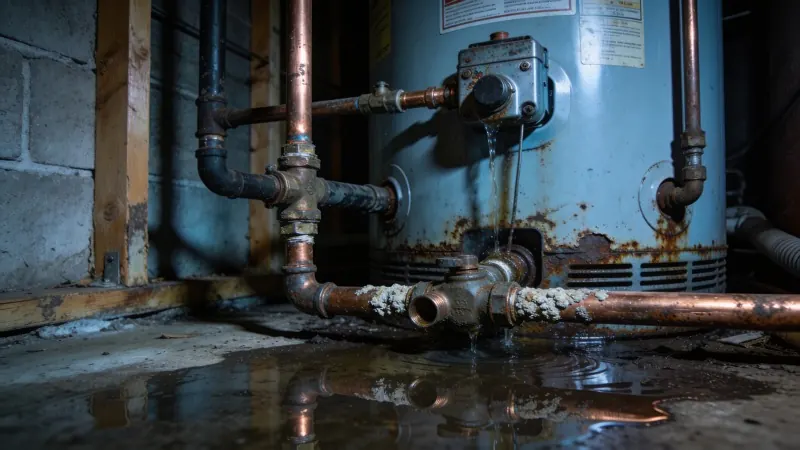
When a Water Heater Fails, Every Minute Counts
The call came in at 5:40 on a Tuesday morning. A homeowner in the Dallas suburbs woke up, swung his feet off the bed, and stepped into an inch of warm water covering his hallway floor. The 50-gallon water heater in his garage had split along the bottom seam overnight. By the time he found the source, water had traveled under the shared wall into the master bedroom, soaked the carpet and pad, and wicked up the drywall in both the garage and bedroom.
That's a scenario our crews respond to multiple times a week. Water heater leak damage is one of the most common and one of the most underestimated sources of residential water damage in the United States. A standard residential tank holds 40 to 50 gallons. Larger homes and households with higher demand run 75 or 80-gallon units.
When a tank fails, that entire volume hits the floor at once, and the cold water supply line keeps feeding fresh water into the broken tank until somebody shuts it off. We've walked into homes where a water heater burst overnight released well over 200 gallons before the homeowner discovered the problem.
If your water heater is leaking right now, or if you've come home to a water heater flood, call (844) 426-5801. Our IICRC-certified emergency crews arrive within 60 minutes with truck-mounted extraction equipment. We handle water heater leak damage restoration from extraction through structural drying and rebuild, and we bill your insurance directly.
This guide covers everything you need to know about water heater leak damage: why tanks fail, how much water you're actually dealing with, what to do in the first hour, and how professional restoration works for these specific scenarios.
Why Water Heaters Fail: Tank Failure Modes That Cause Flooding
Water heaters don't fail randomly. After 15 years of restoring homes damaged by tank failures, we see the same handful of failure modes over and over again. Understanding them matters because some produce a slow drip you might catch in time, and others dump the full tank contents onto your floor without warning.
Internal Tank Corrosion (The Most Common Killer)
Every standard tank-style water heater is a steel cylinder lined with glass (vitreous enamel), as described in IICRC water damage restoration standards. That glass lining is the only thing separating the steel shell from constant contact with hot water. Over time, the lining develops microscopic cracks from thermal cycling, expanding and contracting thousands of times as the burner fires and shuts off, day after day, year after year.
Once water reaches bare steel through those cracks, corrosion starts. You can't see it. You can't hear it. The steel rusts from the inside out. By the time rust-colored water shows up at your hot water taps, the damage inside the tank is already significant. Eventually the corroded steel thins to the point where it can't hold pressure, and the tank ruptures.
This is the failure mode that produces catastrophic water heater burst events. There's rarely any warning drip. The tank simply gives way, usually at the bottom where sediment has accelerated the corrosion, and releases its full volume.
Anode Rod Depletion
The anode rod is the single most important maintenance component in a tank water heater, and most homeowners have never heard of it.
It's a metal rod, typically magnesium or aluminum, that threads into the top of the tank and hangs down into the water. The rod exists for one purpose: to corrode instead of the tank itself. Through a process called galvanic corrosion, the anode rod sacrifices itself so that the steel tank lining gets a second layer of protection.
Here's the problem. Anode rods have a finite life. In most water conditions, a magnesium rod lasts 3 to 5 years. In areas with hard water or high mineral content, a rod can be consumed in as little as 2 years. Once the anode rod is fully depleted, the tank lining is the only protection left, and once that lining cracks, corrosion of the steel shell accelerates dramatically.
What anode rod maintenance looks like: A plumber or a handy homeowner removes the rod every 2 to 3 years by unscrewing the hex head on top of the tank with a 1-1/16 inch socket. If the rod is less than half an inch thick or heavily corroded, it needs replacement. A replacement anode rod costs $20 to $50 at a hardware store. Compared to $3,000 to $8,000 in water heater leak damage restoration, that's the cheapest insurance policy in your house.
Sediment Buildup and Overheating
Every water supply contains dissolved minerals. When water sits in a tank at 120 to 140 degrees, those minerals precipitate out and settle on the bottom. In areas with hard water, sediment can accumulate quickly, forming a layer of calcium carbonate and other mineral deposits on the tank floor.
Sediment creates two problems. First, it insulates the tank bottom from the burner (on gas models) or the lower heating element (on electric models). The burner has to run longer and hotter to heat the water through the sediment layer. That additional heat stress accelerates deterioration of the glass lining at the tank bottom.
Second, sediment traps pockets of water underneath it. When the burner fires, those trapped pockets flash to steam, creating popping and rumbling sounds. Those miniature steam explosions erode the glass lining from below.
Over years of this cycle, the tank bottom becomes the weakest point. When a heavily sedimented tank finally fails, it almost always fails at the bottom, releasing the full tank contents at floor level.
Temperature and Pressure (T&P) Relief Valve Failure
The T&P valve is a safety device threaded into the top or side of the tank. If the water temperature exceeds approximately 210 degrees Fahrenheit, or the tank pressure exceeds 150 PSI, the valve opens and discharges water through a pipe that should run to within 6 inches of the floor or to an exterior drain.
T&P valves can fail in two ways. They can fail open, continuously weeping or streaming water from the discharge pipe. That's the less dangerous failure; it produces a visible leak that most homeowners notice.
The more concerning failure is when a T&P valve fails closed, meaning it gets stuck and can't open when pressure builds. A stuck T&P valve combined with a malfunctioning thermostat can allow pressure to build beyond the tank's design limits. This is rare, but when it happens, the result isn't a leak. It's a rupture.
The discharge pipe from the T&P valve should never be capped, plugged, or reduced in size. We've seen homeowners plug the discharge pipe because it was dripping, not realizing they disabled the tank's primary safety mechanism.
Supply Line and Fitting Failures
The connections at the top of the water heater, both the cold water inlet and the hot water outlet, are potential leak points. Flexible supply lines (the braided stainless steel connectors) have a limited service life, typically 5 to 8 years depending on manufacturer. The rubber core inside the braided jacket degrades over time and can rupture under pressure.
Threaded fittings can loosen from thermal expansion, especially on water heaters that cycle frequently. A slow drip from a fitting can go unnoticed for weeks if the heater is in a garage, basement, or utility closet that doesn't get regular foot traffic. That slow drip causes just as much mold and structural damage as a sudden burst; it just takes longer to add up.
Dip Tube Deterioration
The dip tube is a plastic pipe inside the tank that routes incoming cold water to the bottom, so it gets heated before being drawn from the hot outlet at the top. While dip tube failure doesn't directly cause flooding, a deteriorated dip tube allows cold and hot water to mix at the top of the tank, reducing efficiency and causing the burner to cycle more frequently. That increased cycling accelerates sediment buildup and thermal stress on the lining, shortening tank life and bringing a catastrophic failure closer.
How Much Water Are You Really Dealing With? 40 to 80-Gallon Release Scenarios
| Tank Size | Initial Release | Floor Coverage (3/4" depth) | Supply Line Flow Rate | Volume After 1 Hour | Volume After 8 Hours |
|---|---|---|---|---|---|
| 40 gallon | 40 gal | 50 - 70 sq ft | 2 - 4 gal/min | 160 - 280 gal | 1,000 - 1,960 gal |
| 50 gallon | 50 gal | 65 - 85 sq ft | 2 - 4 gal/min | 170 - 290 gal | 1,010 - 1,970 gal |
| 75 - 80 gallon | 75 - 80 gal | 105 - 130 sq ft | 5 - 8 gal/min | 375 - 560 gal | 2,475 - 3,920 gal |
The amount of damage a water heater failure causes depends on three factors: tank volume, how long the supply line continues feeding water after the failure, and where the heater is located in the home.
40-Gallon Tank Release
A 40-gallon tank is the standard size for a small household, typically one to two people. Forty gallons released at floor level covers approximately 50 to 70 square feet of flooring to a depth of about three-quarters of an inch on a flat surface.
If the cold water supply line isn't shut off, the incoming flow rate is typically 2 to 4 gallons per minute through a standard half-inch supply line. In 30 minutes, that adds another 60 to 120 gallons. In an hour, 120 to 240 gallons on top of the original 40. That's enough water to flood an entire first floor of a typical home.
Real scenario: A retired couple in Phoenix had a 40-gallon electric water heater in an interior utility closet off the kitchen. The bottom seam corroded through sometime around midnight. By 6 AM when they woke up, the supply line had been feeding water for roughly six hours. We measured standing water covering approximately 1,100 square feet of the single-story home. Total volume released: estimated 400+ gallons.
50-Gallon Tank Release
The 50-gallon tank is the most common residential size in the U.S. We see more water heater flood damage from 50-gallon units than any other size, simply because there are more of them installed.
What makes 50-gallon failures especially destructive is where these tanks are typically placed. In many homes, especially in the South and West, the water heater sits in the garage against a shared wall with the living space. Water from a garage tank failure migrates under that shared wall and into the home.
In two-story homes built in the 1990s and 2000s, builders often placed the water heater in a second-floor utility closet or in the attic to save first-floor square footage. A 50-gallon failure on the second floor causes ceiling damage on the first floor. An attic-mounted 50-gallon failure is among the worst scenarios we respond to, because gravity distributes the water through ceiling insulation, light fixtures, ductwork, and multiple rooms below.
75 to 80-Gallon Tank Release
Large-capacity tanks serve households of four or more people. Eighty gallons is a significant volume. Released at floor level, it covers roughly 105 to 130 square feet to three-quarter-inch depth before it even starts spreading to adjacent rooms.
But the real issue with larger tanks isn't just the initial volume. Larger tanks have larger supply connections, sometimes three-quarter inch instead of half inch. The flow rate through a three-quarter-inch line can be 5 to 8 gallons per minute. Left running overnight, the water volume entering the home is staggering.
Real scenario: A family of five outside Atlanta had an 80-gallon gas water heater in the basement. The tank developed a crack along a corroded weld seam while the family was away for a long weekend. When they returned Monday night, the entire basement was under several inches of water. Estimated total water volume over three days: over 2,000 gallons. The restoration included full demolition of the basement drywall, carpet, pad, and trim; structural drying; mold prevention treatment; and complete rebuild.
The Multiplier: Location in the Home
The same tank failure produces drastically different damage depending on where the heater sits:
- Garage (slab-on-grade): Water spreads across the garage floor first, then migrates to living space through the shared wall. Damage is often limited to rooms adjacent to the garage if caught within a few hours.
- Basement: Water pools at the lowest point. Finished basements take the worst damage. Unfinished basements with concrete floors and open framing are easier and less expensive to restore.
- Interior utility closet (first floor): Water radiates outward from the closet into surrounding rooms. Hallways act as channels that carry water to distant rooms.
- Second floor or attic: Gravity makes this the worst-case scenario. Water cascades through flooring, ceilings, light fixtures, and HVAC ducts. Two floors of damage from a single failure point.
Regardless of where your water heater is located, the response protocol is the same: shut off the water supply, cut power to the unit, and call (844) 426-5801 for emergency extraction before the damage compounds.
Water Heater Leaking or Burst?
Our IICRC-certified emergency crews arrive within 60 minutes with truck-mounted extraction equipment.
📞 Call (844) 426-5801Water Heater Lifespan: When Failure Risk Gets Real
Tank-style water heaters have a designed service life, and that lifespan directly correlates with your risk of a leak or burst event.
Manufacturer-Rated Lifespan vs. Reality
Most residential tank water heaters carry a warranty of 6 to 12 years. That warranty period roughly corresponds to expected tank life under normal conditions. The actual lifespan depends heavily on water quality, maintenance, and installation quality.
| Warranty Tier | Build Quality | Lifespan With Maintenance | Lifespan Without Maintenance |
|---|---|---|---|
| 6-year | Budget: thinner steel, smaller anode rods | 6 - 8 years | 4 - 6 years |
| 9-year | Mid-range: better anode rods, sometimes two | 8 - 12 years | 6 - 9 years |
| 12-year | Premium: thicker steel, powered or multiple anode rods | 10 - 15 years | 8 - 11 years |
"Without maintenance" means the anode rod was never inspected or replaced, the tank was never flushed, and the T&P valve was never tested. That describes the vast majority of residential water heaters in the U.S.
The Danger Zone: Year 8 and Beyond
In our experience, the risk of a catastrophic tank failure increases significantly after year 8 for budget models and after year 10 for mid-range models. We respond to more water heater flood events caused by tanks in the 8 to 12-year age range than any other. The tanks are old enough that the anode rod has been depleted for years, sediment has accumulated, and the glass lining has developed enough cracks for serious corrosion to take hold, but not yet old enough that the homeowner has been thinking about replacement.
That 8 to 12-year window is where water heater failures catch homeowners by surprise. The unit still produces hot water. It heats up on schedule. There's no visible indication of the corrosion happening inside. Then one morning the tank gives way.
Warning Signs Before a Water Heater Fails
Some failures provide clues. If you notice any of these, the tank is telling you its time is running short:
- Rusty hot water: Rust-colored water only from the hot side (not the cold) means corrosion inside the tank, not in the supply piping.
- Rumbling or popping sounds: Sediment buildup on the tank bottom. Steam pockets forming under mineral deposits.
- Moisture or mineral deposits around the base: Could be a slow seep from the tank bottom before a full failure.
- T&P valve discharging frequently: The valve is doing its job, but it means the tank is experiencing excessive temperature or pressure.
- Age over 8 years with no anode rod service: If you have never had the anode rod inspected or replaced, and your tank is over 8 years old, the rod is almost certainly depleted.
- Reduced hot water volume or slower recovery: Can indicate heavy sediment insulating the burner from the water.
If your water heater is showing these signs, replacement before failure is far cheaper than dealing with water heater leak damage afterward.
What to Do When Your Water Heater Leaks or Bursts
The first 30 minutes after discovering a water heater leak determine how much damage your home sustains. Here's exactly what to do, in order.
Step 1: Shut Off the Cold Water Supply
The cold water supply valve is located on the pipe feeding into the top of the water heater. Turn it clockwise until it stops. This is the single most important step because it stops fresh water from continuously feeding into the failed tank.
If the valve is stuck, corroded, or you can't reach it safely because of standing hot water, go to the main water shutoff for the house. On most homes, that's near the water meter at the street or where the main line enters the home. Turn off the entire house supply.
Step 2: Cut Power to the Water Heater
For electric water heaters: Go to your electrical panel and flip the dedicated breaker for the water heater. It should be labeled. Electric water heaters use 240-volt circuits, and standing water near an energized electric heater is a serious electrocution hazard.
For gas water heaters: Turn the gas control valve on the front of the water heater to the OFF position. Don't try to relight a gas water heater that's sitting in standing water. If you smell a strong gas odor, don't touch anything, leave the house immediately, and call your gas utility company from outside.
Step 3: Don't Wade Through Standing Hot Water
Water heaters store water at 120 to 140 degrees Fahrenheit. A ruptured tank releases water at or near that temperature. Standing in hot water in bare feet can cause serious burns. If there's standing water around the heater, approach with caution and wear shoes. If you can't safely reach the shutoff valves, call us and we'll handle it.
Step 4: Call (844) 426-5801
Our emergency crew arrives within 60 minutes with truck-mounted extraction equipment. We extract the standing water, set up structural drying equipment, and begin documenting the damage for your insurance claim, all in the first visit. The sooner extraction starts, the less structural damage occurs and the lower the mold risk.
Step 5: Document Everything for Insurance
While you wait for our crew:
- Take photos and video of the water heater, the area of the leak or failure, and all affected rooms
- Note the make, model, and serial number of the water heater (usually on a sticker on the side of the tank)
- Write down the approximate age of the unit if you know it
- Don't discard the failed water heater until your insurance adjuster has seen it or authorized disposal
This documentation supports your insurance claim. Our team adds professional documentation including timestamped photos, moisture readings, and detailed scope of work when we arrive.
Water Heater Leak Damage Restoration: The Professional Process
Restoring a home after a water heater failure follows a specific sequence. Each step matters, and skipping any of them creates problems down the line.
Emergency Water Extraction
We start extraction the moment we arrive. For water heater leak damage, we bring truck-mounted extraction units that pull hundreds of gallons per hour from carpeted and hard-surface floors. Portable extractors handle tight spaces like closets, behind cabinets, and inside wall cavities.
On a typical water heater failure affecting 500 to 1,000 square feet, extraction takes 2 to 4 hours. For more extensive flooding, especially second-floor or attic failures where water has traveled through ceiling assemblies, extraction may take longer because we're working on multiple levels simultaneously.
Moisture Mapping
After visible water is extracted, we use thermal imaging cameras and pin-type moisture meters to map exactly where water has traveled. This step is critical with water heater failures because the water is warm, and warm water migrates faster and farther than cold water from a broken supply line.
We routinely find moisture in areas that look completely dry on the surface. Water from a garage-mounted heater travels under the shared wall and saturates the drywall and carpet padding in adjacent rooms. Water from an attic failure travels through insulation and pools on top of ceiling drywall, sometimes 20 feet from the heater's location.
The moisture map drives every decision that follows, which walls need flood cuts, which areas need drying equipment, and where we need to focus mold prevention treatment.
Demolition of Saturated Materials
Depending on the extent of the damage, some materials can't be dried and must be removed:
- Carpet padding: Virtually always removed after a water heater flood. Carpet pad absorbs water like a sponge and doesn't dry effectively in place. The carpet itself can often be saved if extraction and drying begin quickly.
- Drywall: The standard protocol is a flood cut, removing the bottom 12 to 24 inches of drywall in affected areas. Drywall wicks moisture upward, so the cut must be above the highest point of moisture migration.
- Baseboards and trim: Removed to allow drying behind and beneath them.
- Insulation (in wall cavities): Fiberglass batt insulation that has been saturated is removed. It holds water, prevents airflow, and creates ideal conditions for mold growth.
Structural Drying
With standing water extracted and saturated materials removed, the drying phase begins. For a standard water heater leak damage restoration, we deploy:
- LGR (Low Grain Refrigerant) dehumidifiers: These industrial units pull 15 to 20 gallons of moisture per day from the air. A typical water heater damage job requires 1 to 3 LGR units.
- High-velocity air movers: Positioned strategically to create airflow across wet surfaces. A standard job uses 4 to 8 air movers.
- Injectidry wall cavity drying panels: For wall cavities that still contain moisture after the flood cut, these panels inject warm, dry air directly into the cavity space.
We take moisture readings daily. Wood framing needs to reach 16% moisture content or below. The drying phase for a typical water heater damage event runs 3 to 5 days. If hardwood flooring was affected, drying may take 5 to 7 days with specialty floor mat systems.
For more details on how structural drying works, see our structural drying process page.
Antimicrobial Treatment
Water heater tanks can harbor bacteria, especially at the bottom where sediment collects. Tanks running below 120 degrees are known to support Legionella bacteria growth. When a corroded tank ruptures and releases water mixed with years of accumulated sediment, that water isn't the clean Category 1 water you might assume.
We apply antimicrobial agents to all exposed structural components after demolition. The CDC recommends controlling moisture within 24 to 48 hours to prevent mold colonization, which is why our antimicrobial application happens on day one.
Rebuild
Once drying is verified through final moisture readings, the rebuild phase begins: new drywall, new baseboards, new carpet padding, and new insulation in wall cavities. We match existing textures and paint as closely as possible.
For homes where the water heater leak damage was covered by insurance, our documentation package provides the adjuster with exactly what they need to approve the restoration and rebuild.
Three Families, Three Water Heater Failures
The Slow Drip Nobody Noticed
A couple in their 40s outside Denver had a 50-gallon gas water heater in a finished basement utility room. The T&P valve discharge pipe had been slowly dripping for months. They put a towel under it and kept meaning to call a plumber.
What they didn't realize was that the water was also seeping under the vinyl flooring and into the adjacent finished area. By the time they noticed soft, discolored carpet in the basement family room, we found mold growth on the back side of the drywall, saturated carpet pad extending eight feet from the wall, and elevated moisture readings throughout the area.
The restoration involved removal of all affected carpet and pad, a 24-inch flood cut along 30 linear feet of wall, mold remediation in the utility room, and five days of structural drying. The job cost roughly $5,200. A new T&P valve would have been about $20 plus a service call.
The Weekend Catastrophe
A family of four in the Houston area left Friday morning for a weekend trip. Their 12-year-old, 50-gallon electric water heater was in an interior first-floor utility closet. Sometime Friday evening, the bottom of the tank corroded through. The supply line fed water continuously for approximately 48 hours.
When they walked in, the entire first floor had standing water. The laminate flooring was buckled and destroyed. Drywall on every first-floor wall had wicked moisture above 24 inches. Kitchen cabinets had absorbed water along their bases.
The restoration required demolition of all first-floor drywall to 24 inches, removal of the laminate flooring, kitchen cabinet base repair, and seven days of structural drying with five LGR dehumidifiers and 14 air movers. The insurance claim totaled over $18,000. The water heater had never had its anode rod inspected. The tank warranty was 6 years. It was 12 years old.
The Attic Installation That Went Wrong
A homeowner in a two-story home in the Atlanta metro area had a 75-gallon water heater installed in the attic. The drain pan under the heater had rusted through years earlier and was never replaced. When the tank developed a slow leak from a corroded fitting, water dripped through the attic floor and traveled along ceiling joists.
She first noticed a small water stain on the second-floor master bedroom ceiling. Two weeks later, a section of the ceiling drywall sagged visibly. We found mold on the top side of the ceiling drywall in two rooms. For a closer look at how ceiling water damage is assessed, see our ceiling water damage guide.
The restoration took eight days of drying and a full ceiling rebuild in three rooms. Total cost: approximately $11,500. A functional drain pan costs about $30.
Water Heater Leak Damage and Insurance: What Gets Covered
Most homeowners insurance policies cover sudden and accidental water damage from a water heater failure. According to the Insurance Information Institute, sudden and accidental discharge of water is a standard covered peril.
What Is Typically Covered
A water heater burst or sudden tank failure that causes damage to your home is generally covered under the "sudden and accidental discharge" provision of a standard HO-3 homeowners policy. That coverage includes:
- Water extraction and structural drying
- Demolition of damaged materials (drywall, flooring, insulation)
- Rebuild and repair to pre-loss condition
- Content damage (belongings that were destroyed)
- Loss of use (additional living expenses if you can't stay in the home during restoration)
The water heater itself is not typically covered because the failure is considered a maintenance or wear-and-tear issue. You'll need to purchase a new water heater out of pocket. But the resulting damage to your home and belongings is what the insurance claim covers.
What Is Typically Not Covered
- Gradual leaks you knew about and didn't address: If your water heater has been visibly leaking for weeks and you didn't act, your carrier may argue the damage was preventable.
- The water heater unit itself: The tank replacement is your cost.
- Mold resulting from neglected damage: If you discover a leak and don't mitigate in a timely manner, the mold claim may be denied.
- Flood damage from external sources: If your water heater was damaged by a flood, that falls under flood insurance. Our water damage insurance claim guide has more details on coverage types.
How We Handle the Insurance Process
We work with every major insurance carrier in the U.S. When we respond to a water heater leak damage call, our documentation process starts immediately:
- Timestamped photos of the failed water heater and all affected areas
- Moisture readings from every affected wall, floor, and ceiling assembly
- Detailed scope of work including equipment placement and drying strategy
- Daily drying logs showing moisture reduction over time
- Final verification readings confirming dry standard was met
We bill your insurance company directly. In most cases, you pay only your deductible. For detailed guidance on the claims process, see our complete water damage insurance claim guide.
We Handle the Insurance Paperwork
Direct insurance billing. Professional documentation from day one.
📞 Call (844) 426-5801Preventing Water Heater Leak Damage: Maintenance That Matters
Replacing a water heater costs $900 to $2,500 depending on size, type, and installation complexity. Restoring water heater leak damage costs $2,500 to $15,000 or more. Prevention is overwhelmingly cheaper than restoration.
Anode Rod Inspection and Replacement
Check the anode rod every 2 to 3 years. If the rod is less than half an inch in diameter, heavily pitted, or coated in calcium, replace it. A magnesium anode rod costs $20 to $50 and is the single most effective way to extend tank life and prevent internal corrosion that leads to catastrophic failure.
If you live in an area with hard water (TDS above 250 ppm), consider switching to a powered anode rod. These don't corrode, require no replacement, and protect the tank continuously. They cost $150 to $300 installed.
Annual Tank Flushing
Open the drain valve at the bottom of the tank once a year and let water run into a bucket until it flows clear. This removes sediment before it accumulates into a thick layer that overheats the tank bottom and accelerates lining deterioration.
T&P Valve Testing
Once a year, lift the lever on the T&P valve for a few seconds to verify water discharges through the pipe. If no water comes out, or the valve leaks continuously after you release it, replace the valve. A working T&P valve is a safety requirement, not optional.
Drain Pan Installation
If your water heater is installed on a finished floor, inside a closet, on a second floor, or in an attic, a drain pan with a connected drain line is essential. The pan catches small leaks and routes them to a drain before they damage the surrounding area. A pan and fittings cost $20 to $40.
Know Your Tank's Age
Look at the serial number on the manufacturer's sticker. Most brands encode the manufacture date into the serial number. The first four digits are often the month and year (for example, 0318 = March 2018). If your tank is approaching or past its warranty period, start budgeting for replacement rather than waiting for a failure.
According to the U.S. Department of Energy, conventional storage water heaters have a typical lifespan of 10 to 15 years. Proactive replacement before failure eliminates the risk of water heater leak damage entirely.
Automatic Shutoff Valves and Leak Detectors
For additional protection, consider installing an automatic water shutoff valve on the cold water supply line to the heater. These devices use a sensor in the drain pan or on the floor nearby. When the sensor detects water, it triggers a motorized valve that closes the supply line automatically. Cost: $150 to $400 installed. For homes where the water heater is in a remote location or where the household travels frequently, this is one of the best investments you can make.
Smart water leak detectors (standalone sensors that send alerts to your phone) offer a lower-cost option starting around $30 to $50 per sensor. They won't shut off the water, but they'll notify you immediately when moisture is detected.
Water Heater Leak Damage Restoration Costs
Every water heater failure is different, but here are realistic cost ranges based on what we see in the field. For a comprehensive breakdown of all water damage costs, see our water damage restoration cost guide.
| Scenario | Cost Range | Drying Time | Typical Scope |
|---|---|---|---|
| Small leak, caught quickly (1 room) | $1,500 - $3,500 | 3 - 4 days | Partial flood cut, carpet pad replacement, drywall patch |
| Moderate tank failure (2 - 3 rooms) | $3,500 - $7,500 | 4 - 5 days | Multiple flood cuts, carpet/pad replacement, drywall rebuild |
| Major burst or extended leak (full floor+) | $7,500 - $18,000+ | 5 - 7 days | Extensive demolition, possible flooring replacement, mold prevention |
| Second-floor or attic failure with ceiling damage | $8,000 - $15,000+ | 5 - 7 days | Multi-level extraction, ceiling replacement, insulation replacement |
What Drives the Cost
- Tank size and total water volume released: An 80-gallon tank dumps twice the initial volume of a 40-gallon tank.
- Duration before discovery: Every hour the supply line feeds water into a broken tank adds significant volume and damage.
- Location in the home: Attic and second-floor installations create multi-level damage that doubles the restoration scope.
- Materials affected: Hardwood floors, custom cabinetry, and finished basements cost more to restore or replace.
- Speed of response: Calling within the first few hours typically reduces the total restoration cost because less material needs demolition.
Frequently Asked Questions About Water Heater Leak Damage
A leaking water heater can cause extensive damage depending on tank size and how long the leak runs. A 50-gallon tank that fails overnight with the supply line still running can release 300 to 500+ gallons, enough to flood an entire floor. Damage includes saturated drywall, destroyed flooring, subfloor damage, and mold growth if not addressed within 24 to 48 hours. Restoration costs range from $1,500 for small leaks to over $15,000 for major burst events.
Yes, in most cases. Standard homeowners insurance covers sudden and accidental water damage from a water heater failure, including extraction, drying, demolition, and rebuild. The water heater unit itself is typically not covered because the failure is considered wear and tear. Gradual leaks that were ignored may be denied. We handle insurance documentation and bill your carrier directly.
Most tank-style water heaters last 8 to 12 years, though manufacturer warranties range from 6 to 12 years. Tanks with regular anode rod maintenance can last 12 to 15 years. Without maintenance, failure risk increases significantly after year 8. Water quality matters too: hard water areas see shorter tank life due to accelerated sediment buildup and anode rod depletion.
Shut off the cold water supply valve on top of the heater immediately. Cut power: flip the breaker for electric models or turn the gas valve to OFF for gas models. Don't walk through standing hot water barefoot. Call (844) 426-5801 for emergency extraction. Take photos and document the water heater's make, model, and age for your insurance claim.
Yes. When internal corrosion weakens the tank shell, it can rupture suddenly and release the full tank volume, 40 to 80 gallons, onto the floor. If the cold water supply line isn't shut off, it continues feeding water at 2 to 4 gallons per minute. A 50-gallon tank left running overnight can release 400+ gallons, enough to flood an entire first floor.
Mold can begin growing within 24 to 48 hours of water heater leak damage, especially inside wall cavities and under flooring where moisture is trapped. Water heater leaks are particularly risky for mold because the warm water accelerates microbial growth. Professional extraction and structural drying within the first 24 hours is the best mold prevention strategy.
An anode rod is a sacrificial metal rod (magnesium or aluminum) inside your water heater tank that corrodes in place of the steel tank. When the rod is depleted, the tank itself begins to corrode from the inside out, leading to eventual rupture. Anode rods should be inspected every 2 to 3 years and replaced when they are less than half an inch thick. A replacement rod costs $20 to $50.
Restoration costs depend on the damage extent. Small leaks caught quickly run $1,500 to $3,500. Moderate tank failures affecting 2 to 3 rooms cost $3,500 to $7,500. Major burst events or extended undetected leaks range from $7,500 to $18,000 or more. Second-floor or attic failures with ceiling damage below typically fall between $8,000 and $15,000. Most sudden water heater failures are covered by homeowners insurance.
A leaking water heater presents several hazards. Water stored at 120 to 140 degrees Fahrenheit can cause scalding burns. Standing water near electrical connections, especially with electric water heaters on 240-volt circuits, creates electrocution risk. Gas water heaters surrounded by water can develop gas line issues. Beyond immediate safety, the water damage creates mold risk within 24 to 48 hours if not addressed.
Yes, proactive replacement is strongly recommended once your tank passes its warranty period. A new water heater costs $900 to $2,500 installed. Water heater leak damage restoration costs $2,500 to $15,000 or more, plus the stress and disruption to your household. If your tank is over 8 years old and has never had its anode rod serviced, replacement is the safer financial decision.
Take Action Before Water Heater Leak Damage Gets Worse
Water heater failures are predictable in the sense that every tank has a finite life, the corrosion process is relentless, and neglected maintenance accelerates the timeline. The unpredictable part is when it happens, and it almost always happens at the worst possible time: overnight, over a weekend, while you're on vacation.
If you're dealing with water heater leak damage right now, don't wait. Shut off the water supply, cut power to the heater, and call (844) 426-5801. Our IICRC-certified emergency crews are standing by 24/7 with truck-mounted extraction units, industrial drying equipment, and the experience to handle everything from a slow drip to a full 80-gallon catastrophic burst.